
Anthropic's IPO and the $4 trillion AI selloff left Claude's prices alone

10 min readNovember 24, 2026
Key takeaways
- The IPO priced 980 million shares at $83 on 18 November, an $81.3 billion deal and bigger than SpaceX's $75 billion in June. With the banks' extra shares it raised $93.5 billion gross.
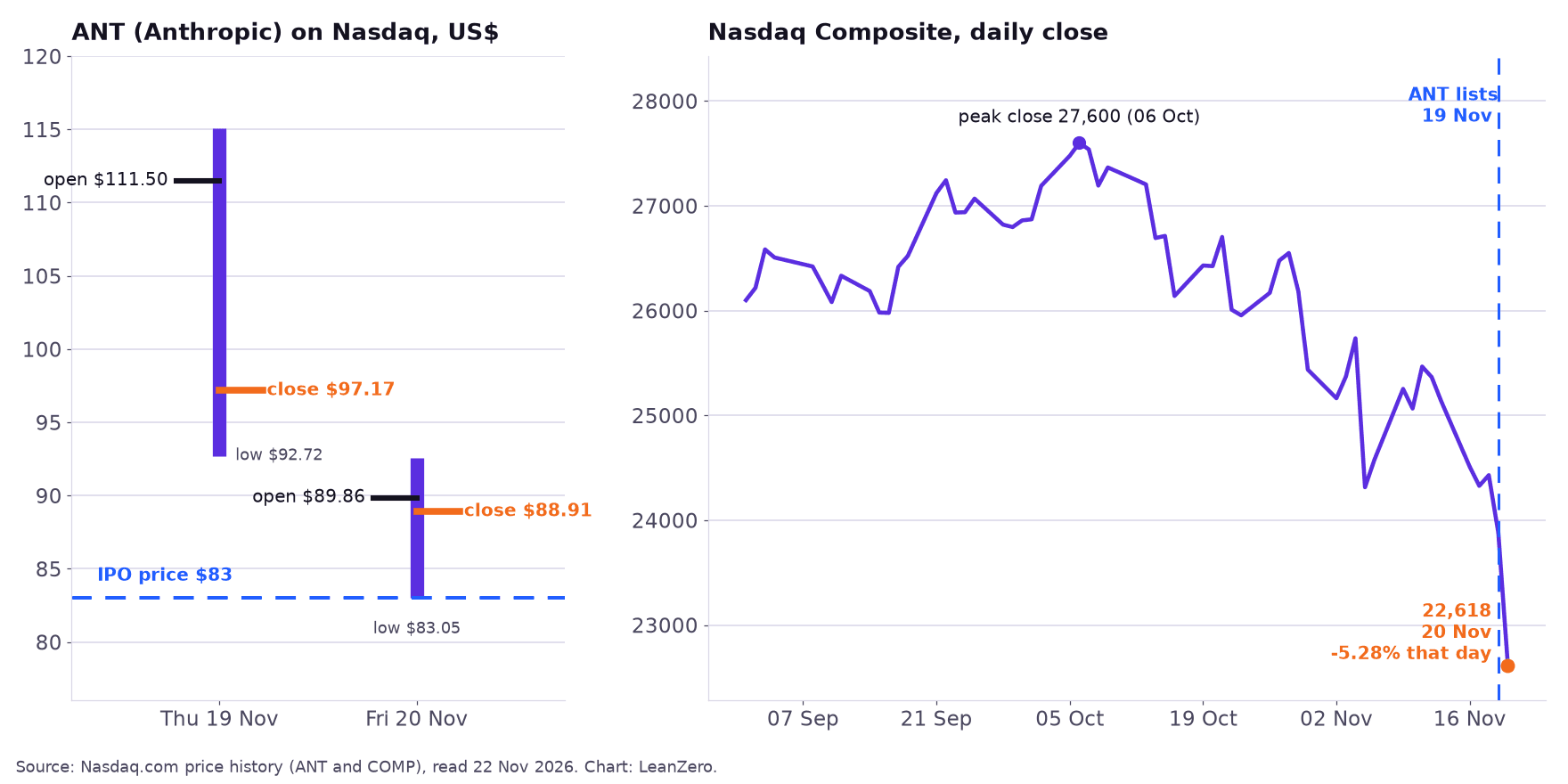
- ANT opened at $111.50, then closed at $97.17 on day one and $88.91 on day two. Its low on Friday was $83.05, five cents over the offer price, and as of 20 November it had not closed below $83.
- The $4 trillion is the Wall Street Journal's figure, as the Guardian relays it, for the Nasdaq's lost value that week. The Nasdaq Composite fell 10.02% in five days, but its slide started at the 6 October peak.
- No Claude price or plan changed between 18 and 22 November. Before the IPO prices were falling: price cuts and discounts cost Anthropic about $600 million of revenue from the second to the third quarter.
- The prospectus says demand for compute has exceeded capacity and that Anthropic may change usage limits, rate limits and model capabilities. Claude Code users should read that line twice.
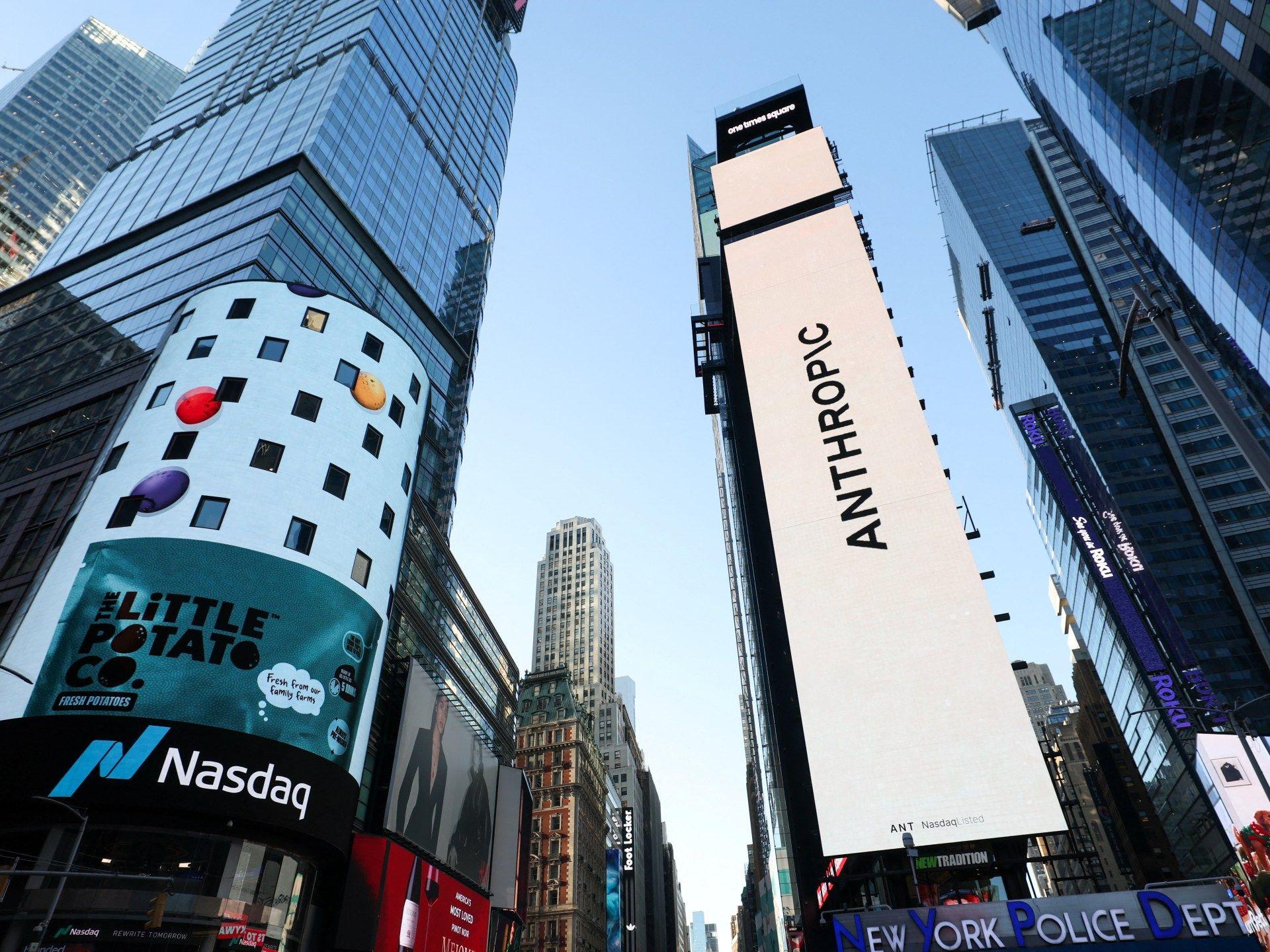
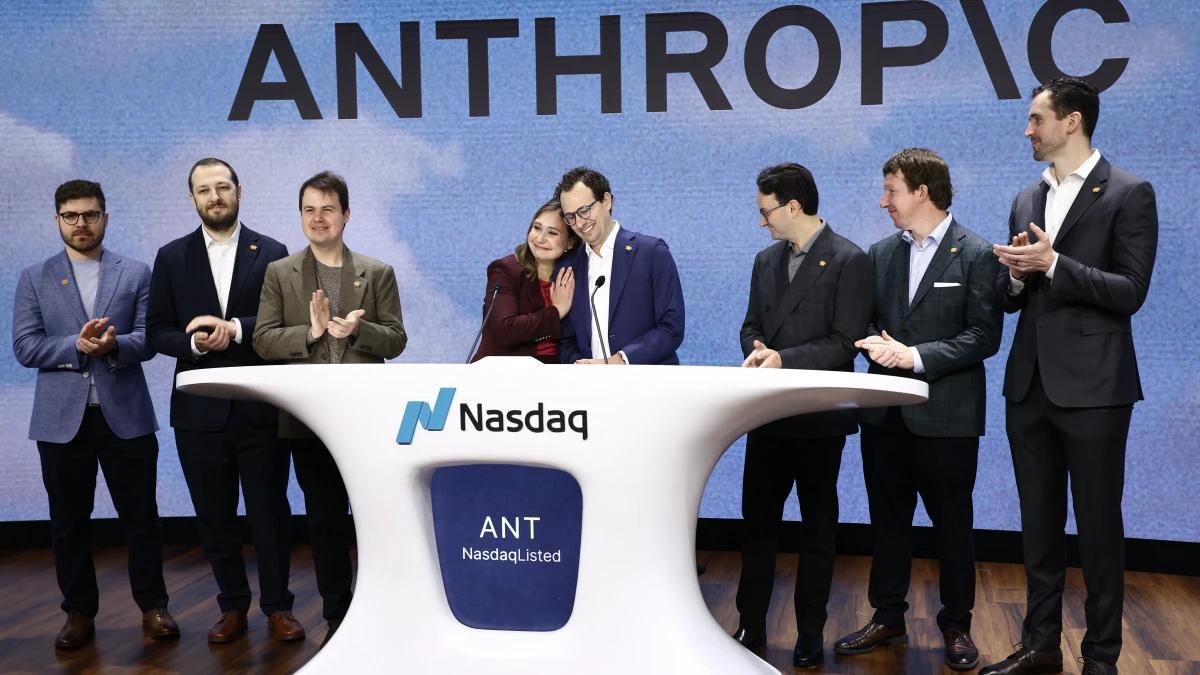
Anthropic, the company behind Claude, priced its IPO (initial public offering, its first sale of shares to the public) at $83 a share on 18 November 2026. The stock started trading on Nasdaq as ANT (its ticker symbol) the next day, opened at $111.50 and closed at $97.17. On Friday it closed at $88.91, according to Nasdaq's own price history. Its low that day was $83.05, five cents over the offer price. Claude's API prices and subscription plans didn't change that week, and I checked them against archived copies from 17 and 18 November.
A headline doing the rounds on Hacker News says the IPO was a bust that deepened a $4 trillion AI wipeout. Part of that is true. The selloff was real: the Nasdaq Composite lost 10.02% in five trading days and closed Friday at 22,617.73. "Bust" isn't, at least not yet. ANT closed both of its days above the price buyers paid, and the Wall Street Journal has since changed its own headline.
I run a small consultancy, and we use Claude Code daily on our own Macs. So my question was narrower than Wall Street's: did anything change for people who build on Claude? I read Anthropic's prospectus, its pricing pages, its release notes and its status page. A paragraph about compute in the prospectus says more to a Claude Code user than the share price does.
Nothing here is investment advice. I've dated and sourced the numbers.
Anthropic IPO and the AI selloff: five things I found
- It really is a record. At the base size of 980 million shares, the deal was $81.34 billion, ahead of SpaceX's $75.0 billion in June.
- It fell, but not under the offer price. It went from the $111.50 open to a $88.91 close on day two, a 20.3% drop from the open. It's still 7.12% above $83.
- The "$4 trillion" is one paper's estimate for the Nasdaq's lost value over the week, relayed by the Guardian. I couldn't read the Journal's own article (it's paywalled), so the exact method stays open.
- Stocks were sliding six weeks before the IPO. The Nasdaq Composite peaked on 6 October and was already 11.9% lower by 5 November.
- For Claude users, nothing changed from 18 to 22 November. No price change, no plan change, and no status-page incident from 20 to 22 November. The prospectus does warn that limits can change.
Anthropic IPO price: $83 a share, and the largest IPO on record
Anthropic launched its roadshow on 10 November with a range of $70 to $78 and 825 million shares. It priced above the range. The pricing release says 980 million shares at $83.00: 956,351,354 sold by Anthropic and 23,648,646 by existing shareholders. TechCrunch and Al Jazeera reported the same terms.
I checked the record claim against both prospectuses on EDGAR (the public filing system of the US Securities and Exchange Commission). Anthropic's 424B4 (the final prospectus, filed 19 November) gives 980,000,000 x $83 = $81.34 billion. SpaceX's, filed 12 June, offered 555,555,555 shares at $135, which is $75.0 billion. So it's the biggest, by about $6 billion.
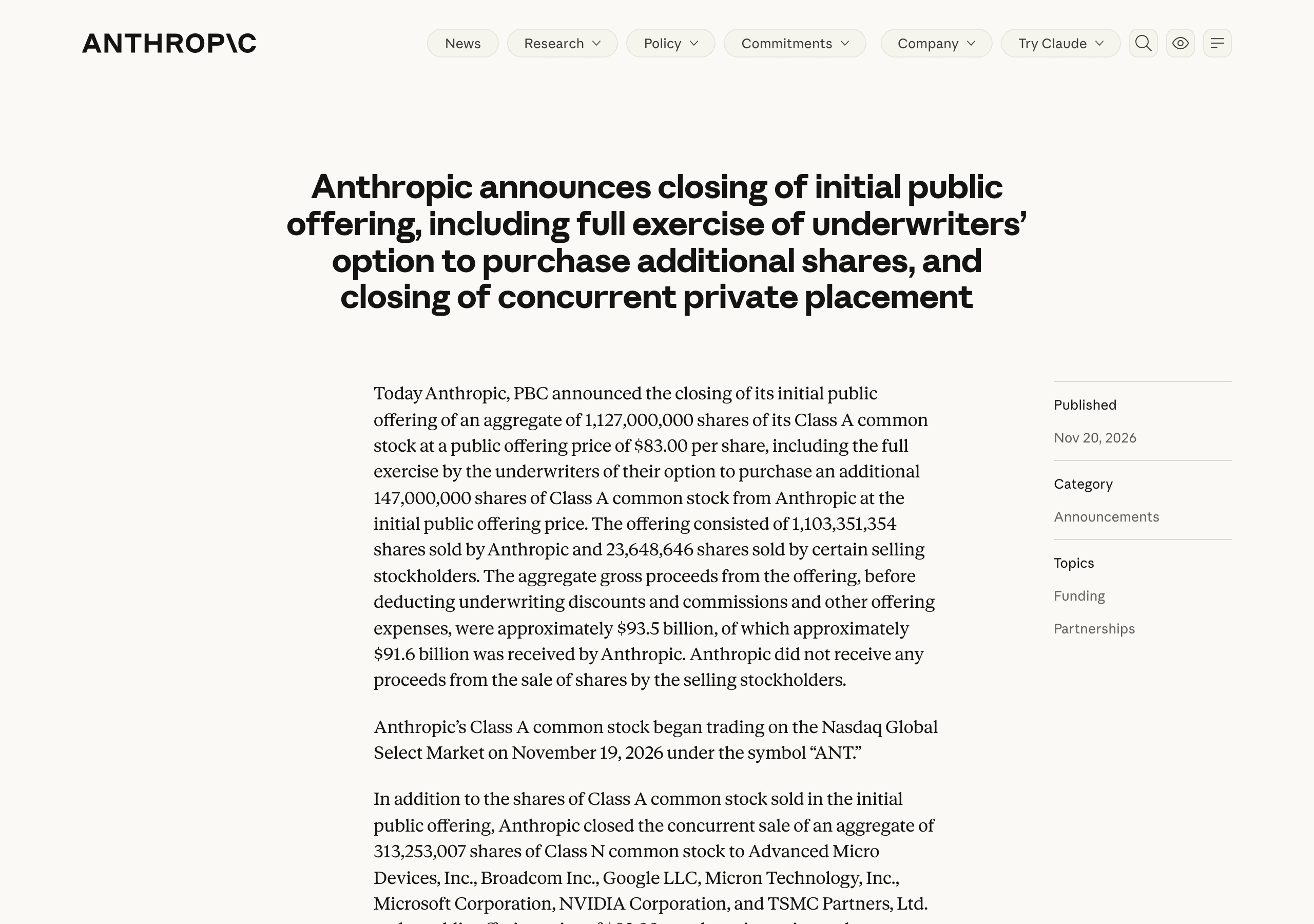
Then the deal grew. Anthropic's banks had an option to buy 147 million more shares, and they used all of it. Anthropic's closing release of 20 November puts the IPO at 1,127,000,000 shares and about $93.5 billion gross, of which about $91.6 billion went to Anthropic. Seven partners also bought 313,253,007 non-voting Class N shares at the same $83 in a private sale, which is $26.0 billion. They are Advanced Micro Devices, Broadcom, Google, Micron, Microsoft, Nvidia and TSMC (through TSMC Partners). Together that's about $119.5 billion.
You'll see all of $81 billion, $91 billion, $93.5 billion and $119.5 billion in the coverage. They're all right. They count different things.
CNN reported the fully diluted value (counting options and share awards as if they were shares) at $1.76 trillion at the first day's close.
Anthropic (ANT) stock in its first two days: $111.50 to $88.91
Nasdaq's history for the two days:
Day | Open | High | Low | Close | Shares traded |
|---|---|---|---|---|---|
Thu 19 Nov | $111.50 | $115.10 | $92.72 | $97.17 | 857,312,300 |
Fri 20 Nov | $89.86 | $92.56 | $83.05 | $88.91 | 400,460,300 |
Day one closed up 17.07% on the offer price. Day two lost 8.50%. 21 and 22 November were a weekend, so there's no third day yet.
Some reports quoted $88.30 (the Guardian) or about $87 (Fortune, at midday). Neither is the close. The official close is $88.91, and CNBC (the US business news channel) uses it too.
Late on Friday, New York time, the Journal followed up with "The Blame Game Has Begun Over Anthropic's Turbulent Trading Debut". Its summary says the stock dropped "to just 5 cents above its IPO price". Fortune called it "just a nickel above". Reuters ran a story headlined "Anthropic's IPO bank closed position meant to stabilize stock, removing source of support". I could only read its headline.
The prospectus explains how this kind of support works. Morgan Stanley is named as the "stabilization agent", and it may buy shares to "prevent or slow a decline in the market price". It "is not required to engage in these activities and may end any of these activities at any time." In plain words, the banks sold more shares than the base deal. They could cover that extra by buying shares in the market, which props the price up, or by taking the 147 million option shares from Anthropic at $83. Anthropic says on 20 November that they took all of the option shares. That would close the covered part of their position without buying in the market. The prospectus also lets the banks sell beyond the option and bid for shares on their own, and nothing I read says whether they did. This is my reading of the two documents. I couldn't read what Reuters wrote.
The $4 trillion AI selloff: whose number it is, and which week
The Hacker News title, "Anthropic's IPO Bust Deepens $4T AI Wipeout on Wall Street", isn't the Journal's headline. The Journal's own feed lists the story as "Anthropic's IPO Turmoil Caps $4 Trillion AI Wipeout on Wall Street", by Hannah Erin Lang and Sam Goldfarb, published on Friday evening. Its web address still says "bust". One commenter on the thread wrote that the site "did actually say Bust on the website earlier".
The $4 trillion figure reaches the open web through the Guardian: "the tech-heavy Nasdaq erased some $4tn in market value this week, according to the Wall Street Journal". As the Guardian relays it, that's the Journal's figure for the Nasdaq's lost value this week (Monday 16 to Friday 20 November). It's about the Nasdaq, not about Anthropic. Which Nasdaq index it covers, and how it was counted, I can't confirm from outside the paywall.
You can check the index moves yourself. From Nasdaq's data and CNBC's close on Friday:
Index | Fri 20 Nov | Week | 2026 so far | From its record close |
|---|---|---|---|---|
Nasdaq Composite | -5.28% to 22,617.73 | -10.02% | -2.69% | -18.05% (6 Oct) |
Nasdaq-100 | -5.61% to 25,028.98 | -10.43% | -0.87% | -19.84% (6 Oct) |
S&P 500 | -3.7% to 6,910.39 | -8.6% | +0.95% | -11.62% (6 Oct) |
Dow | -1.93% to 48,147.33 | about -8% | +0.17% | -11.41% (5 Aug) |
I took the week's figures for the S&P 500 and the Dow from CNBC. CNBC called it the Dow's worst week since March 2020. I computed the rest from Nasdaq's index history and FRED (a CSV file), the St. Louis Fed's data service.
I'd correct two things in the coverage. A "-1.55%" Nasdaq figure circulating for Friday matches a Thursday midday reading in an AP (Associated Press) story I couldn't open. Friday's close was -5.28%. And the Guardian says the Composite ended "down 5% from its value on 1 January". It ended down 2.69% for the year. The 5% was Friday's fall.
Both the S&P 500 and the Dow entered correction (10% under their record close) at Friday's close. On Thursday the S&P was 8.23% under its record.
Abroad, the Guardian reported Taiwan down 6.7% on Friday, the Kospi 5.5% and the Nikkei 5%. Nvidia fell 14% that day and Micron 12%.
Did the Anthropic IPO cause the AI selloff?
CNBC says so outright. Its live blog wrote that "the much-hyped Anthropic IPO caused investors to take profits on the artificial intelligence-led rally rather than revive it". Its explainer lists five forces, and the "Anthropic IPO cash-out" is the first of them. It notes that Anthropic "upped its offering amount a day before going public", which fed the fear that the debut was "a collective cash-out moment". The other four were Nvidia's troubles, the S&P 500 breaking its long-term trend, inflation forcing the hand of the Federal Reserve (the US central bank), and slower earnings growth.
Yet the same explainer says the straws "were already adding up" six weeks earlier, when the S&P 500 and the Nasdaq Composite were both at records. The data agrees. The Composite's peak close was 27,599.89 on 6 October, and by 5 November it was already 11.9% lower, two weeks before ANT existed.
So some analysts, CNBC among them, see the IPO as what set off this week's fall. It can't explain a slide that began in October. And the analysts don't agree with each other:
- James Reilly at Capital Economics, via CNBC: Anthropic's success "as other AI-related stocks tumbled highlights how different parts of the AI ecosystem no longer move as one". His forecast, not mine, is that the falls "have further to run".
- Chris Beauchamp at IG (the online trading firm), to the Guardian: the IPO could be "draining market liquidity", and "that liquidity has to come from somewhere".
- Daniela Hathorn at Capital.com, also to the Guardian: demand for AI exposure "remains strong, but it has not been enough to overcome concerns about elevated valuations, profitability and the sustainability of investment spending".
- Chris Larkin at E*Trade, to Fortune: "the move appears to be highly sentiment driven".
Those are their views. I'm not adding a forecast of my own.
Does the Anthropic IPO change the price of Claude and Claude Code?
No. Not as of 22 November, anyway. I read the pages on 22 November.
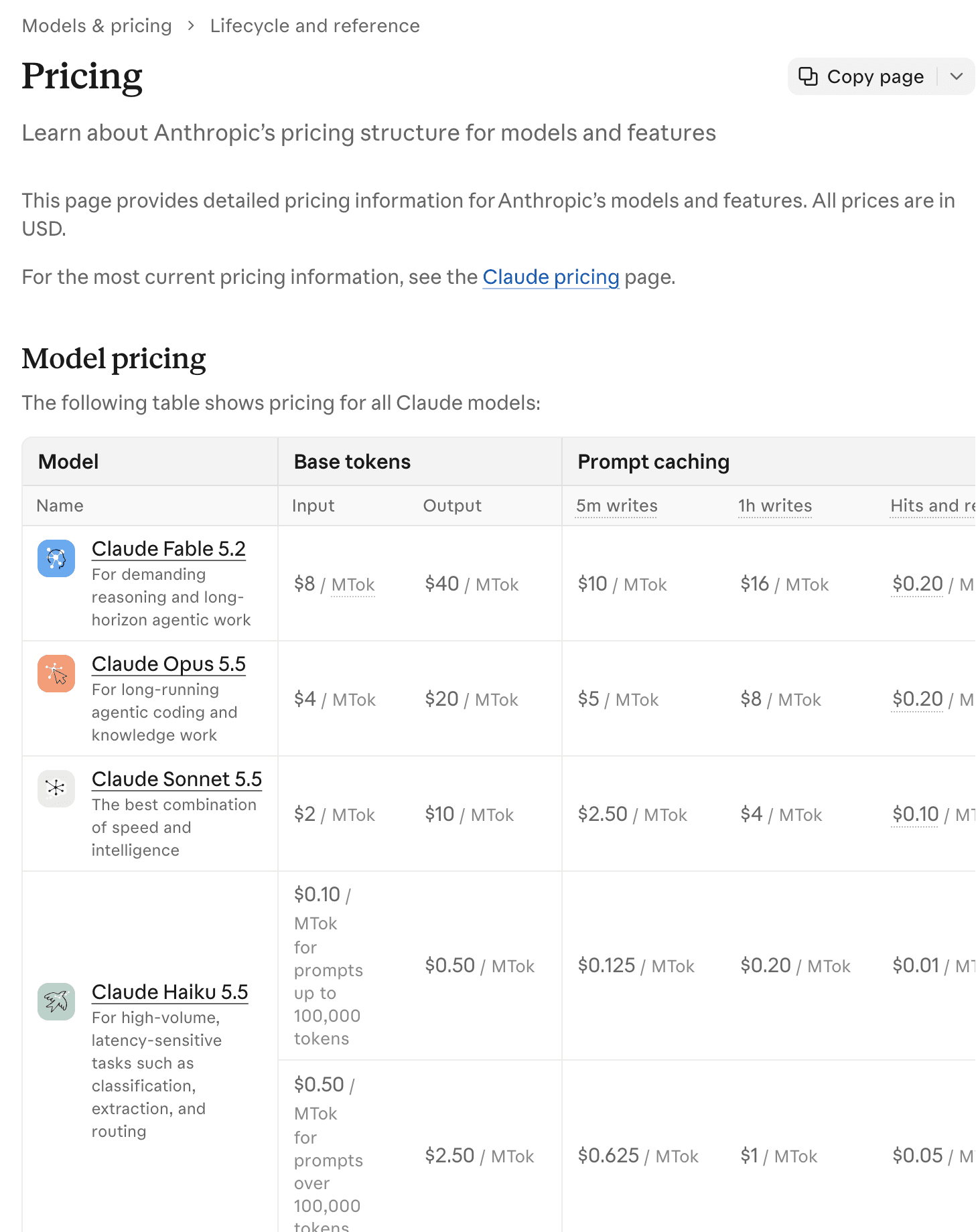
The API pricing page lists, per million tokens of input and output:
Model (as the page prints it) | Input | Output |
|---|---|---|
Claude Fable 5.2 | $8 | $40 |
Claude Opus 5.5 | $4 | $20 |
Claude Sonnet 5.5 | $2 | $10 |
Claude Haiku 5.5 | $0.10 | $0.50 |
Haiku's price is for prompts up to 100,000 tokens. Above that it's $0.50 in and $2.50 out.
I compared Opus and Sonnet on our own benchmark in October, if you're choosing between them.
The plans page has Pro at $20 a month billed monthly ($17 a month on an annual plan, $200 up front), with Claude Code included. Max is $100 a month with "5x Pro usage". Ultra is $200 a month with "10x Pro usage every week" and no five-hour limit "for verified accounts". The footer says: "Price and plans are subject to change at Anthropic's discretion." The same line was on the page on 1 September, so it isn't new to the IPO.
The API release notes have no entry dated 18 to 22 November, and the last one before that gap is from 17 November ("Linked billing in beta"). Anthropic's newsroom has only the two IPO notices in those five days, and both are legal notices that say nothing about products. On 23 November a new release note deprecated Claude Opus 4.5, added a data retention option in beta and added two webhook events. None of it touches prices.
Before the IPO, prices were going down. The prospectus says that from the second to the third quarter of 2026, revenue from higher usage was "partially offset by a decrease of approximately $600 million from price reductions introduced as part of new model versions and contractual discounts." I found no plan to raise prices in what I read.

What the prospectus says to people building on Claude Code
Claude Code gets 47 mentions in the 424B4. Anthropic says it believes the launch of Claude Code "was comparable in its impact to the introduction of the first widely adopted conversational" assistants. Fine. I'd spend my time on the risk factors instead.
Compute is the stated constraint. "Because demand for compute has historically exceeded available capacity, any constraint on our ability to procure, maintain, or expand that capacity could adversely affect multiple aspects of our business simultaneously, including our ability to serve customers at the quality and scale they expect." And it names agentic tools as the heavy users: multi-step reasoning, repeated tool calls, long context and "sustained inference sessions that consume significantly more compute per user interaction than single-turn API calls or chat-based interactions". It reads like a description of a Claude Code session, written by lawyers.
Limits can change. "We have also changed, and may in the future change, usage limits, rate limits, or model and product capabilities." It doesn't say in which direction. The same passage says safety and welfare considerations may lead Anthropic "to limit or delay the deprecation of older models", which is good news if you pin a model version.
Three clouds carry it. The prospectus names its CSPs (cloud service providers): "We rely on a limited number of CSPs—Amazon, Google, and Microsoft—and suppliers, such as Broadcom, for compute." Their outages are Anthropic's outages.
The money goes to compute and people. Use of proceeds is "general corporate purposes", including capital spending on "compute and infrastructure" and hiring, plus about $4.3 billion for taxes on employee share awards. Anthropic may buy companies but says it has no agreement for any material acquisition "at this time".
Control stays inside. Anthropic is a public benefit corporation (a company that must also weigh a stated public mission). Its Long-Term Benefit Trust elects the Class T directors, who make up a majority of the board. A single Class F share, held by a company owned by the seven co-founders, carries 50.1% of the vote on general matters. Public Class A shares get one vote each. Selling shares to the public didn't hand control of the roadmap to the market.
Subscribers are suing. Anthropic faces "several putative class action complaints" claiming it marketed Claude subscription plans deceptively. It disputes them.
For outages, the status page logged one incident created between 19 and 22 November: elevated errors for Claude Mythos 5.2 and Claude Fable 5.2. Anthropic's note puts the impact at 08:56 to 09:11 UTC on 19 November (15 minutes), hours before Wall Street opened. Nothing was logged for 20, 21 or 22 November. Before the listing, sign-in broke twice: on 13 November for Claude.ai and Claude Code, and on 17 November for Sign in with Apple on claude.ai and the iOS app.
What I'm doing about it as a Claude Code user
Not much, and that's the point. A share price doesn't set a per-token price, and the pages that do haven't changed.
Three things worth watching, because the prospectus points at them:
- The release notes and the plans page, for any change to usage or rate limits. Anthropic has written down that it may change them.
- The model version your agents call. Pin it rather than an alias, and watch the deprecation dates. On 23 November Anthropic set 22 January 2027 as the day Claude Opus 4.5 retires from the API, although the prospectus says older models may be kept around longer.
- The status page during heavy weeks. Compute is the constraint Anthropic itself names, and long Claude Code sessions are the expensive kind it describes.
If you're training people on Claude, our Claude Certified practice exams are free.
What I don't know: whether ANT closes under $83 on Monday, what the Journal counted in its $4 trillion, and what the Reuters story says past its headline. If you've read either article in full, or you've seen a limit change on your own Claude plan since Thursday, tell me. I'd like to see it.
Comments
0Add a comment