Is 25 Rovo credits per user enough? Cost and usage per action, measured
Gabriela Perdum
Author
13 min readOctober 15, 2026
Key takeaways
One Rovo Chat Quick answers message cost exactly 10 credits on our test org on 14 October 2026, and a 3-message thread cost 30. A thread bills per message you send.
Two single Think deeper messages cost 65 and 86 credits. One of them is more than three months of a Jira Standard seat's 25-credit allowance, or more than one month of a Premium seat's 70.
Let Rovo decide stayed at 10 credits for a simple question. Deep Research answered 'temporarily unavailable' on all 3 attempts, so we have no number for it.
Credits are pooled per org: 200 Jira Standard seats give 5,000 a month, which is 500 Quick answers or about 66 Think deeper messages for the whole company. Teamwork Collection Standard gives the same 200 seats 50,000.
If 200 people each send one Quick answer per working day, that's about 42,000 credits a month. On Jira Standard alone the overage is about $370 a month at $0.01 a credit, from 3 December 2026.
The Platform usage total moved within 22 seconds of the answer in the four clean runs we timed, while the Credits this period figure and the Features tab lagged behind it on the same page.
Back in June, Andrew Fleig asked on the Atlassian Community: "70 credits...10 per chat? So, only 7 chats per month on a paid plan?" He was right about the 10, and wrong in the expensive direction: on our own test org a Quick answers message cost exactly 10 credits, and a Think deeper message cost 65 and 86. An Atlassian team member told him at the time that the credits are pooled and that Atlassian wasn't billing overage yet.
That last part changes on 3 December 2026. We ran Rovo Chat on our test org on 14 October and read the Rovo credits meter after each message. Deep Research wouldn't run at all for us.
So Andrew's maths holds for quick questions, and it's optimistic for anything that thinks. One Think deeper message of 86 credits is more than three months of a Jira Standard seat's 25.
Is 25 Rovo credits per user enough, then? For one person, no. For a company, it depends a lot on how many people use Think deeper and how often. Below you'll find the per-action numbers we measured, how to read the same meter on your own org, the pooled maths for 50, 200 and 500 seats, and what I'd set before December.
Six things we measured on our own org
Quick answers cost 10 credits per message you send. One message was 10 and a 3-message thread was 30. Atlassian's table says the same: "10 Rovo credits per billable event", and "each user message is a billable event".
Think deeper cost 65 and 86 credits for one message each. Atlassian lists it as "Variable credits per billable event" and publishes no number. Ours are the numbers.
Let Rovo decide stayed at 10 for a simple question. Atlassian says Rovo switches to Think deeper by itself on "a multi-layered or open-ended prompt", so an auto prompt can cost more. Our simple one didn't.
Deep Research answered "Deep Research is temporarily unavailable" three times on 14 October 2026. We have no number for it, and we can't tell whether those failed replies were charged.
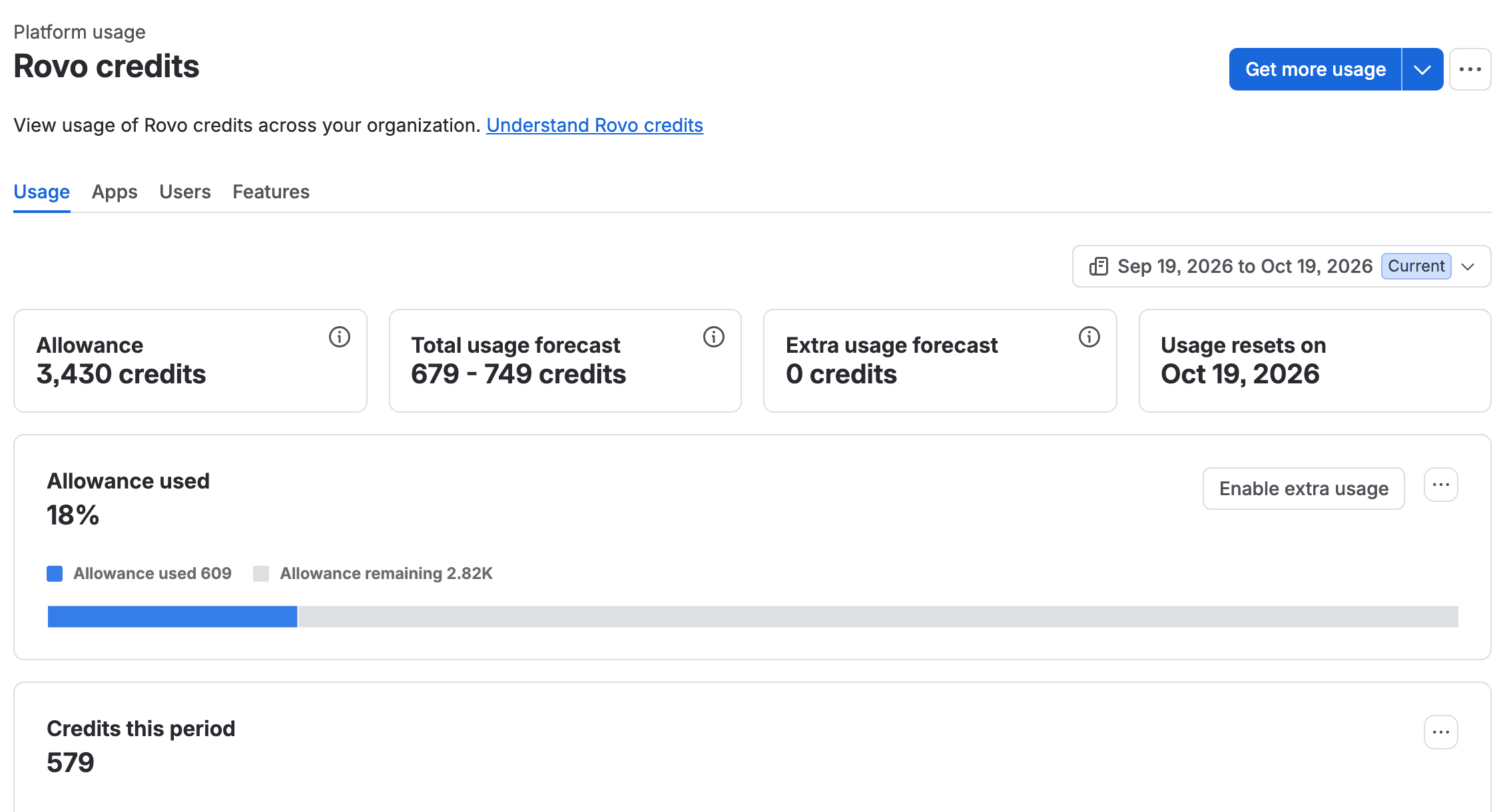
The meter total updates fast, but other numbers on the same page lag behind it. The total moved within 22 seconds of the answer in the four clean runs we timed. At 23:14 UTC, about two and a half minutes after our last answer, the same page said "Allowance used 609" and "Credits this period 579", while the Features tab still said 483.
On Jira Standard, 200 people asking one quick question a working day would cost about $370 a month in overage. If you already pay for Jira and Confluence Standard at 200 seats ($3,050 a month at list price, a 10,000-credit pool), Teamwork Collection Standard lists at $2,940 with a 50,000-credit pool.
What Rovo credits cost per action: Quick answers 10, Think deeper 65 to 86
Our test org is a real Atlassian Cloud org that we use to test our apps. Atlassian Administration shows its Rovo credits under Insights, then Platform usage, then Rovo credits. That page loads its total from an endpoint, and we read the same endpoint before each action and every 20 seconds after it.
We sent one action at a time from a real logged-in browser and picked the reasoning mode in the Rovo Chat composer. At the start of three of our runs we watched the total for two to four minutes to make sure nothing else on the org was using Rovo. It never moved during those checks (408, 483 and 569, all steady), and it didn't move between runs either.
Run (14 Oct 2026, UTC)
Mode
Messages
Credits before
Credits after
Cost
22:50
Quick answers
1
408
418
10
22:53
Think deeper
1
418
483
65
22:59
Think deeper
1
483
569
86
23:06
Let Rovo decide
1
569
579
10
23:09
Quick answers thread
3
579
609
30
6 rows × 6 columnsHeader row enabled
Credits per action on our test org, 14 October 2026, plotted from the meter readings in the table. Notice that both Think deeper bars sit far above the dashed 25-credit line, which is one Jira Standard seat's whole month.
Quick answers cost exactly 10 credits per message, and a thread is per message
The single Quick answer ("What does the Resolution field do in Jira?") cost 10. The thread asked what a Jira component is, how it differs from a label, and whether a work item can have more than one. Three messages, 30 credits.
Empyra, an Atlassian partner, wrote that a five-message Quick answers thread "costs 50 credits, not 10". Our thread fits that. If you're picturing a long back-and-forth as one "chat", it isn't one. Each message you send is a billable event.
We didn't expect the third answer to draw on our own work. It built its example from a real login-retry ticket on our test site and named two components for it, "Authentication" and "Platform Instrumentation". Neither exists on any of our 48 projects, and a few lines later it called the second one "Platform Probes". So the 10-credit tier still reads your data. It just thinks less, and it can still make things up.
The third message of our Quick answers thread on our test org. Notice the example comes from our own work, but the components Authentication and Platform Instrumentation (then Platform Probes) don't exist on our site. This thread cost 30 credits, 10 per message.
Think deeper cost 65 and 86 credits for one message each
The 65 was a comparison of a Scrum board and a Kanban board for a 12-person support team. The 86 was a one-page plan for a change advisory process at a 40-person company. They took 75 and 110 seconds to answer.
Atlassian says Think deeper credits depend on "Reasoning steps", "Search volume", "Tools invoked" and "Model power". I think a longer brief probably means more of all four, and our longer brief did cost more. Two runs are a small sample, so read 65 to 86 as one org's range on one evening. We ran the Scrum question twice earlier in the evening, before the clean setup. Those readings suggest about 77 and somewhere between 78 and 108, but they overlapped with other actions, so they're not in the table.
Atlassian's own rate card gives ranges for premium work: light tasks 10 to 200 credits, medium 201 to 500, heavy 500 and up. Both of ours were light.
Let Rovo decide stayed at 10 for a simple question
In our captures the composer's mode button read Auto before we picked anything, which is Let Rovo decide in the menu. We asked it for the keyboard shortcut to create a work item, and it cost 10. Atlassian's Compare reasoning modes page says Rovo "will activate think deeper mode automatically if it detects a multi-layered or open-ended prompt". I'd expect an open-ended question in auto mode to cost Think deeper prices. We didn't test that one, so this part is my reading of the doc.
Deep Research credits: no number, it was "temporarily unavailable"
We tried three times between 22:13 and 22:19 UTC on 14 October. All three times the answer was "Deep Research is temporarily unavailable". We couldn't tell whether the failed attempts were charged. We only had the lagging Features tab for them, and it moved by 10 about 15 minutes after the last one. Our session totals fit each "unavailable" reply costing 10, but we can't prove it.
Atlassian's current rate table doesn't name Deep Research in any row. The support doc calls it "a premium AI feature that consumes Rovo credits". The June 2026 version of the credits page said 100 credits per request, and that figure is gone from the live page. A lot of third-party pages still quote 100 (eesel's posts from 2025 and 2026, for example). So I don't know what it costs today.
Agents and the other premium features are "variable" too
We didn't measure an agent run. Atlassian's table puts "Basic Rovo Agents (no model selection)" at 10 credits, and lists "Advanced Rovo Agents (with model selection)", "Agents in Jira", "Jira Coding Agent", "Confluence slides" and "Create with Rovo" as variable. Its doc for Agents in Jira says: "Each time an agent is invoked to work on a Jira work item, credits are used from your organization's Rovo credit balance." If our Think deeper numbers are any guide, a premium agent run on a real work item will be in the tens of credits at least. Who may create and run agents is a separate decision, and we covered the admin side in Rovo agent permissions vs CogniRunner approvals.
Per Atlassian, Rovo Search in Atlassian apps and the in-line summaries are free. A summary you ask for inside Chat is a Chat message, though, so I'd assume that one costs 10.
How to check Rovo credits usage in Platform usage
You need to be an org admin. In admin.atlassian.com:
Open Insights in the left sidebar, then Platform usage.
Select Rovo credits. You'll see your allowance, a usage forecast, an extra usage forecast and the date usage resets.
Use the Users tab to see who spent what, and the Features tab to see which feature spent it. On our org it was all "Rovo Chat".
For a per-event list, open the ... menu and pick Export data. Atlassian says the CSV covers up to 3 months and arrives by email, with a link that "expires after 24 hours".
Our org's Rovo credits page at 23:14 UTC on 14 October 2026. Notice 'Allowance used 609' and 'Credits this period 579' on the same screen, about two and a half minutes after our last answer: the chart total is missing our last 30-credit thread. The Enable extra usage button shows extra usage isn't switched on for this org yet.
Our first attempt at measuring went wrong. We were reading the Features tab. A Quick answer at 21:42 wasn't there a minute later and was there by our next reading at 21:58, and later two actions showed up together as one jump of 87. The total behind the Allowance used bar moved within 22 seconds in the four clean runs we timed. So if you're checking what something cost, wait a couple of minutes and read the Allowance used number. The Features table trails it.
Your users can't see their own usage either: the request to let them, ROVO-960, has 16 votes, and the ticket lists "None available" under workarounds. And Rovo asks for no confirmation before a costly mode, which is ROVO-866, "Show estimated credit cost before submitting a prompt". So the 86 credits in our table cost the same one click as the 10.
Illustration, generated locally with FLUX. A Quick answer cost 10 credits and a Think deeper message cost up to 86, with nothing on screen to tell them apart before you hit Enter. The cake was not on the menu either.
Rovo credit allowance pooled for 50, 200 and 500 seats
Allowances per user per month, from Atlassian's "How Rovo credits work" page (read 15 October 2026):
Plan
Standard
Premium
Enterprise
Jira
25
70
150
Confluence
25
70
150
Service Collection
250
700
1,500
Teamwork Collection
250
700
1,500
5 rows × 4 columnsHeader row enabled
The important word is pooled. "All of your organization's Rovo credit allowances are combined into a single shared pool," the doc says, and they're added up across apps: 100 Jira Premium users plus 100 Confluence Premium users give "14,000 Rovo credits per month". Nothing rolls over. The pool resets monthly, and Atlassian words the reset date four different ways across its pages, so read yours on the Platform usage page.
At three company sizes the pool buys this much. Monthly licence prices are Atlassian's new list prices from 13 October 2026, worked out across its per-user tiers. The Think deeper column uses 75 credits, the middle of our two runs.
Seats and plan
Monthly list price
Pool per month
Quick answers
Think deeper (at 75, rounded down)
50, Jira Standard
$485
1,250
125
16
50, Jira Premium
$980
3,500
350
46
50, Teamwork Collection Standard
$750
12,500
1,250
166
200, Jira Standard
$1,790
5,000
500
66
200, Jira Premium
$3,425
14,000
1,400
186
200, Teamwork Collection Standard
$2,940
50,000
5,000
666
500, Jira Standard
$3,912.50
12,500
1,250
166
500, Jira Premium
$6,707.50
35,000
3,500
466
500, Teamwork Collection Standard
$6,385
125,000
12,500
1,666
10 rows × 5 columnsHeader row enabled
Add Confluence and the pool grows by that product's allowance too, at its own edition. Atlassian doesn't give an example that mixes editions (Jira Standard with Confluence Premium, say), so I'd check the allowance figure on your own Platform usage page rather than trust the sum.
Illustration, generated locally with FLUX. Every seat's credits go into one org-wide jar, and nobody gets a personal share of it yet. The big robot with the magnifying glass is the admin reading Platform usage.
That pooling is the good news and the bad news. A quiet seat funds a busy one, so the averages above work out fine if most people barely use Rovo. But there's no per-person limit yet ("Coming soon: you'll be able to allocate Rovo credits by user"), so a few people on Think deeper can spend the whole company's month.
When the pool runs out: extra usage at $0.01 per credit from 3 December
From 3 December 2026, usage above the pool bills at "$0.01 per Rovo credit, or $10 per 1,000 credits". So a Quick answer over the pool costs about 10 cents and our 86-credit Think deeper about 86 cents. Atlassian's FAQ says 3 December is the date "for most meters" and that you'll hear the date for your own organization, so watch for that email.
Whether that happens automatically depends on a setting. Atlassian's usage-based pricing FAQ says extra usage is enabled by default "for most organizations". Our own org showed an Enable extra usage button on 14 October, and the page's data says the meter isn't onboarded yet, so we can't tell whether the default switches on nearer December. Check yours now and again in late November.
With extra usage on, work keeps going and is billed, up to a spending cap if you've set one, and org and billing admins get alerts at 80% and 100% (your users don't). With it off, "new credit-consuming AI features and enriched Teamwork Graph API and tool calls are paused until the allowance resets next month." A chat that's already running finishes, and Rovo Search and the free summaries keep working.
One trap from Atlassian's doc on managing extra usage: if you set the monthly limit lower than the extra usage you've already run up, your org can't use metered features "until usage resets".
If you read Atlassian's pages in the summer, you may remember different words. In June the credits page said extra usage was "not currently billed" and promised "at least 90 days' notice and require an explicit opt-in". The announcement came on 1 September, 93 days before billing. The opt-in wording is no longer on the page.
Rovo Dev credits are a separate allowance for Rovo Dev CLI and code reviews, with their own meter. The 6,207-view Community thread "How do credits translate to tokens?" is about Rovo Dev credits, and it shows up in searches for Rovo credits, so check which meter a page means before you trust its numbers.
A worked example: 200 people, one quick question a working day
Let's take a habit that sounds small. Each of 200 people sends one Quick answers message per working day, 21 days a month. That's 4,200 messages, or 42,000 credits at the 10 we measured.
200 seats on
Pool
Used
Over the pool
Extra cost per month
Jira Standard
5,000
42,000
37,000
$370
Jira Standard + Confluence Standard
10,000
42,000
32,000
$320
Jira Premium
14,000
42,000
28,000
$280
Teamwork Collection Standard
50,000
42,000
0
$0
5 rows × 5 columnsHeader row enabled
Swap a fifth of those messages for Think deeper at 75 credits and the 42,000 becomes 96,600 (3,360 Quick answers at 10 plus 840 Think deeper at 75). That's $916 a month over the pool on Jira Standard, and even the Teamwork Collection pool runs out, at $466 over.
Is $370 a month a lot against $1,790 of Jira Standard licences? It's about a fifth on top. For some teams that's fine if Rovo saves people time. For others it's a surprise line on the first invoice after 3 December. Either way, I think someone should pick that number deliberately, before the invoice does.
Automation rules and sandboxes spend Rovo credits too
Automation is the easy one to miss. Atlassian's automation doc says "Agentic components like Use Rovo, Use agent, or Use Jira Coding agent are billed separately under Rovo credits and do not consume automation steps." A rule that hands every new ticket to an agent spends Rovo credits on every run, and nobody is sitting in Chat to notice. Sandboxes count too: the pricing FAQ says "AI interactions in sandbox consume credits from your allowance", and sandbox and production aren't shown separately yet.
If you run Jira Service Management, check whether your plan is now Service Collection, which carries 250, 700 or 1,500 credits per user. That's ten times the Jira figure, although Service Collection is priced per agent and none of the Atlassian pages we read says whether portal customers count as users. And on Enterprise (from 801 users on Jira and Confluence), 150 credits a seat is 15 Quick answers or about two Think deeper messages a month.
So, is 25 Rovo credits per user enough?
For one person, no. 25 credits is two and a half Quick answers a month, or a third of one Think deeper. Andrew was right about that.
For an org, it's enough if most of your seats never open Rovo Chat and the people who do mostly ask quick questions. Our test org used 609 of its 3,430 credits this month, and most of that was us measuring. It isn't enough if Rovo is part of daily work for most of your people, or if a handful of them reach for Think deeper. Then you're either paying overage, moving to a Collection with ten times the allowance, or rationing.
Before 3 December, I'd do this:
Read your own number now. Open Insights, Platform usage, Rovo credits. Since 31 August, usage is counted at the new rates, so this month's figure is a real preview. Look at the Users tab to see whether it's spread out or concentrated.
Choose your extra usage setting yourself. If it's on, set a monthly cap you'd be comfortable explaining. A cap of $100 is 10,000 credits, about 1,000 Quick answers or 133 Think deeper messages. If you'd rather Rovo pause than bill, turn it off, and tell people what pausing looks like so they don't file tickets about it.
Tell people that Think deeper costs about six and a half to nine Quick answers. They can't see their own usage and there's no warning in the composer, so this only reaches them if you say it.
Re-run the maths for a Collection if you already pay for Jira and Confluence. At 200 seats, Jira Standard plus Confluence Standard list at $3,050 a month with a 10,000-credit pool. Teamwork Collection Standard, which includes Jira, Confluence and Loom, lists at $2,940 with 50,000. If you only have Jira, the credits alone don't pay for the move: 45,000 extra credits are worth $450 of overage and the upgrade costs $1,150 more.
If you've measured an agent run or a Deep Research run on your own org, I'd love to see the number. We'll add it here with credit. Our own Team '26 notes on extra usage and the December switch have more on what Atlassian announced in Amsterdam.
Jira local LLM integration: pin one HR project to LM Studio with CogniRunner
One Jira Cloud project sends its AI checks to a Qwen model in LM Studio on our Mac Studio, and the site stays on its cloud provider. I ran it 8 times on 14 October 2026: 8 refusals and 8 passes, about three seconds per click. Then I saved a wrong token and the request went straight through.






Comments
0Add a comment