
Tidal Bans AI-Generated Music on December 9: What Counts and How It Is Detected

10 min readNovember 26, 2026
Key takeaways
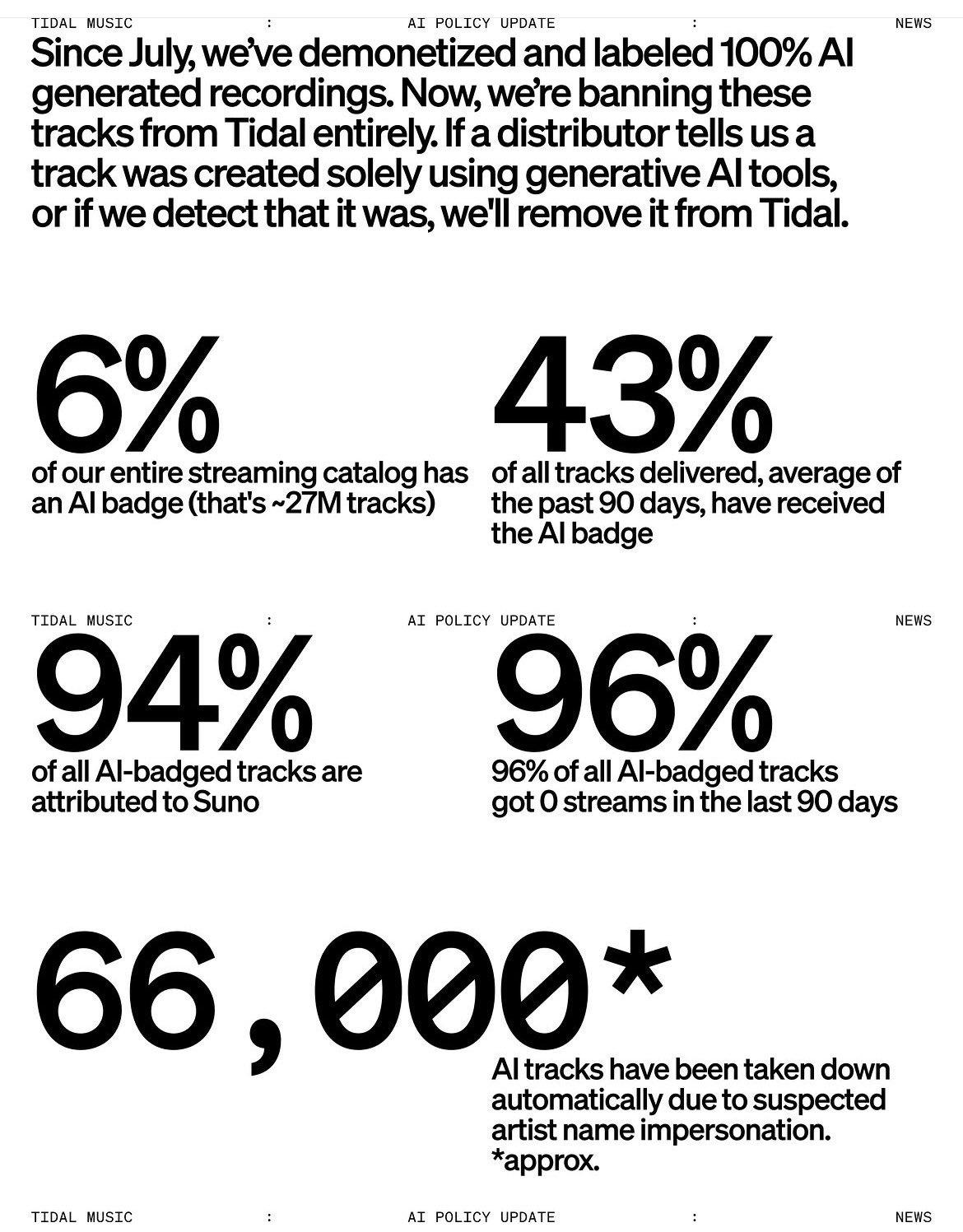
- From 9 December 2026 Tidal rejects and removes tracks it decides are 100% AI-generated. About 27 million tracks, 6.3% of its catalogue, carry its AI tag today.
- Tidal says 94% of the tracks it tagged as AI come from Suno and 96% got zero streams in 90 days. Over 60% of deliveries on 6 November were wholly AI.
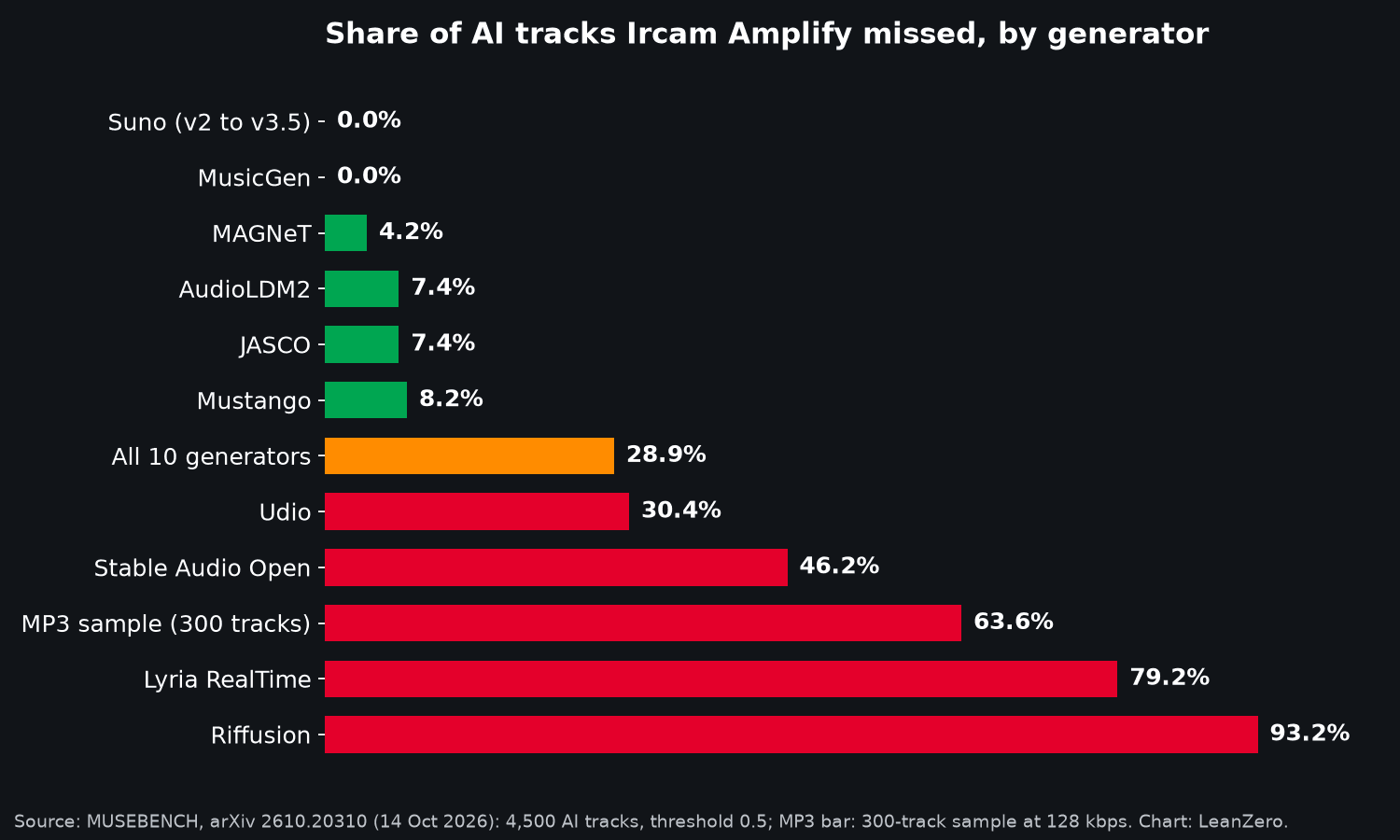
- In the MUSEBENCH test, Tidal's detection partner Ircam Amplify missed 0.0% of tracks from Suno v2 to v3.5, 79.2% from Lyria RealTime and 63.6% of 300 AI tracks converted to MP3.
- Songs made with AI help stay on Tidal. Bandcamp has banned AI music since January 2026, while the other big services mostly label it or keep it out of recommendations.
- The money explains why people upload songs nobody plays. A US court sentenced Michael Smith to 18 months for using up to 10,000 bot accounts to stream AI songs for over $8 million in royalties.
Tidal bans AI-generated music from 9 December 2026: on 24 November it posted that "any wholly AI-generated track that's submitted to Tidal will be rejected and removed from our platform". About 27 million tracks carry Tidal's AI tag today (the label it has put on tracks it decided were fully AI-made since July). That is 6.3% of everything on the service. Tidal says 96% of them got zero streams in the last three months. Songs that used AI as a helper stay. Robert Andersen, who runs Tidal at its parent company, Block, put the number to be deleted at 29 million.
I found the detector more interesting than the ban. Tidal names its detection partner. It's Ircam Amplify, a company that sells an AI music detector. An independent benchmark published in October, MUSEBENCH, ran Ircam Amplify on 4,500 AI tracks: it missed none of the Suno tracks, and it missed 79.2% of the tracks from Google's Lyria RealTime. One catch: the 250 Suno tracks in Ircam Amplify's run came from Suno versions 2 to 3.5, taken from the SONICS dataset published in 2025, and Suno has since replaced those versions with v6. Tidal says 94% of the tracks it tagged as AI come from Suno. If Ircam Amplify does as well on Suno's current model, the ban should work against the flood Tidal has now. I couldn't find a test of that. I'm less sure about the next flood, if it comes from other generators.
I think that's the fair reading. Tidal is banning Suno spam at scale, and its own numbers say as much. "No AI music on Tidal" is a promise its detector, as tested, can't keep for every generator.
Six findings: one generator, almost no listeners, a detector with gaps
- The ban covers only "100% AI generated" tracks. Tidal's announcement and help page give no threshold below that, and the help page already says partly AI tracks "may remain unlabeled".
- The tagged flood is mostly one tool. Tidal's own graphic attributes 94% of AI-tagged tracks to Suno. That counts only what Tidal caught, and a detector that misses most Lyria RealTime tracks would under-count them.
- Almost nobody listens to it. 96% of AI-tagged tracks on Tidal had zero streams in 90 days. On Deezer, AI music is 1% to 3% of streams.
- Ircam Amplify leans toward not accusing, on the paper's headline numbers. In MUSEBENCH it was right 98.6% of the time when it said AI, and it caught only 71.1% of AI tracks. The authors call it a "conservative, precision-oriented design". The same paper's appendix table also lists 9.0% of human tracks flagged as AI.
- Compression hides most tracks from it. Its miss rate was 28.9% on the main test and 63.6% on 300 AI tracks converted to MP3 (a common compressed audio format) at 128 kbps.
- Only Bandcamp bans it outright so far. CBC (Canada's public broadcaster) calls Tidal the first major music streaming platform to ban fully AI music. Qobuz's contracts already forbid delivering 100% AI tracks, but it badges and hides what gets through instead of deleting it.
What the Tidal AI music ban covers from December 9
I read the announcement first. It's an X Article titled "Tidal Is Deleting, Rejecting, and Banning Fully AI-Generated Music", posted at 14:22 UTC on 24 November. Tidal's help-centre page "AI Policy" was updated 26 minutes earlier with a banner that says the same thing.
First, Tidal will remove "all tracks that we determine are 100% AI generated" from the existing catalogue. Andersen wrote on X that removal begins on 9 December and that "you'll see them completely gone by the beginning of the year". Second, new deliveries: Tidal is "banning distributors from delivering these tracks to us, and will reject deliveries if their metadata says they were generated solely using AI tools". A distributor is the company that delivers an artist's files to every streaming service. Andersen expects 80,000 to 85,000 rejected songs a day.
About the two numbers you'll see in headlines: 27 million is what Tidal's article says is tagged today, and 29 million is Andersen's estimate of what the deletion will remove. Both come from Tidal, so I use 27 million for what exists now. Ars Technica uses the first and The Verge the second.
This is Tidal's second step. In late June it announced labels and demonetisation for wholly AI tracks, effective 15 July: they stayed playable, earned no royalties, and listeners could switch them off in Settings. Some older pages that still come up in searches about Tidal and AI music describe that June policy, so check the date before you trust a headline.
Why now? Tidal says 43% of all tracks distributed to it in the last 90 days were wholly AI, and on 6 November more than 60% were. It has also taken down over 65,000 tracks for suspected artist-name impersonation, meaning AI songs uploaded under a real artist's name. "At this scale, the authentic music and artists that Tidal subscribers are looking to listen to and discover get buried," the article says.
Does Tidal allow AI-generated music? Only AI-assisted songs
Not if it is wholly AI-generated. AI-assisted songs, yes. Tidal's sentence on it: "Tracks that were assisted by AI tools, but not the sole outputs, will be allowed on the platform." Tidal's help page explains why the line sits there: "Due to limitations in AI-detection technology, and to avoid false positives, we will only be taking action with respect to wholly AI-generated recordings." It adds that it will move to "substantially AI-generated" recordings when detection gets more reliable, and that it takes no action on AI-written compositions.
By that wording, a song where you wrote and sang the parts should be fine, even if an AI tool did the mastering or a backing loop. A track that came out of a prompt box is not. I like that line. The grey zone in between is what one Hacker News comment with 22 replies worries about (the thread has 326 points and 314 comments): user orblivion wrote that the line "between someone using 'AI music' and, say, a sampler or a synthesizer that somebody else programmed, is going to be pretty blurry". Another user, marknutter, asked whether his own songs count, since he writes them and then uses Suno to produce them. Tidal's announcement and help page don't cover that case.
If you used no AI at all and your track was tagged anyway, the help page sends you to the support form. Choose "I need help with a copyright or trademark violation or AI tagging", then "I want to file an AI flag review", then "This track was wrongly tagged as AI". The page offers no appeal route for a track that used AI tools but was wrongly judged wholly AI. Tidal Upload, the feature that lets listeners upload up to 200 of their own tracks, follows the same AI standard as the catalogue.
How Tidal detects AI music: Ircam Amplify and metadata
Tidal names two paths. The first is metadata. If the delivery says the track was made solely with AI tools, it is rejected. That relies on the uploader telling the truth, the same kind of self-declaration Spotify and Apple Music use for their AI credits. The second is detection: "Enforcing our policy is made possible with technology provided by Ircam Amplify, our AI detection partner." Ars Technica guessed Tidal would rely on watermarks; Tidal's own text points to a detector instead.
Ircam Amplify's product page claims "99% accuracy" with "Less than 1% false positives". It also says it can "Scan more than 250.000 tracks within 1 hour". I found no paper or test set behind those numbers.
How do these detectors work? I found the clearest answer in Deezer's own research. Music generators leave "small yet distinctive spectral peaks" in their audio: patterns in the frequencies that come from the layers that build up the sound. Deezer's researchers say these are "inherent to a chosen model architecture rather than a consequence of training data or model weights". People usually can't hear them; software can. Since each architecture leaves its own pattern, a detector can even tell which generator was used.
The same mechanism has a cost. A detector that learned Suno's pattern can miss a model it never saw, and anything that smears those frequency peaks (a format change, a pitch shift) can hide them.
Ircam Amplify missed 28.9% of AI tracks in an independent test
MUSEBENCH comes from researchers at the University of Georgia, Virginia Commonwealth University, the University of Tennessee and Cornell. It was posted to arXiv on 14 October 2026. They ran Ircam Amplify's detector, through its paid API, on 1,990 human-made tracks and 4,500 AI tracks from ten generators, and used a decision threshold of 0.5 on its confidence score (a scale from 0 to 1).
On the paper's headline numbers, when Ircam Amplify said a track was AI, it was right 98.6% of the time. It caught 71.1% of the AI tracks. So it missed 28.9%. The authors call that "conservative predictions", which fits Tidal's stated goal of avoiding false positives.
The paper's appendix table gives a second number that cuts the other way. It lists a 9.0% false-positive rate, meaning Ircam Amplify called about 9 in 100 of the 1,990 human tracks AI. That 9.0% fits the paper's overall score for Ircam Amplify, 81.0% balanced accuracy: the average of 71.1% of AI tracks caught and 91.0% of human tracks cleared. The 98.6% doesn't fit the same track counts. The paper doesn't explain the gap. So I wouldn't take either number as the false-alarm rate Tidal will see, and Tidal's announcement and help page don't give one.
Per generator, the spread is huge. Six of the ten were under 10% missed, with Suno (v2 to v3.5) and MusicGen at 0.0%. Udio was at 30.4%, Stable Audio Open 46.2%, Lyria RealTime 79.2% and Riffusion 93.2%.
Then the compression test. It's the one that worried me. The test converted 300 AI tracks to MP3 at 128 kbps, and Ircam Amplify missed 63.6% of them. The paper says the commercial detectors are "particularly sensitive to compression". It tested the compressed files themselves. It says nothing about an MP3 converted back to a lossless file, so I wouldn't stretch the 63.6% that far.
The paper's setup limits what these numbers say. The authors chose the 0.5 threshold, and Tidal hasn't published its own. They call the commercial APIs "reference points rather than strictly controlled baselines" and suspect a gap between the vendors' training data and their test set. The Suno tracks were from versions 2 to 3.5; Suno now runs v6. And they tested Lyria RealTime, Google's interactive music model, while Tidal's announcement just says "Lyria".
Deezer's open method did better overall in the same benchmark. It scored 97.6% balanced accuracy, against Ircam Amplify's 81.0%. But its miss rate rose to 93.6% when the tracks were pitch- or time-shifted. Deezer's own November research post says the same about existing detectors in general: their performance "collapses under simple audio manipulations, such as speed modification or pitch shifting". I read that as good news and bad news for 9 December. Older Suno uploads, the bulk of what Tidal has tagged, look easy to catch. Someone who wants to slip AI tracks past Tidal has a cheap option in a less common generator, and a pitch or speed shift is another.
We have an article on why a single benchmark score is a weak guide, from running 32 coding models twice. The same caution applies to MUSEBENCH: one test set, one threshold, one run.
Does Spotify ban AI music? Other streaming services compared
No. Spotify's September 2025 policy says "all music is treated equally, regardless of the tools used to make it". What it does instead is remove spam and hide slop. It removed more than 75 million spammy tracks in the 12 months to September 2025. In 2026 it took more than 50 million "slop and spam tracks" out of recommendations, which leaves them on the service. Vocal impersonation needs the impersonated artist's permission. Spotify also says AI detection "has limitations, and it will only get harder as generative AI evolves".
Service | Fully AI tracks | How it finds them | Source, date |
|---|---|---|---|
Tidal | Rejected and removed from 9 Dec 2026 | Ircam Amplify detector plus delivery metadata | Tidal X Article, 24 Nov 2026 |
Bandcamp | Not permitted ("wholly or in substantial part") | User reports and review | Bandcamp blog, 13 Jan 2026 |
Deezer | Tagged, kept out of recommendations and editorial playlists; fraud tracks and tracks unstreamed for 6 months taken down | Its own detector, claimed 99.8% accuracy | Deezer newsroom, 21 Jul 2026 |
Spotify | Allowed; spam removed, slop kept out of recommendations | Many signals, including third-party detectors | Spotify newsroom, 20 Oct 2026 |
Apple Music | Allowed; AI tags required from content providers, visible Made With AI labels announced for later in 2026 | Tags declared by the content provider | Apple email quoted by 9to5Mac, 20 Aug 2026 |
YouTube Music | Allowed, labelled when made primarily with generative AI | Partners and its own detection tools | YouTube blog, 14 Oct 2026 |
Qobuz | Badged, out of recommendations, hidden from search unless the exact title is typed; contracts prohibit delivering 100% AI content | Detection, with appeals through the distributor | Qobuz AI Charter v2, Sep 2026 |
I'd call Bandcamp's wording stricter than Tidal's on paper ("substantial part" against "100%"), with no named detector behind it. Deezer is the one with the longest public record: about 10,000 AI tracks a day when it launched its tool in January 2025, around 75,000 a day (44% of uploads) by April 2026, and more than half of daily uploads in June.
Streaming royalties explain why anyone uploads songs nobody plays
Follow the money. On 6 October 2026 a US federal court in New York sentenced Michael Smith, a North Carolina man, to 18 months in prison for streaming fraud. According to the Justice Department, he used "as many as 10,000 Bot Accounts at once" to stream songs made with AI tools, collected "more than $8 million in royalties" between 2017 and 2024, and was ordered to forfeit $8,091,843.64. The release says he needed lots of songs quickly to get around the platforms' anti-fraud policies. In April 2023 his bots streamed his music 80.9 million times on YouTube Music family plans, against 9.3 million family-plan streams for the whole Taylor Swift catalogue on YouTube Music the same month.
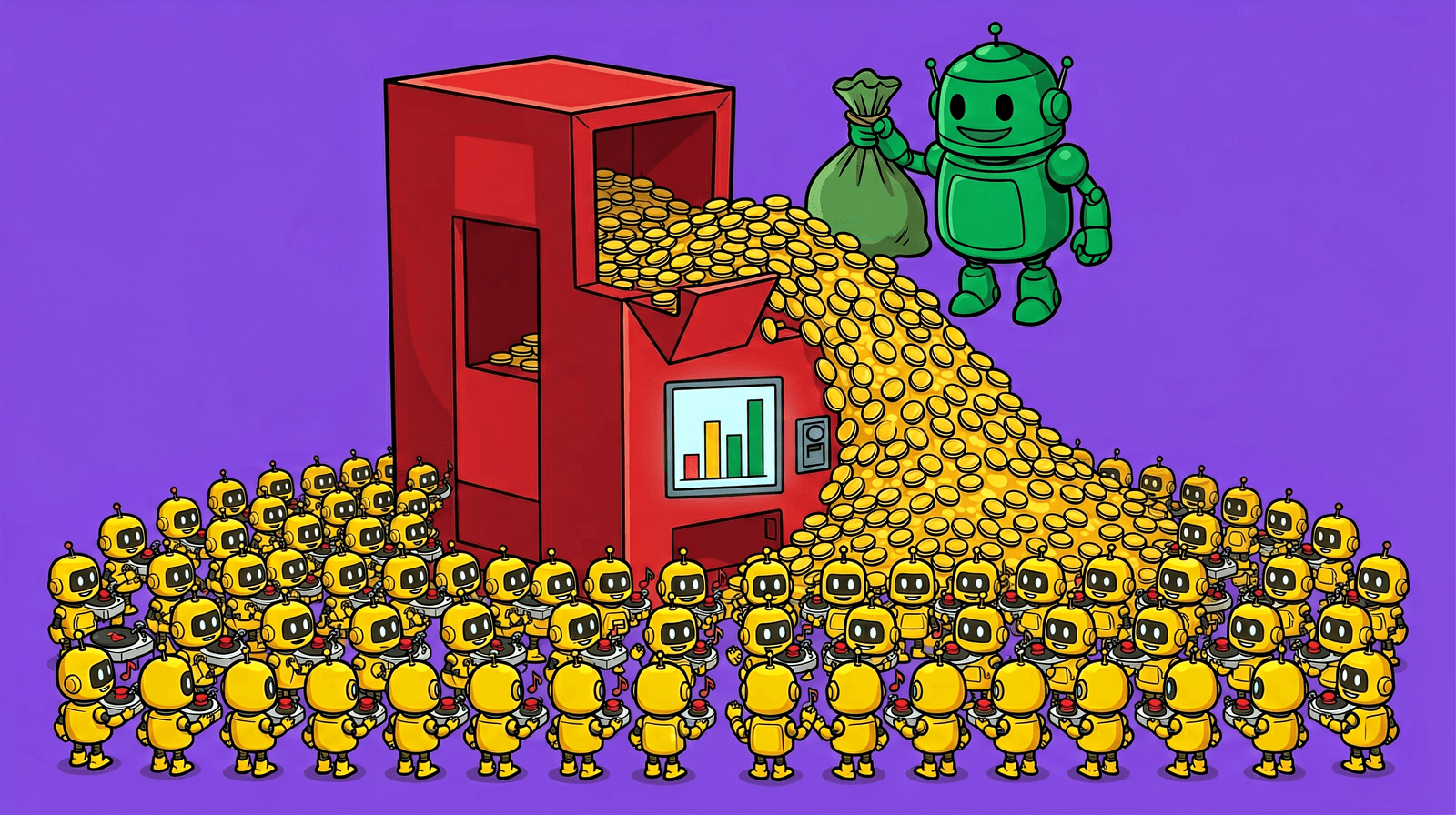
Deezer's numbers point the same way: up to 85% of streams on fully AI tracks were fraudulent in 2025, against 8% fraud across its whole catalogue. Tidal already cut AI tracks out of the royalty pool in July. They kept coming anyway: 43% of deliveries over 90 days. Demonetising after the fact didn't stop the uploads. That is a decent argument for rejecting them at the door.
What changes for artists and distributors on December 9
If you release through a distributor, here is what changes. A track flagged as solely AI in its metadata will bounce at Tidal. A track already on Tidal that it determines is 100% AI will be removed, and Andersen says they'll be gone by the beginning of the year. A track with no AI in it, tagged by mistake, goes through the AI flag review form; the help page names no route for AI-assisted tracks. Tidal's announcement and help page give no false-positive rate, appeal volumes or appeal times. At 80,000 or more rejections a day, that's the number I'd want before trusting the system.
If you only listen, I doubt you'll notice, since Tidal's own count says almost nobody played them.
Our own AI music track would be banned on Tidal
We've made fully AI-generated music ourselves. For our AI YouTube narrator project I ran ACE-Step 1.5 (an open music model whose licence lets anyone use the code and weights) on a Mac Studio. It made eight tracks of 190 seconds each, and each took 51 to 90 seconds to generate. We kept one as a background track under a video. Under Tidal's rules that track is "wholly AI-generated". It would be rejected if we ever delivered it as a release. We didn't, and we never put an artist's name in the prompt (genre words only, a rule we wrote down for that project). ACE-Step also runs on anyone's own GPU, with no company service between the model and the file, which is the kind of tool Ars Technica points to when it doubts how far detection can go.
I haven't run a detector on our track, so I can't tell you whether Ircam Amplify would catch it.
My verdict: banning wholly AI tracks is the right call for a paid service whose listeners don't play them, and Tidal's own numbers make the case. So I'd keep the ban. But read "banned" as "Suno uploads removed". The claim that a fan won't hear AI music on Tidal is only as good as the detector, and the one independent test I found says that depends a lot on which generator made the song.
If you make music with AI somewhere in the chain, where would you draw the line Tidal drew? And if you've had a track tagged by any of these services, did the appeal work? I'd like to hear how it went, in the comments under this post or on our GTA VI piece where the same "did they use AI" question came up for a game.
Comments
0Add a comment