Atlassian Partner Accelerate at Team '26 Europe: Forge, revenue share and who we met
Gabriela Perdum
Author
7 min readOctober 6, 2026
Key takeaways
Atlassian Partner Accelerate is a partner-only day of ecosystem strategy, held on Monday 5 October 2026 at RAI Amsterdam, the day before Team '26 Europe. It sold out.
From 1 October 2026 Atlassian's revenue share is 17% on Forge apps and 25% on Connect apps, per its November 2025 timeline. Partners keep 100% of Forge revenue up to $1 million in lifetime Forge revenue.
Connect end of support for Jira and Confluence apps now begins on 31 January 2027, moved from December 2026. After that Atlassian will only address critical security patches.
Marketplace Partner Program levels are Silver, Gold and Platinum. Per Atlassian's program page, Gold asks for at least $10K a year in Forge sales and Platinum for $150K.
Teamwork Graph connectors are generally available via Forge, so partners can bring outside data into the Teamwork Graph. Source permissions carry over only if the connector replicates them.
In the Forge changelog around the conference, rovo:mcp went into Preview on 1 October (its module docs still mark external AI clients as EAP), rovo:skill on 2 October and Confluence static macros on 6 October. Preview isn't GA.
Atlassian Partner Accelerate, the partner-only day before Team '26 Europe, ran on Monday 5 October at RAI Amsterdam, and for us it was above all a day of meeting solution partners and other Forge app builders. If you build or sell on the Atlassian Marketplace, here are the numbers to know. Atlassian's schedule puts its share at 17% on Forge apps and 25% on Connect apps from 1 October 2026, and partners keep 100% of Forge revenue up to $1 million in lifetime Forge revenue. Below that you'll find the partner tiers, the Connect date that moved, and a little Amsterdam, because we did go outside.
This is part 2 of our series. Part 1 is the hub, with the dates, the agenda and the keynote times, so this part sticks to the partner day.
Partner Accelerate Europe at the RAI: the Forge builders and partners we met
Atlassian describes the day as "a focused, partner-only day of ecosystem strategy delivered by Atlassian's senior leadership before Team '26 Europe begins" (Partner Accelerate page). It ran 9:30 to 17:30, it sold out, and there was no onsite registration. Morning keynotes, then four afternoon deep dives, moving from building AI solutions to selling by industry, driving adoption and co-selling with Atlassian.
The day was about people, though. We met people from Adaptavist, from Opus Guard and from Ricksoft. Three different shapes of partner, honestly. Adaptavist is a Platinum Atlassian Partner, and its group makes ScriptRunner. Opus Guard is a Marketplace Partner that makes Content Retention Manager for Confluence and Jira. Ricksoft makes project-management apps such as WBS Gantt-Chart for Jira, and says its whole app portfolio is now on Forge.
We're a two-person company. You don't get many chances to put faces to the names you see on Marketplace listings. For us, that was the most important part of the day.
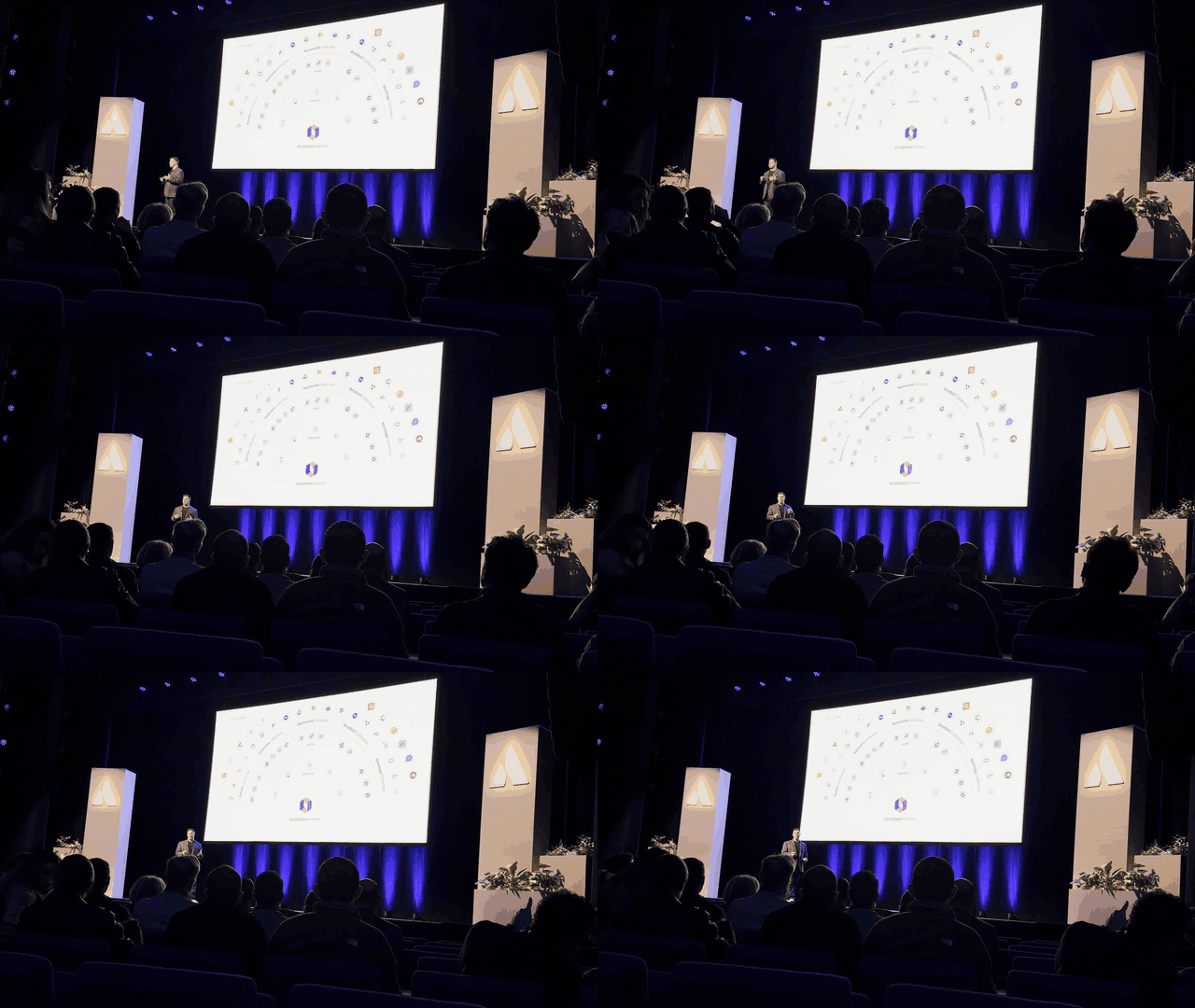
The auditorium on Monday, from our seats: a short loop from our own clip. The audience is in silhouette and the speaker is the small figure on the left of the stage.
Forge and Teamwork Graph connectors: what partners saw on stage
There was a lot about Forge on the screens. One slide called Forge "Atlassian's personalization layer. Where the future gets built." I couldn't find that wording on any public Atlassian page, so take it as a line from the stage, not a published position. The public version, on About Forge, is plainer: "Atlassian's serverless app development platform".
The Forge slide at Partner Accelerate. The words are the slide's own. We found no Atlassian page that repeats them.
Another slide we photographed was the Teamwork Graph one: "More connections, richer context", drawn as a map where Forge apps and Marketplace apps sit next to tools like Salesforce, Google Drive, Figma and Microsoft Teams. The slide doesn't announce anything by itself. What makes it concrete is that Teamwork Graph Connectors "are now generally available via Forge", and "customers and partners can now build their own connectors to bring data from any source", with permissions intact. That's from Atlassian's Teamwork Graph post from May. The graph:connector module is how you do it. Its reference is more careful about permissions than the post: they carry over only when the connector declares replicatesPermissions: true, and if that's false, "all ingested data is visible to every user in the Atlassian workspace". The description of one afternoon breakout lists "MCP, Forge LLM, Forge CLI, the Teamwork Graph, and Assignable Agents" as the surfaces to build on.
The Teamwork Graph slide. Count the Forge app and Marketplace app nodes: they're drawn into the same graph as the big SaaS tools.
The Forge changelog didn't sit still around the conference either, and here the status labels matter. On 1 October the rovo:mcp module went into Preview. It lets a Forge app offer its Rovo actions as tools to custom agents in Rovo Studio and to MCP clients such as Claude Desktop, Codex and Cursor, and that external access stays off until it's enabled for each installation. Check the label on the external part, though. The changelog says it's "now in Preview", but the module reference still marks connecting third-party AI clients as EAP, "not recommended for use in production environments". On 2 October the rovo:skill module moved from EAP to Preview, and the Forge LLMs limit went from 50,000 to 500,000 tokens per minute, per installation and per model. The rovo:agentConnector module, which connects an agent hosted outside Forge to Rovo over A2A, reached GA on 28 September. And on 6 October, the day this goes out, Confluence static macros moved from EAP to Preview. Preview isn't GA. Atlassian calls it suitable for early adopters in production, so read the entry before you build on one.
Atlassian Marketplace revenue share for Forge apps after 1 October 2026
This is the part I'd want if I were you. Atlassian's extended timeline post (3 November 2025) sets its share at 16% for Forge and 20% for Connect from 1 April 2026. From 1 October 2026 the same post moves them to 17% for Forge and 25% for Connect. If you're still on Connect, that's an eight-point gap.
Atlassian's pricing and billing docs say the same thing from the partner's side. You receive 83% on a Forge app and 75% on a Connect app, and the page still says "will change" even though the date has passed. To count as Forge, an app must contain no Connect modules, use OAuth authentication and use Forge UI.
Then there's the Forge incentive: "As of 1 January 2026, partners will receive 100% of gross revenue earned on Forge, up to $1 million in lifetime Forge revenue." That limit counts per partner, not per app. Atlassian's May 2025 post calls the 0% incentive "temporary" and promises at least six months' notice before changes to standard rates. Apps with the Runs on Atlassian badge got a three-month head start on it. I wrote about what Runs on Atlassian means for Sentinel Vault on 2 October.
The Connect date moved too. Atlassian's August 2026 post extends end of support for Jira and Confluence Connect apps "from December 2026 to January 31, 2027". After that, "Atlassian will only address critical security patches." If you've migrated already, check the leftovers. Mihai wrote up how Cloud Fortified still probes your old Connect URL after a move to Forge.
Atlassian Marketplace Partner Program tiers and what they ask in Forge revenue
The program page has three levels: Silver, Gold and Platinum. They're set on revenue, security and trust compliance, and customer support. The cloud gross sales minimums are $150K, $750K and $3M a year. Gold also needs at least $10K a year from Forge, and Platinum $150K. Platinum asks for SOC 2 Type 2 or ISO 27001:2022 and a third-party validated Trust Center.
One caveat. That page says "Last updated May 28, 2025", and Atlassian reserves the right to change the requirements. Read it yourself before you plan around a number.
There's a new trust programme to know about too. On 1 October Atlassian launched Atlassian Enterprise Certified (AEC), for apps that meet enterprise needs on compliance, security, reliability, privacy, accessibility and responsible AI use. It's open to eligible Forge cloud apps, and partners apply with their evidence. Cloud Fortified is on its way out. It stopped taking submissions on 1 September and will be retired on 31 December 2026.
We also used the day to get people to know what LeanZero builds. We did that with the new share dialog on our site, a QR code for each thing we make. We merged it on the Monday morning. You'll find it as a small QR button in the header of leanzero.net.
It opens a share dialog, full screen on a phone, with one large QR code and a list of what you can share. There's the page you're on, our home page, each of our three Marketplace apps and every product page, 20 codes in all. The Marketplace codes use the short marketplace.atlassian.com/apps link, so they're less dense and scan from further away. The Full screen button, or a tap on the code, shows a plain white code and asks the phone to keep its screen on. Below the code you get Open listing (or Open page), X, LinkedIn and Copy link. Try it on your phone.
Captured on leanzero.net at phone size on 6 October 2026, with LeanZero Management selected. One tap on the QR or Full screen gives you a bigger, white, code-only view.
Amsterdam after Partner Accelerate: a tall ship, the Munttoren and NEMO
Now the lighter part. We'd flown in at sunrise.
The tall ship is the replica of the East Indiaman Amsterdam, moored at Het Scheepvaartmuseum since 1991. The original was built for the Dutch East India Company in the 18th century. The museum behind it is housed in a former naval storehouse, built in 1656.
The replica East Indiaman Amsterdam at Het Scheepvaartmuseum. Look past the rigging at the museum building, a former naval storehouse.
We also saw the Munttoren on Muntplein. It was once part of a medieval city gate, and it got its spire in 1620. Then there was NEMO, Renzo Piano's copper-green science museum, which looks like it's rising out of the water at dusk. And the canal houses, which are worth looking at one front door at a time.
The Munttoren on Muntplein at night. The tower was part of the Regulierspoort city gate. The spire came with the 1620 rebuild.
And we stopped at a bruin café, a brown bar, the kind of traditional Dutch pub I amsterdam calls "a quintessential part of Amsterdam's culture".
A brown cafe in Amsterdam: stained-glass lamps, a bare brick wall and a Delft-blue tile picture.
What we're watching at Wednesday's Founder Keynote
The Founder Keynote, "Your business knows better", is on Wednesday 7 October at 09:00 CEST. The hub has the livestream times, including where Atlassian's own pages disagree. We'll be listening for anything new on Forge, on Teamwork Graph connectors and on the Marketplace, because those decide what we build next. We'll see on Wednesday. Part 3 will cover the keynote announcements.