
Atlassian usage-based pricing: a 2027 budget for 50, 200 and 500 seats

Key takeaways
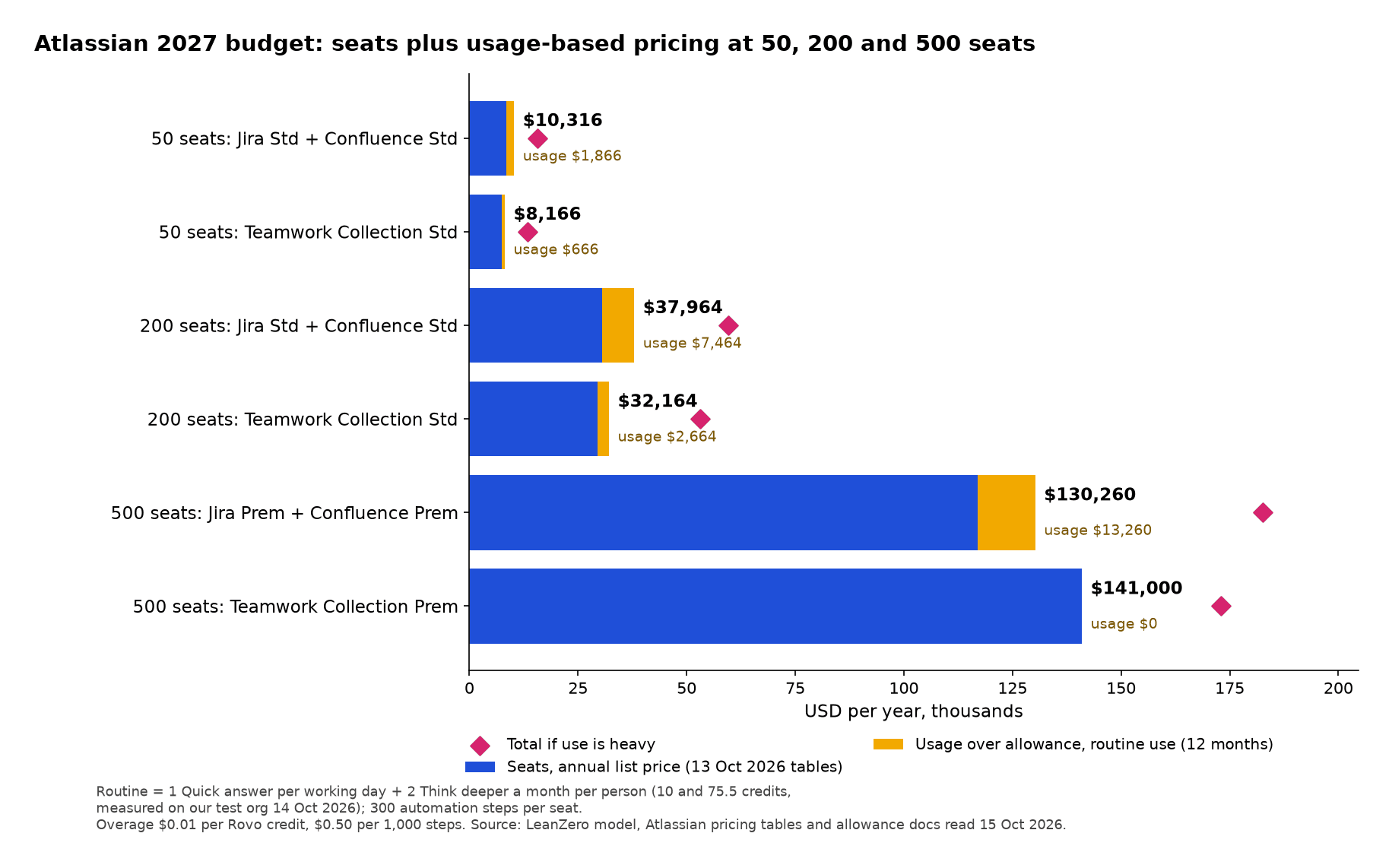
- Routine Rovo use (one Quick answer per working day and two Think deeper a month per person, 10 and 75.5 credits each as measured on our test org) adds $7,464 a year to a 200-seat Jira Standard + Confluence Standard org, 24.5% on top of $30,500 of seats.
- Teamwork Collection Standard costs less than Jira Standard + Confluence Standard on Atlassian's annual tables at all three sizes ($7,500 vs $8,450 at 50 seats, $29,500 vs $30,500 at 200, $64,000 vs $64,500 at 500), and its per-seat pool is five times larger (250 credits against 50, 2,500 steps against 500). At 200 seats with routine use the year drops from $37,964 to $32,164.
- At 500 Premium seats the collection costs $24,000 a year more than Jira Premium + Confluence Premium and pays for itself above about 540 Rovo credits per person per month. It includes Atlassian Guard Standard ($19,500 a year at 500 users), so for an org that buys Guard anyway the gap is $4,500 and the line drops to about 215 credits.
- Automation steps barely move the bill at $0.50 per 1,000: the worst case in our model is $50 a month, 200 Standard seats running 1,000 steps each.
- The 13 October 2026 list price change put a 200-seat Jira Standard + Confluence Standard annual renewal up from $28,500 to $30,500 (+7.0%). Atlassian publishes no percentage, so we computed it from its own old and new tables.
- AI agent resolutions cost $1.00 each from the first one, with no allowance. Atlassian's own calculator estimates 2,000 to 8,000 a month whether you have 50 people or 500.
In September someone on the Atlassian Community wrote that they were "on Jira Cloud Standard (123 users) and trying to figure out the new usage-based pricing before it starts on Dec 3". Make that company a bit bigger, 200 seats on Jira Standard and Confluence Standard, and let people use Rovo most days. The answer we got is about $7,464 a year of usage on top of $30,500 of seats at list price. That's close to a quarter more than the seats alone.
We worked it out for a 50-seat, a 200-seat and a 500-seat company. The prices come from Atlassian's tables on 15 October 2026. The Rovo costs come from our own test org, where we watched the meter move after each question.
The automation meter, which several of the worried Community threads are about, came to almost nothing. The money is in Rovo credits. And the cheapest fix we found was a different product. Teamwork Collection Standard costs less than Jira Standard plus Confluence Standard at all three sizes, before you count its bigger allowances.
The assumptions are printed near the end, with a formula, so you can redo it for 340 seats or 1,500.
Rovo moves the bill and automation barely does
- Rovo is the line that moves. At 200 Jira Standard + Confluence Standard seats, one Quick answer per working day plus two Think deeper a month per person costs $622 a month over the pool, $7,464 a year.
- Teamwork Collection Standard is cheaper on seats at 50, 200 and 500. By $950, $1,000 and $500 a year on the annual tables. On Premium it's cheaper at 50 and 200 too.
- At 500 Premium seats the collection costs $24,000 more, and wins above roughly 540 credits per person per month (about 215 if you'd buy Atlassian Guard anyway).
- Automation is small change. $0.50 per 1,000 steps; our heaviest Standard case is $50 a month.
- The 13 October rise was about 7% on the seat line for Jira plus Confluence, 5.4% for Teamwork Collection Standard at 200 seats and 0% at 50.
- Atlassian's calculator starts above the Standard allowance. Its lowest Rovo profile assumes 100 to 500 credits per person a month; Jira and Confluence Standard include 25 each.
- AI agent resolutions can't be sized from headcount. They cost $1 each with no allowance. The calculator gave 2,000 to 8,000 a month for 50 people and for 500.
What Atlassian usage-based pricing bills from 3 December 2026
Your seats stay as they are. Atlassian's usage-based pricing FAQ: "You continue paying for seats as before, and usage-based charges apply only if you consume metered capabilities beyond your included allowance." What's new is that each paid subscription now carries monthly allowances on several meters, the allowances pool across your whole organization, and anything over the pool is billed.
Atlassian's blog post of 1 September says "Allowance limits and billing for these meters will go into effect on December 3, 2026." That's 49 days from the day I'm writing this.
Here are the allowances and prices on Atlassian's pages on 15 October (Rovo credits, automation, Assets, resolutions):
Meter | Jira (Std / Prem) | Confluence (Std / Prem) | Teamwork Collection (Std / Prem) | Price over the pool |
|---|---|---|---|---|
Rovo credits, per user per month | 25 / 70 | 25 / 70 | 250 / 700 | $0.01 per credit |
Automation steps, per user per month | 400 / 750 | 100 / 250 | 2,500 / 5,000 | $0.50 per 1,000 steps |
Assets objects, per organization | 1,000 | n/a | 5,000 | $0.02 per object per month |
AI agent resolutions (Customer Service Management) | no allowance | $1.00 per resolution |
A few mechanics change the maths, so here they are before the numbers. The pool is per organization: "All usage across your sites counts towards the same pool at the organization level, and all of your users draw from it." It refreshes monthly even on an annual plan ("Annual customers don't get a lump-sum yearly allowance, they receive a new monthly allowance instead"), and unused allowance doesn't roll over (Assets is the exception: it counts the objects you hold, so it never resets). Sandboxes count for Rovo and automation but not for Assets. And extra usage is on by default "for most organizations", which means nothing stops at the pool unless someone sets a limit.
If you want the background on how Rovo credits and extra usage were announced, I covered the Team '26 Europe announcements here, including the Platform usage path in admin.
The 13 October 2026 Atlassian price increase in the seat line
Atlassian's cloud pricing FAQ names the date and the products ("Atlassian is updating the list price of all cloud subscriptions for the following apps on October 13, 2026 PT") but gives no percentage anywhere. Partners have been quoting 7 to 10%. I wanted the actual figure for these sizes, so we read the old and new columns in Atlassian's own pricing tables, cell by cell, and did the subtraction.
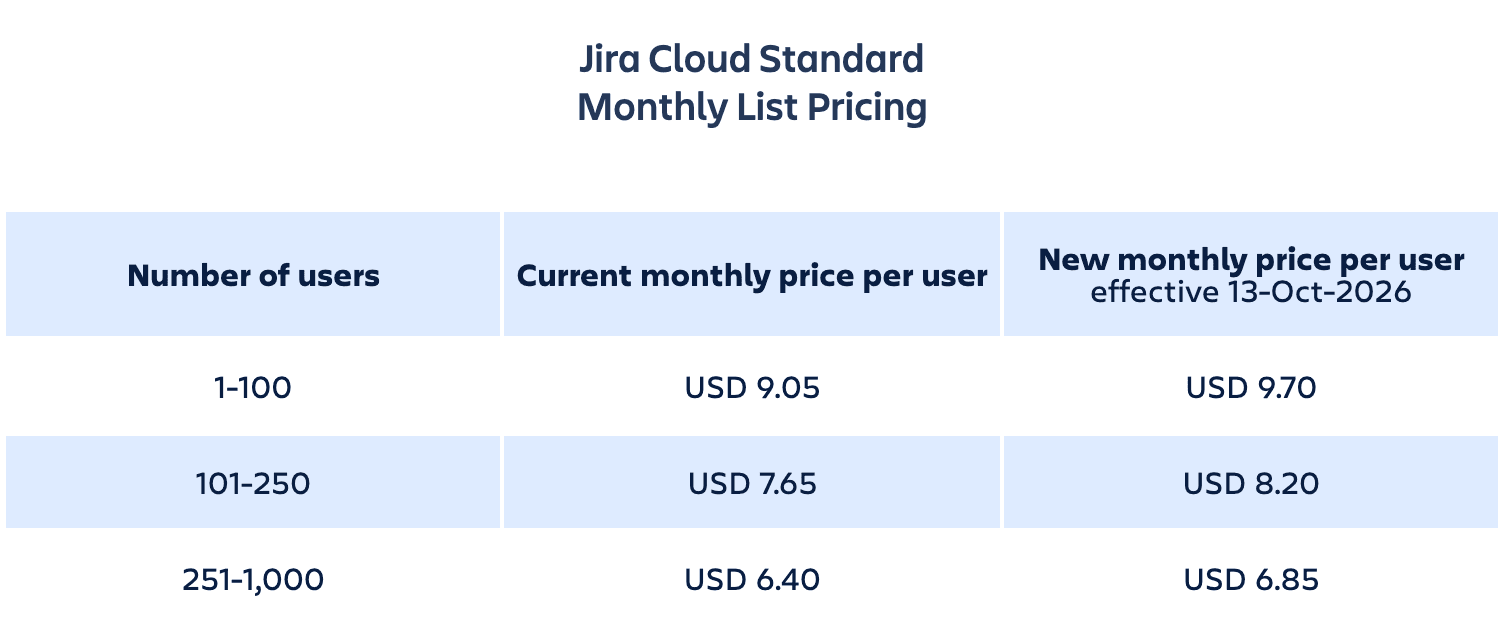
Configuration (annual tier) | Before 13 Oct | From 13 Oct | Change |
|---|---|---|---|
50 seats: Jira Standard + Confluence Standard | $7,900 | $8,450 | +7.0% |
50 seats: Teamwork Collection Standard | $7,500 | $7,500 | 0.0% |
200 seats: Jira Standard + Confluence Standard | $28,500 | $30,500 | +7.0% |
200 seats: Teamwork Collection Standard | $28,000 | $29,500 | +5.4% |
500 seats: Jira Premium + Confluence Premium | $109,000 | $117,000 | +7.3% |
500 seats: Teamwork Collection Premium | $131,500 | $141,000 | +7.2% |
Inside those totals the single products move unevenly. Jira Standard at 200 seats went from $16,500 to $18,000 (+9.1%) while Confluence Standard at 200 went from $12,000 to $12,500 (+4.2%). Jira and Confluence monthly bills at these sizes rose 6.7% to 7.2%. Service Collection's monthly per-agent price rose 7.5% at every tier these sizes use.
From the same FAQ: a quote generated before 13 October is honoured "under the prior price until the quote expires", so if you have one, check its expiry date. And annual is still the cheaper way to pay. 200 seats of Jira and Confluence Standard on monthly billing come to $3,050 a month. That's $36,600 over a year, against $30,500 on the annual tier.
Atlassian cost per user in 2027, usage included: 50, 200 and 500 seats
This is the budget. Seats are annual list prices from the new tables. Usage is the monthly overage above the pooled allowance, times twelve, at $0.01 a credit and $0.50 per 1,000 steps. Each configuration gets three usage levels per person.
Configuration | Seats a year | Light use | Routine use | Heavy use |
|---|---|---|---|---|
50: Jira Std + Confluence Std | $8,450 | $8,450 | $10,316 | $15,704 |
50: Teamwork Collection Std | $7,500 | $7,500 | $8,166 | $13,404 |
200: Jira Std + Confluence Std | $30,500 | $30,500 | $37,964 | $59,516 |
200: Teamwork Collection Std | $29,500 | $29,500 | $32,164 | $53,116 |
500: Jira Prem + Confluence Prem | $117,000 | $117,000 | $130,260 | $182,640 |
500: Teamwork Collection Prem | $141,000 | $141,000 | $141,000 | $173,040 |
Per seat at the routine level, a year:
Size | Jira + Confluence: seat + usage | Teamwork Collection: seat + usage |
|---|---|---|
50, Standard | $169.00 + $37.32 | $150.00 + $13.32 |
200, Standard | $152.50 + $37.32 | $147.50 + $13.32 |
500, Premium | $234.00 + $26.52 | $282.00 + $0 |
On Premium at the smaller sizes the collection wins on seats too: $14,500 against $16,900 at 50 (Jira Premium $9,800 plus Confluence Premium $7,100), and $58,000 against $59,000 at 200.
To redo the usage line for your own size, take seats × credits per person, subtract seats × pool per seat, and multiply by $0.01 and by 12. If the subtraction comes out negative, the line is zero. Steps work the same way at $0.0005 a step.
How I priced a Rovo user
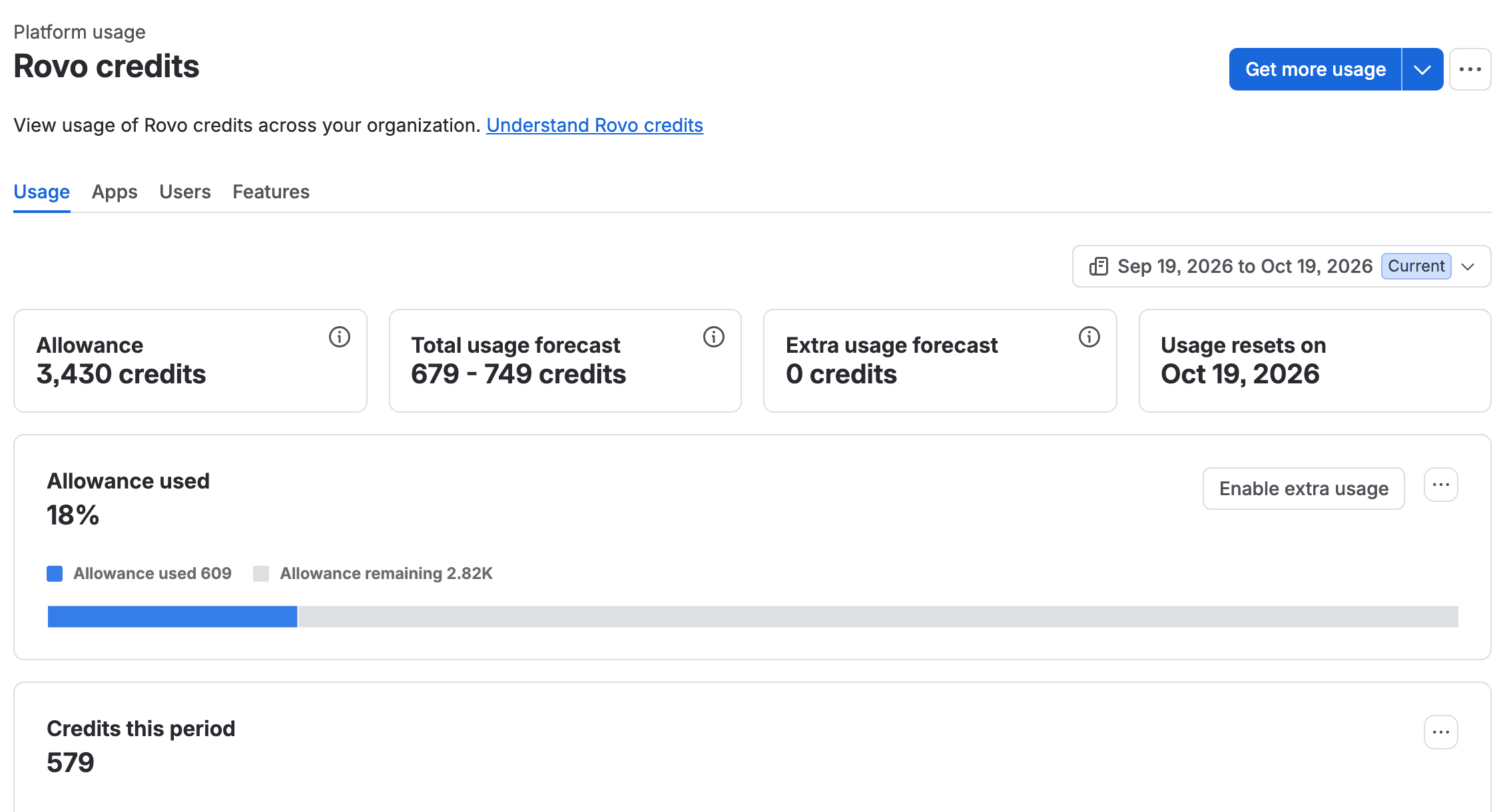
I didn't want to guess what a Rovo question costs, so I used what we measured on our own test org on 14 October. One Quick answers message cost 10 credits (the meter went from 408 to 418). Two Think deeper messages cost 65 and 86, so I used their mean, 75.5. A three-message Quick answers thread cost 30. We couldn't measure Deep research because Rovo kept saying "Deep Research is temporarily unavailable" (three tries), and agents vary by configuration, so neither is in the model. Treat the usage line as a floor. A Community user who exported their usage also found "a much bigger chunk of credits (2,000+) showing up under a category called "Jira Administration" with no clear feature label", which no profile here would predict.
From those, three people:
Profile | What one person does in a month | Rovo credits | Automation steps per seat |
|---|---|---|---|
Light | 4 Quick answers | 40 | 50 |
Routine | 1 Quick answer per working day (21) + 2 Think deeper | 361 | 300 |
Heavy | 3 Quick answers per working day + 2 Think deeper a week | 1,234 | 1,000 |
Is "routine" realistic? I think it's probably on the modest side for a team that has really adopted Rovo, since one question a day isn't much. It sits inside the lowest band Atlassian's own calculator assumes, 100 to 500 credits a person. And you can check it against your Platform usage page, which you can't do with a vendor's band.
Teamwork Collection pricing: cheaper than Jira and Confluence Standard at 50, 200 and 500 seats
This surprised me more than anything else in the tables. Atlassian's Teamwork Collection pricing page says "A Teamwork Collection subscription includes Jira, Confluence and Loom." At 200 seats the Standard collection is $29,500 a year on the annual tier. Jira Standard plus Confluence Standard for the same 200 people is $30,500. The monthly prices point the same way ($2,940 against $3,050), and so do 50 seats ($7,500 against $8,450) and 500 Standard seats ($64,000 against $64,500).
Then the allowances. Per seat, the collection carries 250 Rovo credits against 25 + 25 = 50 for the two apps, and 2,500 automation steps against 400 + 100 = 500. Atlassian's Rovo licensing page says "10x the allowances" for the collection, which is true for Rovo credits against one standalone app (250 against 25). Against Jira and Confluence together it's 5x on both meters.
So for the 200-seat routine case, the pool goes from 10,000 credits to 50,000, the overage from 62,200 credits a month to 22,200, and the year from $37,964 to $32,164. That's $5,800 a year, about 15%, for switching to a bundle that also happens to include Loom.

Before you call your partner: the same page says "Teamwork Collection Premium and Enterprise plans include Atlassian Guard Standard". The Standard collection doesn't, so at Standard the comparison is like for like. Your Marketplace apps and contract terms may make a switch messier than the list price suggests, so treat this as a list-price comparison and estimate the move yourself.
At 500 Premium seats, the collection pays above 540 credits a person, or 215 with Guard
At 500 seats on Premium the picture turns around. Jira Premium plus Confluence Premium is $117,000 a year, and Teamwork Collection Premium is $141,000, $24,000 more. In exchange the pool grows from 70,000 credits a month (140 per seat) to 350,000 (700 per seat).
When does that trade pay? On the two apps, each credit a person uses above 140 a month costs $0.01, so 500 people at x credits each cost 60x minus $8,400 a year in overage. That equals the $24,000 gap at x = 540. Below roughly 540 credits per person per month, stay on the apps; above it, the collection is cheaper. Without Guard in the picture, our routine person uses 361 (the apps win, $130,260 against $141,000) and our heavy person uses 1,234 (the collection wins, $173,040 against $182,640).
Guard changes that. Teamwork Collection Premium includes Atlassian Guard Standard, which lists at $19,500 a year for 500 users on the new tables. If you'd buy Guard anyway, the gap is $4,500 and the line drops to about 215 credits a person, which our routine user passes.
540 credits is about 54 Quick answers or 7 Think deeper messages a month per person. Your Platform usage page, Users tab, will tell you which side of that line you're on long before the renewal.
Automation steps are the smallest line
I expected this one to matter more, since several Community threads worry about it. In our model it barely registers. At $0.50 per 1,000 steps, overage shows up only in the heavy Standard cases. 200 seats at 1,000 steps each use 200,000 against a 100,000 pool, which is $50 a month. 50 seats come to $12.50.
The things that do burn steps are odd ones, and we measured some on test rules for another article. A scheduled rule that finds nothing still costs 1 step per run. Run it every 5 minutes and that's 8,640 steps a month, or $4.32 at the overage price. On our test site, two forgotten copies of a test rule from last October were 88% of October's steps so far (3,617 of 4,091). The money there is small. The risk is that a rule like that eats the pool, and with extra usage off your real rules stop until the reset. And steps aren't where the AI goes. The automation usage doc says: "Agentic components like Use Rovo, Use agent, or Use Jira Coding agent are billed separately under Rovo credits and do not consume automation steps."
AI agent resolutions are the line you can't size from headcount
If you run the Customer Service Management AI agent for your customers, this is a separate meter and it has no allowance at all. The resolutions doc says "your organization is charged $1.00 per resolution from the first successful resolution." A resolution counts only when the agent answers without handing over to a person and the system's LLM judge rates the conversation resolved, assessed, per the Service Collection licensing page, "after a conversation has been inactive for 24 hours with no reply from the customer". Escalations don't count, and neither do abandoned chats or answers a person had to finish.
Headcount tells you nothing here. Your customer volume does. 500 resolutions a month is $6,000 a year. Atlassian's calculator returned 2,000 to 8,000 resolutions a month whether we told it 50 people or 500, which would be $24,000 to $96,000 a year. I left it out of the table for that reason. If you use it, budget it as a cost per resolved conversation and compare it with what an agent's time costs you. The default cap is 25,000 resolutions a month, and annual packs knock 5% off from 12,000 a year.
What Atlassian's usage calculator leaves out (it is not a cloud pricing calculator)
Atlassian does have a usage calculator. It covers the meters only; seat prices are on each product's pricing page and in the pricing tables. We drove it in a browser for 50, 200 and 500 people, on all four meters and their profiles. It asks which meter you care about, how many people you have and a usage profile. It doesn't ask which plan you're on, so it can't compare its estimate with your allowance, and it shows no dollar figure except for resolutions. Its footer says "This estimate isn't binding for either you or Atlassian."
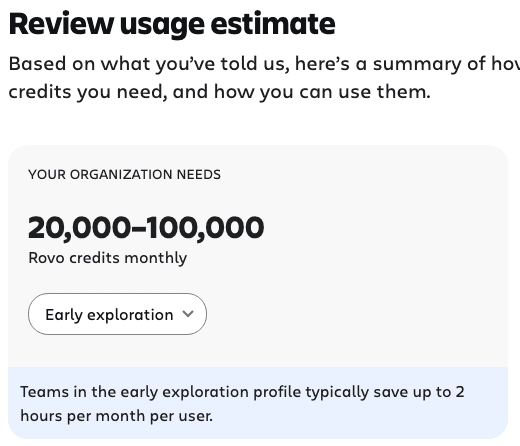
That lowest profile, which it describes as "A few Chat searches and summaries", works out at 100 to 500 credits per person per month. Jira and Confluence Standard include 25 each. So by Atlassian's own estimate, a 200-seat Standard org that is only exploring Rovo is already $100 to $900 a month over its pool. Our routine person (361 credits) sits inside that "exploring" band. Its middle profile is 500 to 2,000 credits per person.
The automation side has its own oddity. The "Experimenting" profile is labelled "1–10 steps run per seat per month" but returns 1,500 to 10,000 steps for 50 seats, which is 30 to 200 per seat. I'd use the calculator for a rough order of magnitude and your own usage pages for anything you put in a budget.
Where Atlassian's own pages disagree
Three of these matter for a budget, and on 15 October all of them were live at the same time.
Is extra usage opt-in? The usage-based pricing FAQ says "Extra usage is enabled by default", and so does the Rovo credits doc. The cloud pricing FAQ says "Extra usage billing requires opt-in. You're never charged beyond your allowance unless an billing admin explicitly enables extra usage." The Jira pricing page still says Atlassian "has committed to at least 90 days' notice and an explicit opt-in before that changes". The announcement came 93 days before 3 December. On our test org the Rovo and automation pages both showed "Enable extra usage", so it was off there. Check yours rather than trusting any one page.
When do annual customers pay overage? One billing doc says "For most customers, extra usage is billed monthly." The doc on switching to annual says "Any extra usage beyond your set allowance is aggregated annually and billed at the end of your billing cycle." The AI agent resolutions doc says annual plans get resolution charges monthly. Your usage billing date decides which invoice December's overage lands on, and it differs per org. On our test org even the meters differ (Rovo resets on the 19th, automation on the 27th), so check each one under Platform usage. If you're annual, ask your partner or Atlassian which applies to your contract. It decides whether a bad month shows up this quarter or in a lump next year.
Does Enterprise still have unlimited automation? The automation licensing page says "Enterprise plans will no longer have unlimited automation", and the automation usage doc gives Jira Enterprise 1,000 steps per user per month. The Jira pricing page says both: 1,000 steps in one FAQ and "unlimited automation" in another. On the pricing pages Enterprise starts at 801 users for Jira, Confluence and the collection, so it doesn't apply at our sizes. Near that line, I'd get the answer in writing.
The assumptions behind the budget
So you can rebuild it with your numbers:
- List prices in USD on the annual tier, from Atlassian's Cloud Pricing Tables on 15 October 2026. No partner discount, no tax, no Marketplace apps, no Atlassian Guard.
- Every user has both Jira and Confluence on the same edition. If your Confluence user count differs from Jira's, each product adds its own allowance to the pool.
- Rovo cost per action from our own measurement: 10 credits per Quick answer, 75.5 per Think deeper (mean of 65 and 86). Deep research and agents not included.
- Automation at 50, 300 and 1,000 steps per seat a month for light, routine and heavy.
- Usage is spread evenly across the 12 months and across people. Pools are org-wide, so heavy users are subsidised by light ones until the pool is gone.
Assets and AI agent resolutions are left out of the table. Jira includes 1,000 Assets objects per organization and each object over that is $0.02 a month, so 1,000 extra objects add $20 a month. Atlassian also says "Most customers won't exceed their allowance." On Standard, that's true for our light user and not for our routine one.
If you'd rather shrink the seat line itself, the cheapest seat is one nobody uses. Deactivating inactive users also lowers your pool, so do it before you size usage. We wrote about automating licence clean-up in Jira. If your organization spans several sites, our explainer on how Atlassian Cloud splits org, site and product shows what sits at the organization level, which is where the pool lives.
What I'd do before 3 December
Here's my recommendation, in order. It holds if your people use Rovo at all; if Platform usage shows almost nothing, you can stop after step 2.
- Open Platform usage this week. In Atlassian Administration go to Insights, then Platform usage. Read each meter's allowance and forecast, and note the reset date. The Users tab on Rovo credits shows who is using what.
- Decide on extra usage per meter. Turning it off "takes effect immediately", and nothing is billed past the pool. Once the pool is used up, billable Rovo chat and agent requests pause until the reset (Rovo Search and summaries keep working). Automation flows stop too, and Atlassian says events that fire while they're stopped won't be re-run when the allowance refreshes. So for automation a limit is usually safer than off. If you keep it on, set a monthly extra usage limit on that meter's page; your budget's usage line divided by twelve is a sensible start.
- Put a usage line in the 2027 budget. From our table, if most people use Rovo daily, it's about 22 to 25% of the seat cost on Jira and Confluence Standard, about 9% on Teamwork Collection Standard, and about 11% on Jira and Confluence Premium at 500 seats. Then treat it as a floor, since Deep research and agents aren't in it. If almost nobody uses Rovo, budget zero.
- Price Teamwork Collection at your renewal if you run Jira and Confluence Standard for the same people. On list prices it was cheaper at 50, 200 and 500 seats. On Premium at 500, check your credits per person against the 540 line first, or 215 if you already buy Guard.
- Look for scheduled automation that runs and does nothing, and switch it off. A rule every 5 minutes uses 8,640 steps a month. That only costs money once the pool is gone ($4.32), but it brings the day your real rules stop closer.
And if your numbers come out very different from mine, I'd love to hear where. A real 200-seat org's usage would make this model a lot better than our test org can :)
Comments
0Add a comment