
Customer Service Management pricing: Atlassian's $1 AI agent resolution, and when it pays

Key takeaways
- The $1.00 meter is the Customer Service Management AI agent's. Our Service Collection Premium plan feeds 2,800 Rovo credits, 26,000 automation steps and 50,000 Assets objects into the pools and 0 resolutions, because no plan includes any. Billing starts 3 December 2026.
- Jira Service Management's self service agent is a Rovo agent and bills Rovo credits: 15 replies across 8 chats on our site cost 150 credits, exactly 10 a reply. The older virtual service agent bills a third meter, $0.30 per assisted conversation after 1,000 a month on Premium and Enterprise.
- A plain answer from the knowledge base is billable. Atlassian's FAQ lists answering a question from the knowledge base as an autonomous action that counts, an LLM judge decides after 24 hours of customer silence, and the verdict is permanent.
- Only the CSM test panel and evaluations are free. A test in a live channel is billed for each conversation the judge calls resolved, and sandboxes don't support CSM resolutions. On our site one Test now click created a Rovo agent and app accounts on 12 sites, and a test chat raised a real request, HSD-37.
- At MetricNet's 8.6-minute handle time, $1 is cheaper than an agent's time above $6.98 an hour. What decides it is how many resolved chats would have become tickets: at $25 an hour, below about 28% the $1 costs more than it saves.
- The default limit is 25,000 resolutions a month ($25,000), after which the agent raises requests instead. Annual packs save 5% from 12,000 a year, 10% from 50,000 and 15% from 200,000, and unused resolutions expire monthly.
Phil H. was about to roll out Atlassian's Customer Service Management when the pricing notice arrived. From 3 December 2026 its AI agent bills $1.00 for each resolution, from the first one, with no allowance on any plan. So he asked the Community for other teams' numbers ("Would love to know how many 'resolution' tickets teams are getting per month from this at the moment and what size organisation you are?"), got one unsourced guess of 15% to 25%, and his team decided not to roll it out. One reason was that "any testing to get our own benchmarks would have to be done in our production environment."
He was right about the testing. The app itself costs nothing extra on Service Collection. Its AI agent is what bills.
But if your help desk runs in Jira Service Management rather than CSM, whether it serves employees or customers, you're probably not on that meter at all. We ran Jira Service Management's self service agent eight times on our Service Collection Premium test site on 17 October. It spent Rovo credits, exactly 10 per reply, and Atlassian's pages tie the $1 meter to Customer Service Management alone.
So which one are you? Does your desk run in JSM, for employees or for customers, with no CSM customer experience set up? Then your AI bill is Rovo credits (the self service agent and Request Resolver) or assisted conversations (the older virtual service agent). If you run CSM's AI agent for outside customers, the $1 resolution is yours, and the rest of this piece is mostly for you. The whole Atlassian bill at 50, 200 and 500 seats is in our usage-based pricing budget for 2027.
Six findings: the $1 meter is CSM's, and a knowledge base answer counts
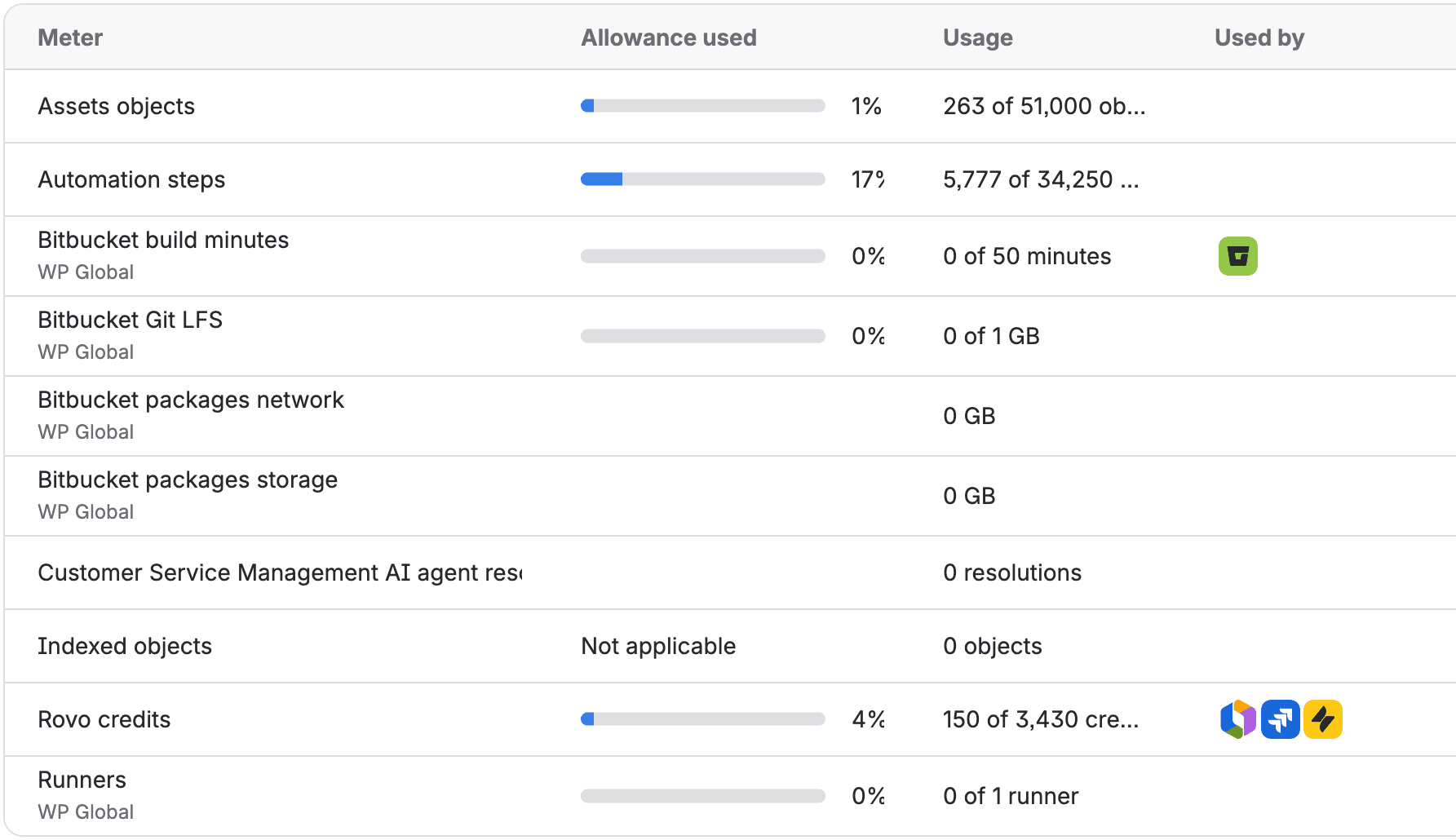
- The resolutions meter belongs to Customer Service Management. Platform usage on our org calls it "Customer Service Management AI agent resolutions", and its Contributions tab says no subscription contributes to it.
- JSM's self service agent used 10 Rovo credits per reply. Fifteen replies, 150 credits, the same 10 a Rovo Quick answers message costs.
- A knowledge base answer is billable. It's the first example of an "autonomous action" in Atlassian's own FAQ.
- An LLM judge decides once, after 24 hours of silence. Customers can't reopen a conversation, so a repeat contact can bill again.
- Testing in a live channel bills its resolutions. Sandboxes don't support CSM resolutions, so there's no safe place to rehearse a live channel.
- At an 8.6-minute ticket, $1 beats agent time from $6.98 an hour. Whether it pays depends on how many resolved chats would ever have reached a person.
Atlassian CSM vs JSM: which AI agent bills $1 per resolution
Customer Service Management (CSM) is Atlassian's app for external support, where your customers aren't employees. JSM is the one most teams run for employees' requests, though it can serve outside customers too. Atlassian calls CSM "Atlassian's AI-powered, purpose-built customer support app for external customer support within Service Collection". Service Collection bundles Jira Service Management, CSM, Assets and Rovo, and "the apps cannot be purchased separately."
A JSM shop gets near this meter through renewal. The old JSM pricing URL now redirects to the Service Collection pricing page. An Atlassian staff member wrote in May that "most JSM customers are being transitioned to Service Collection automatically during their renewal window." The pricing page says CSM is "included at no additional cost with Service Collection Standard and Premium plans". The staff article has the line I'd show a nervous admin first: "If you're not using the AI agent, nothing changes."
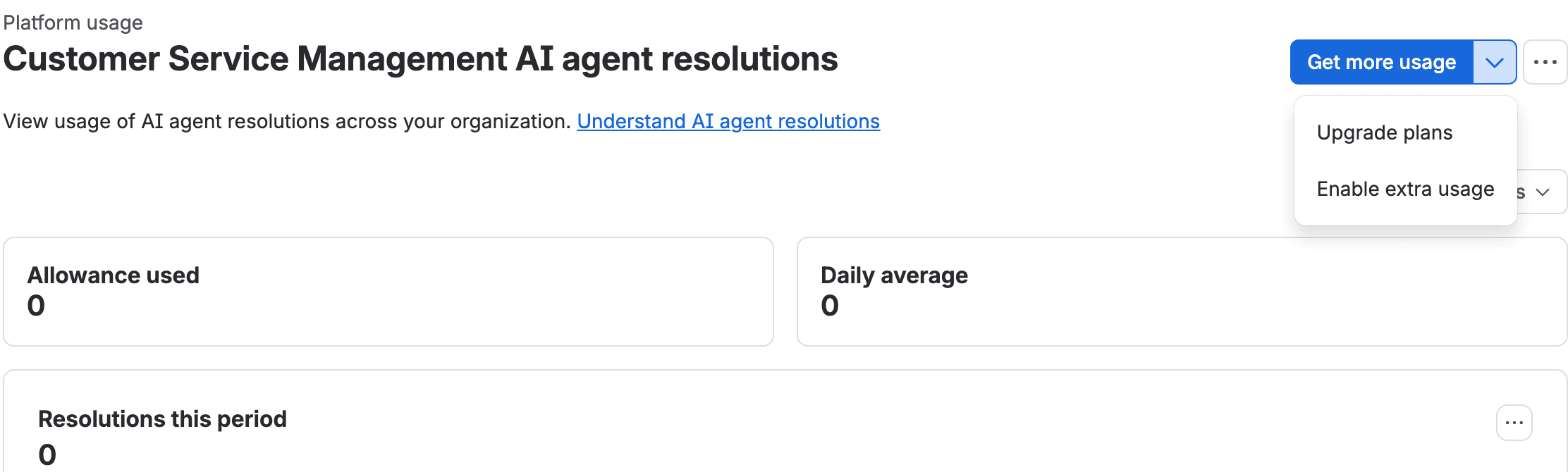
Atlassian's billing pages tie the resolutions meter to CSM. The resolutions usage doc sits under Customer Service Management, and the usage-based pricing FAQ calls it "CSM AI agent resolutions". On our org's Platform usage page it's "Customer Service Management AI agent resolutions", with no allowance bar.
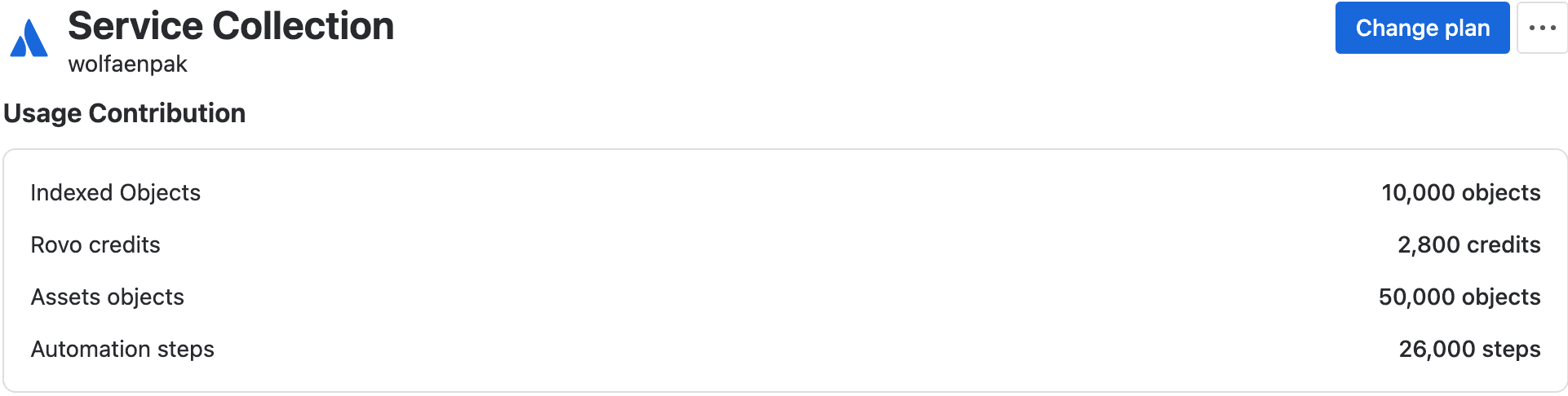
Our Service Collection Premium subscription (4 agents) lists what it puts into the shared pools: 10,000 indexed objects, 2,800 Rovo credits, 50,000 Assets objects and 26,000 automation steps. Resolutions aren't there. Get more usage on the resolutions meter opens its Contributions tab. It says "You don't have any eligible subscriptions to contribute to the allowance." The Service Collection licensing FAQ agrees: "Included allowance: None."
Jira virtual service agent pricing: $0.30 per assisted conversation after 1,000
The virtual service agent is JSM's older bot. It matches intents in Slack, Teams and the portal, and it's been metered since October 2024. Service Collection Premium and Enterprise include it with 1,000 assisted conversations a month (or 12,000 a year). Standard doesn't include it. Above that, the pricing page says they "start at $0.30(USD)/assisted conversation/month with volume discounts".
It counts differently from CSM. The pricing page defines an assisted conversation in the same words as the 2024 announcement: "any conversation that was matched to an intent, regardless of whether the virtual service agent resolves the issue or escalates it". An AI-answered chat the customer abandons counts too. So this meter bills a handover and an abandoned chat, and CSM's bills neither.
Its usage lives in Jira's own Settings, under Products, then Feature usage, says the usage limit doc. On our site the virtual service agent exists but isn't active, so this part comes from Atlassian's pages only.
JSM's self service agent used 10 Rovo credits per reply
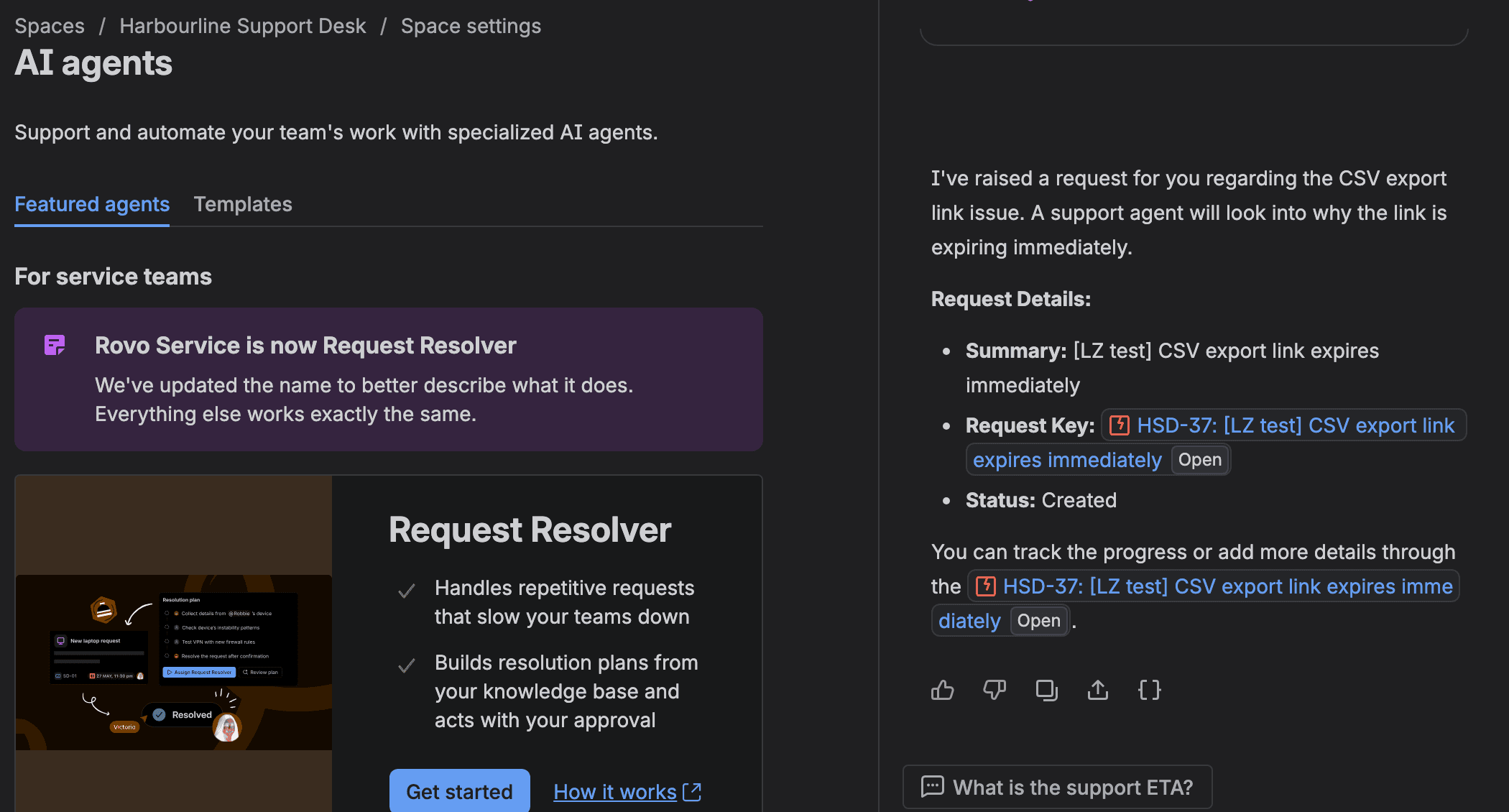
You'll probably meet the newer agent first. In a JSM space, Space settings has an AI agents page with two cards. Request Resolver is for your agents ("Rovo Service is now Request Resolver"). Self service is for the people asking for help. Self service is a Rovo agent, managed in Rovo Studio. Atlassian's doc for the help center version says "Self Service Agent is a premium AI feature that consumes Rovo credits."
We wanted to see that on the meter. Our browser test harness, logged in as Mihai, drove it on our Harbourline Support Desk test space. It ran four conversations in the test panel between 01:22 and 01:30 UTC. Then we published the agent to the portal and ran four more as a signed-in customer between 01:33 and 01:41. Three chats ended with the customer saying thanks. Two raised a request, and two reached the request form and stopped. In one the agent just couldn't answer (the space has no knowledge base).
When (UTC, 17 Oct 2026) | What we did | Agent replies | Rovo credits |
|---|---|---|---|
01:09 | before anything | 0 | 0 of 3,430 |
01:30 | after 4 test panel chats | 7 | 70 |
01:41 | after 4 portal chats | 8 more | 150 |
01:56 | 15 minutes later | none | 150 |
The org audit log counts each agent reply as an invocation, and the meter moved by exactly 10 credits per invocation in both phases. That's the 10 a Quick answers message cost when I measured Rovo credits per user, and the agent ran in Quick answers mode. Atlassian lists the self service agent as "Variable credits per billable event", so treat 10 as what we saw for short answers in Quick answers mode.
Rovo credits are pooled across the org, so I can't prove nobody else used Rovo between 01:09 and 01:41. We had nothing else running, though, and the Jira Service Management icon appeared in the Rovo credits Used by column at the same time.
What would an internal desk pay? Service Collection includes 250 Rovo credits per user a month on Standard and 700 on Premium. Say 20 agents and 1,000 employee chats a month, two replies each at 10 credits. That's 20,000 credits against a pool of 5,000 on Standard, so 15,000 over at $0.01, or $150 a month. On Premium the pool is 14,000 and the overage is $60. (Our own pool reads 3,430 because Jira Premium and Confluence Premium add 280 and 350 to Service Collection's 2,800.) Request Resolver uses the same pool, at 100 credits per resolution plan it generates. That's $1.00 at the overage price, on a different meter from CSM's.
AI agent resolutions: what counts, and why an LLM judge decides
Here's Atlassian's definition, from the About AI agent resolutions page: "A resolution is a conversation between a customer and the AI agent that is successfully completed without needing to hand off the conversation to a human agent or create a work item. The agent must provide a complete answer, and the conversation must be judged as resolved by the system's LLM (large language model) judge."
That page also lists what doesn't count. A handoff or a created work item doesn't, nor does a conversation "where the AI agent says it cannot help". Neither does a test "in the customer service agent settings". A conversation can have at most one resolution. The Service Collection licensing FAQ adds two more free cases, an abandoned conversation and a chat where the agent offers an article and the customer opens a ticket anyway.
A knowledge base answer counts as a resolution
Another member of Phil's thread asked "whether a simple informational answer—for example, retrieving and summarizing a knowledge-base article through RAG (agent) —counts as a billable resolution", and nobody in the thread answered it.
The licensing FAQ does. Under "Counts as an AI agent resolution (charged $1)" it lists "AI agent completes an autonomous action (e.g., answering a question from the knowledge base, checking order status, etc.)." So a how-to answer from your knowledge base is billable once the judge calls it resolved, even if the agent took no action. The easy FAQ traffic you'd most like the agent to take is what bills at $1 a go.
The judge waits 24 hours, and its verdict is permanent
The FAQ describes three steps. First, "a resolution is assessed after a conversation has been inactive for 24 hours with no reply from the customer." Then "Atlassian's AI automatically reviews the full interaction". Finally "each conversation is assigned a single resolution state (resolved or not resolved). This state is permanent once set."
Customers "cannot reopen a closed conversation". If they come back about the same problem, it's a new conversation, and that one can be resolved and billed as well. Atlassian says "No additional charge is applied to the original resolved conversation", so the first $1 stays billed. Intercom's Fin does it the other way round: "If the conversation is later reopened, the outcome is refunded."
Think a conversation was marked resolved by mistake? The FAQ names one route, and it isn't self-serve: "Contact Atlassian Support with the interaction details and our team will review it."
Our agent took thanks for a non-answer, twice
We couldn't watch the CSM judge work, because our org has no CSM agent. The JSM run still showed the kind of chat a judge has to read. In the test panel and again in the portal, the agent said it couldn't find an answer. Our test customer then sent a thank-you we'd written in advance, "Thanks, that fixed it.", to see what the agent would do with it, and it closed happily. In the portal it said "I'm glad to hear that clearing the cache resolved the issue" after it had said it "couldn't find any matching information".
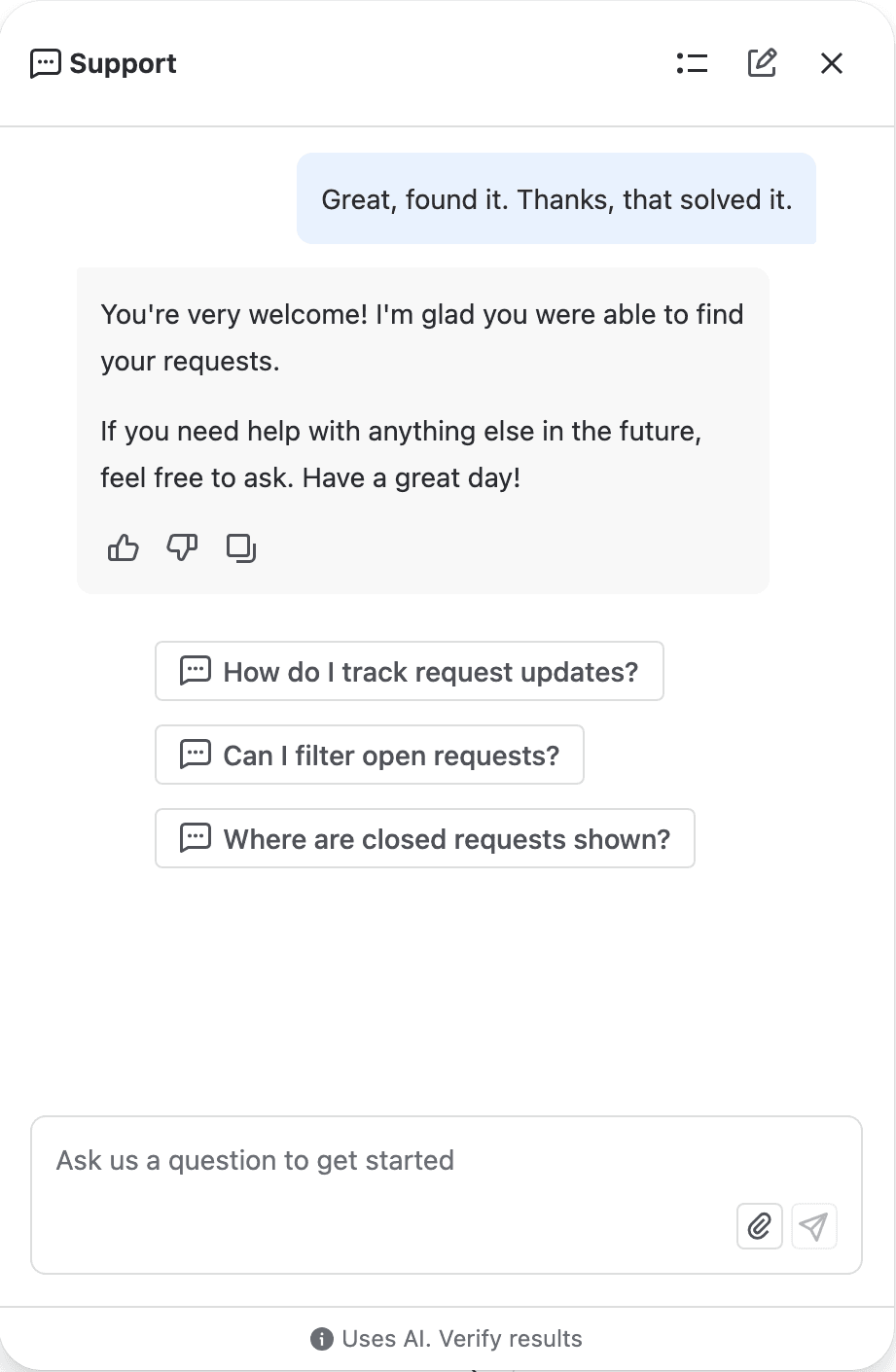
In another chat the agent answered from general knowledge about the My requests page, although its instructions said to answer only from knowledge. Our script's next line was "Great, found it. Thanks, that solved it.", and it got a cheerful goodbye.
None of these was a CSM resolution, and I don't know what Atlassian's judge would make of them. The About page asks for "a complete answer". The CSM reporting doc defines its Resolution rate chart as Relevant, Accurate, Safe and Contained. The product guide says containment and resolution rate "directly inform your AI agent resolution billing". I found no page that says the billing judge applies those same four criteria. In your first week I'd pull a few chats like these out of the review queue and read them.
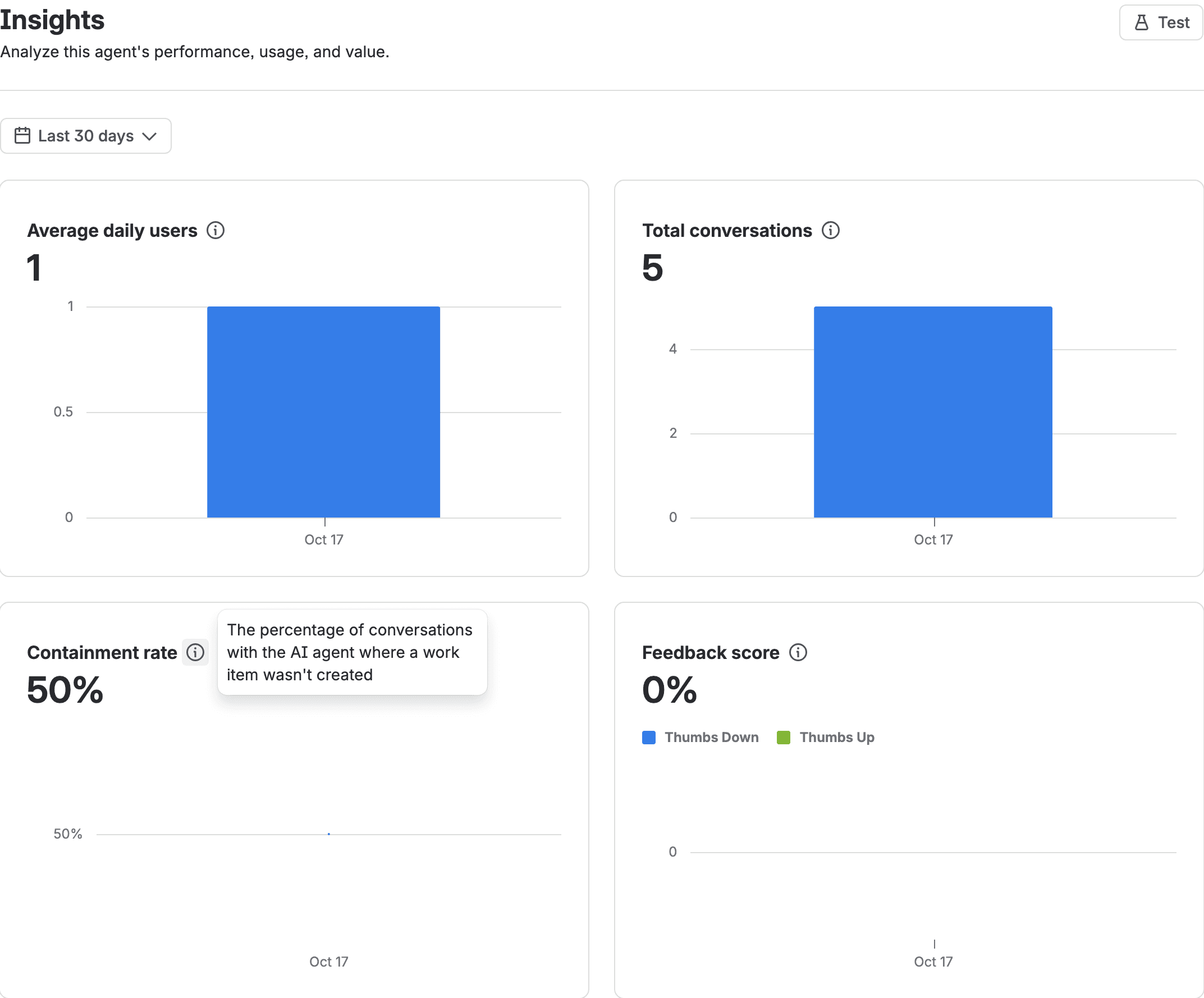
The JSM agent's Insights page has no resolution number at all. It showed Total conversations 5. Its Containment rate of 50% means "The percentage of conversations with the AI agent where a work item wasn't created." Studio's site page said 4 conversations, and the org audit log had 15 chat-started events (13 messages plus 2 Raise request clicks). With three different counts for the same 20 minutes of chats, I wouldn't read containment as a forecast of a resolution bill.
Testing the AI agent: the test panel is free, live channels are billed
For CSM, the usage doc says to test "in the test panel in the AI agent's settings". It adds, "You can also test your agent with batches of questions without being charged by running an evaluation." An evaluation takes up to 50 questions at once, and an LLM judge gives you an overall resolution rate. Atlassian suggests the same evaluation for forecasting costs.
Then the line behind Phil's objection: "Testing your AI agent in any channels will result in charges for successful resolutions." On sandboxes, the usage-based pricing FAQ says "Customer Service Management AI agent resolutions: Not applicable (sandbox environments are not currently supported)." Someone in Phil's thread suggested rolling out in a "sandbox project". A sandbox site doesn't support CSM resolutions at all, and a test project on production is a live channel, so it bills.
Free on the resolutions meter doesn't mean free everywhere, either. Our JSM test panel chats spent 70 Rovo credits, because that agent bills Rovo.
Test now on the JSM AI agents page did more than open a chat. At 01:17:26 UTC it created a Rovo agent in draft, plus an app account named after the agent. The org audit shows 2 Jira users and 12 Confluence accounts, each added to a group, on 12 of our sites. Deleting the agent later deactivated the 12 Confluence accounts.
A test panel chat also raised a real request. We asked for a human, the agent showed its request form, we clicked Raise request, and HSD-37 appeared in the live queue, status Open. If you test on production, put "[test]" in the summary and warn your agents first.
The 25,000 default limit, resolution packs and what happens at the cap
"By default, your organization starts with a limit of 25,000 resolutions per month for usage-based billing." At $1 each, $25,000 a month can go out before anything stops. The system limit is 250,000 a month.
At the limit the agent keeps talking. In Atlassian's words it "stops providing direct resolutions. Instead it will notify customers that it's raising a request on their behalf, and will automatically create a work item using your default form." The usage-based pricing FAQ adds "Human support continues uninterrupted".
Atlassian's steps for changing the limit: Administration, Insights, Platform usage, AI agent resolutions, then the More primary actions dropdown next to Get more usage, then Update extra usage limit. Our resolutions meter showed Upgrade plans and Enable extra usage in that menu instead. On Rovo, Mihai found the item reads Set extra usage limit until a limit exists, in his Rovo usage limit tutorial.
That menu is the part I couldn't settle. Atlassian's usage hub says "Extra usage is enabled by default", and the resolutions doc says you start with a 25,000 limit. Our Rovo and automation meters show Upgrade plans and Enable extra usage when extra usage is off. I found no page that says whether an org in that state gets billed for resolutions on 3 December, or whether its agent raises requests from resolution one. If you're counting on either, send Atlassian Support something like this before December:
We run the Customer Service Management AI agent. On our org, Platform usage shows the AI agent resolutions meter with the option Enable extra usage. From 3 December 2026, will successful resolutions be billed, or will the agent raise requests instead? What monthly limit applies to us today?
Resolution packs save 5% to 15%, and unused ones expire monthly
Packs are used before usage-based billing. On an annual plan "the total number of resolutions is divided equally and added to your allowance each month for 12 months". Unused ones "expire at the end of your monthly billing period". Discounts, from the usage doc's table:
Annual pack volume | Discount | Net per resolution | Per month |
|---|---|---|---|
Fewer than 12,000 | 0% | $1.00 | under 1,000 |
12,000 to 49,999 | 5% | $0.95 | 1,000 to about 4,166 |
50,000 to 199,999 | 10% | $0.90 | about 4,166 to 16,666 |
200,000 or more | 15% | $0.85 | about 16,666 and up |
A 12,000 pack costs $11,400 a year. Each monthly slice of 1,000 expires, so a month with 600 resolutions still uses up the whole 1,000. Counting at most 1,000 a month, you need 11,400 resolutions across the year just to match pay-as-you-go, and one quiet August wipes out most of the $600 discount.
Annual subscribers, note this too: "Although your subscription is billed annually, usage-based billing for resolutions is charged monthly."
When $1 per resolution pays: break-even against agent time
Atlassian's staff article gives a formula: "monthly ticket volume × AI resolution rate × $1 = estimated monthly spend." Start with the human side of it. MetricNet's benchmark, published through HDI in 2019, puts the average ticket handle time at 8.6 minutes, with "a typical password reset" at one to three minutes. At 8.6 minutes, one ticket costs more than $1 of agent time once your agent costs more than $6.98 an hour. Check that against your own handle time.
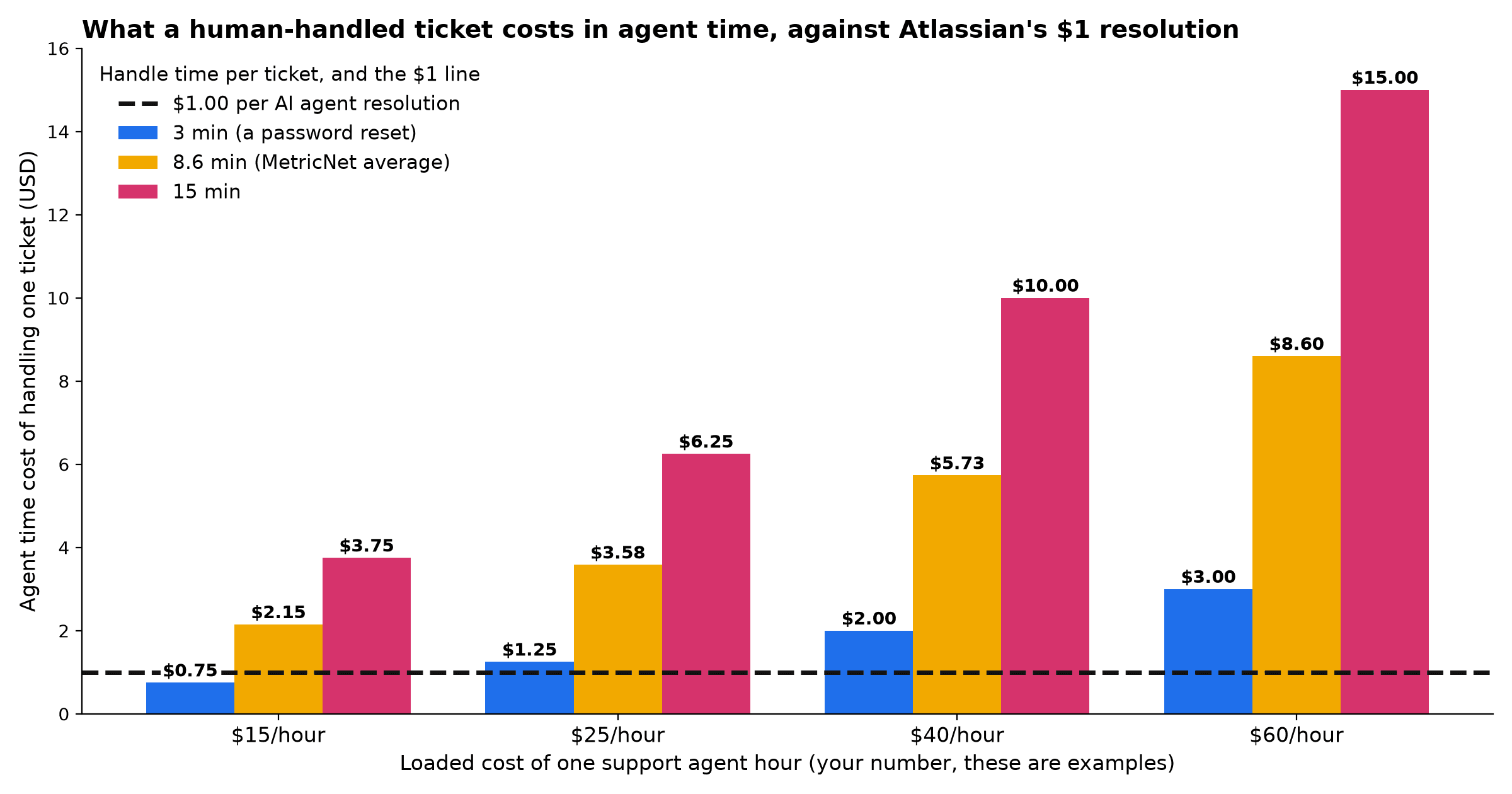
At those handle times, $1 nearly always wins per ticket. But Atlassian bills resolved conversations, and some people who chat with an agent would never have filed a ticket. A resolution saves money when it replaces work a person would have done.
Say your support website gets 3,000 AI agent conversations a month.
- Resolutions. At a 25% resolution rate that's 750, so $750 a month. (The 15% to 25% is that unsourced guess from Phil's thread. Atlassian says its own production use reached "a 45% resolution rate", without saying over what base. Your evaluation result is the number to use.)
- What a replaced ticket would have cost. At 8.6 minutes and a loaded $25 an hour, $3.58.
- If all 750 resolutions replaced a ticket, you'd save 107.5 agent hours, about $2,687 a month.
- If a third of them would have become tickets, you save 250 tickets, about 36 hours and $896, and you're $146 ahead.
- The break-even share is $1 divided by $3.58, about 28%. Below that, the $1 costs more than it saves.
Your own data can give you that share. Compare ticket volume in the month before the agent went live with the month after. If tickets fell by 300 while the meter counted 750 resolutions, 40% of resolutions replaced a ticket. Run an evaluation first (it's free) to get a resolution rate on your real questions, then watch the meter and the queue side by side for a month.
For comparison, other vendors' prices from their own pricing pages, read on 17 October:
Vendor | Unit | Price | Notes |
|---|---|---|---|
Atlassian CSM | resolution | $1.00, packs to $0.85 | no allowance; first $1 stays billed on a repeat contact |
Intercom Fin | outcome | $0.99 | refunded if the conversation is reopened |
Zendesk Suite | automated resolution | $2.00 pay as you go, $1.50 committed | 5 to 15 included per agent a month, up to 10,000 a year; contained and escalated tiers don't count |
Freshworks Freddy | session | $49 per 100 sessions | 500 sessions free once per account |
Atlassian's $1 is at the cheap end of that table. Unlike Intercom it doesn't refund a reopened conversation, and it doesn't say whether the billing judge uses its reporting criteria.
We couldn't make the $1 meter move
Our org has the CSM role and its Customers page, but no CSM customer experience, so there's no CSM AI agent to talk to. Setting one up is project-level work, and we didn't want a half-built support site in our test org. We also read the resolutions meter 15 minutes after the last chat, and Atlassian only judges a conversation after 24 hours of silence, so its 0 proves nothing by itself. The evidence that JSM's self service agent sits elsewhere is Atlassian's own "consumes Rovo credits" line and the Rovo meter moving within minutes.
We also couldn't answer whether email replies can ever bill. An email always creates a work item, which is a no-charge condition, yet the FAQ calls resolutions "Channel-agnostic". And does the "Send customer next steps" handoff count as a handoff? None of the Atlassian pages I read says.
After the run we deleted the agent, deleted HSD-37 and HSD-38, and checked that the portal had no widget left. We bought nothing and switched on no extra usage.
What I'd do before 3 December
That's about six weeks away. Running your desk in Jira Service Management, with no CSM customer experience? Check your Rovo pool and the virtual service agent's Feature usage instead. Those are what your agents spend.
If you do run the CSM AI agent for customers, I'd go in this order:
- Run an evaluation of 50 real questions from last month's tickets. It's free, and it gives you a resolution rate for the maths above.
- Set the monthly limit to a number your finance person has agreed, instead of keeping the 25,000 default. At 3,000 conversations and 25%, a 1,000 limit leaves room for a busy month.
- Ask Atlassian how your org behaves on 3 December if the meter's menu says Enable extra usage, as ours does.
- Keep testing in the test panel. If a live channel test is unavoidable, warn the team that real requests will appear.
- Hold off on an annual pack until you've seen two months of the meter, since unused resolutions expire monthly.
And Phil, if you're reading: you were right that there's no safe place to rehearse a live channel. The evaluation is the closest thing to a free benchmark, and I'd start there.
Comments
0Add a comment