
Rovo credits cost: we got Think deeper wrong, and Rovo picks the price

9 min readOctober 27, 2026
Key takeaways
- Our 15 Oct article put Think deeper at 65 to 86 credits from two runs. A usage export we pulled five days later had four single Rovo Chat messages at 203, 238, 268 and 310 credits. The export has no mode column, so we can't say which mode those four used.
- On 27 October we sent 21 more messages on our test org, one at a time. Think deeper cost between 10 and 182 credits, and the identical prompt cost 12, 49, 65 and 134 on four runs.
- In Think deeper, runs where Rovo read nothing from the site cost 10 to 26. Runs where we saw it read Jira or Confluence cost 57 to 182. A prompt asking for 1,500 words cost 15 and 16.
- The same 469-item Jira question cost 106, 141 and 182 on Think deeper and 11 on Let Rovo decide. Both answers found the same six themes and the same 166 overdue items.
- From 3 December a credit is $0.01, so 310 credits is $3.10, or more than twelve months of a Jira Standard seat's 25. Admins see one Rovo Chat line and no mode, and can't cap a person yet.
Two weeks ago we told you a Think deeper message in Rovo costs 65 to 86 credits. That was wrong. We measured two runs on one evening and wrote the range up as if it meant something. When we exported our org's usage five days later, it had single chat messages at 203, 238, 268 and 310 credits, and nobody went back to check the article against it.
Then an admin at another company told us they're seeing single calls above 300. So on 27 October we went back to our test org (a pool of 3,920 credits this period) and sent 21 more messages, one at a time, reading the meter after each. They cost 1,285 credits. Think deeper came in anywhere between 10 and 182. The same prompt, word for word, cost 12 on one run and 134 on another.
It's a small sample on a small org, and I'll say where it runs out. If you put our 65 to 86 into a budget, take it out. The original article stays up as it was.
What our usage export says
Atlassian Administration will email you a CSV with one row per billable Rovo event (Gabriela walked through the export in how to check Rovo credits usage for each user). Ours was exported on 20 October 2026 at 21:46 UTC and has eleven columns: Usage Id, Usage Count, Date, Org ID, Site ID, Site Name, App, Actor ID, Feature, Agent, Feature Status. There's no column for the mode.
It has 19 Rovo Chat rows between 8 September and 20 October. Sorted by credits: 10 eleven times, then 65, 77, 78, 86, 203, 238, 268, 310.
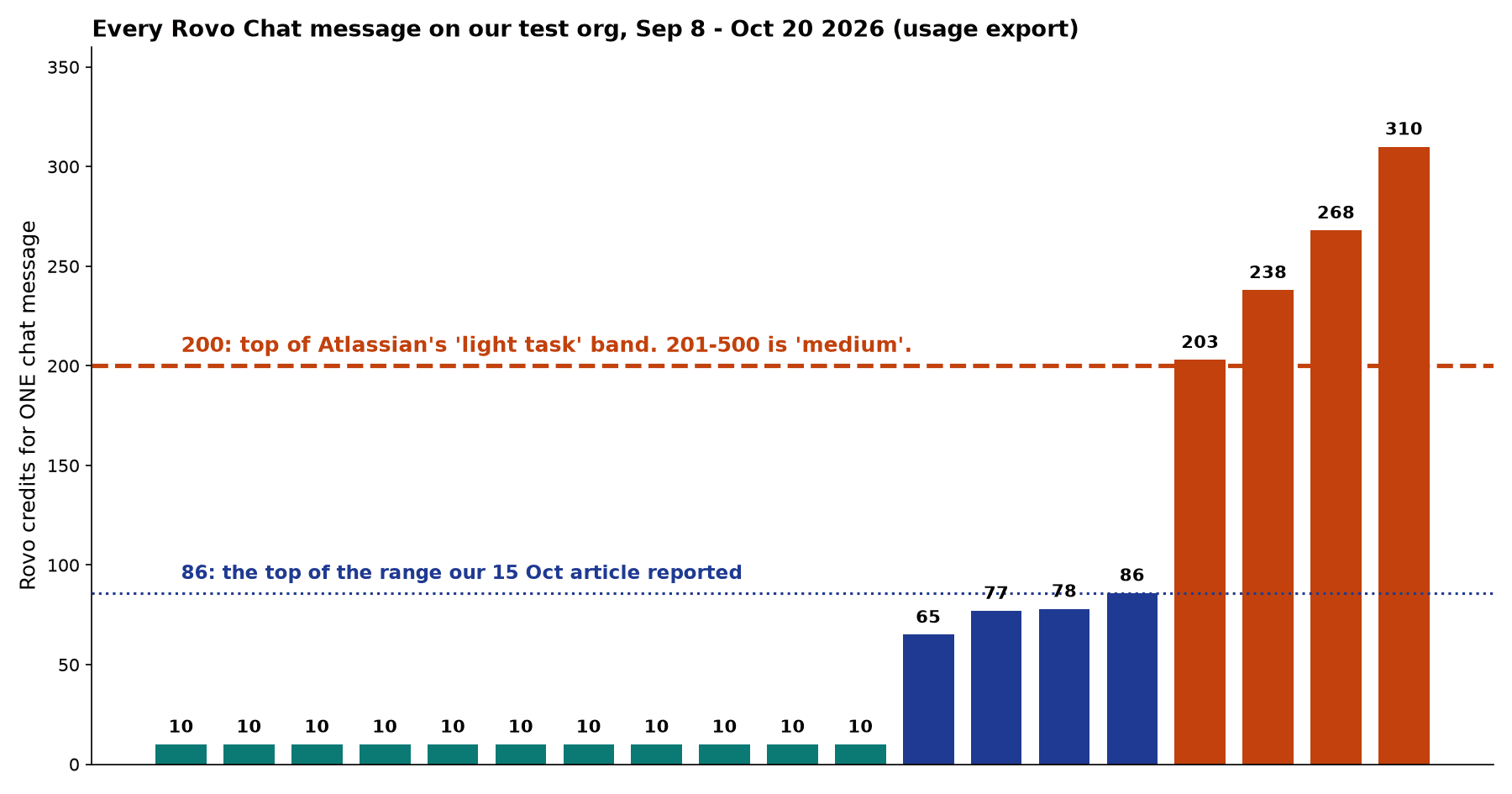
Three of the big ones came within twelve minutes of each other on the morning of 11 September (310, 268, 238). On 14 October at 07:56 UTC came the 203, the same day we measured. That evening also had two messages at 77 and 78 that never made our table. I don't know what those prompts were. Nobody wrote them down, and I'm not going to guess.
We picked two cheap runs and didn't look at our own data afterwards. That's on me.
Rovo credits per prompt: the same prompt cost 12, 49, 65 and 134
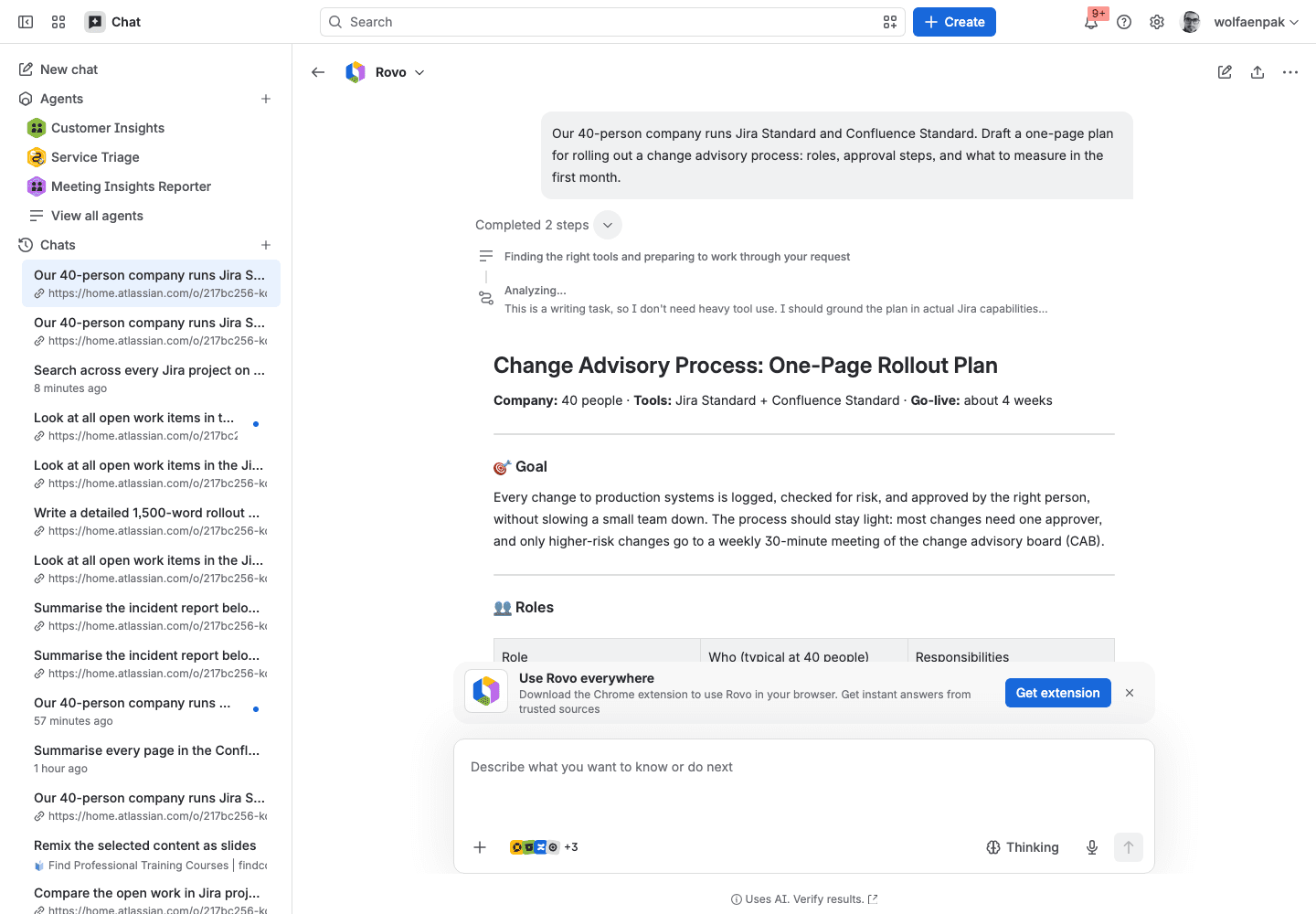
We started by repeating our own 15 October prompt, the one that cost 86: "Our 40-person company runs Jira Standard and Confluence Standard. Draft a one-page plan for rolling out a change advisory process: roles, approval steps, and what to measure in the first month."
We forced Think deeper from the mode menu on each run. Four runs: 134, 49, 65, 12.
Look at the 12. Rovo's step panel on that run says "This is a writing task, so I don't need heavy tool use", and it finished in 2 steps. On the 65 run it ran a Teamwork Graph search first. For the 134 and the 49 we didn't capture the steps, so I can't tell you what Rovo did on those.
What moves Think deeper credits from 10 to 182
Here are the 21 messages, all on our wolfaenpak test org. The meter never moved between messages, so nothing else was spending, and each message's full charge was already there at the first read, 21 to 22 seconds after the answer.
What we asked | Mode | Read site data? | Credits |
|---|---|---|---|
Change advisory plan, four runs | Think deeper | not captured, not captured, Teamwork Graph search, no | 134, 49, 65, 12 |
Same plan as a thread, follow-ups 2 to 4 | Think deeper | no | 44, 29, 26 |
Summarise a 100-word incident report | Think deeper | no | 10 |
Summarise a 2,000-word incident report, twice | Think deeper | no | 23, 26 |
Write a 1,500-word rollout plan, twice | Think deeper | no | 16, 15 |
Summarise every page in a 13-page Confluence space, twice | Think deeper | yes | 57, 80 |
Group all 469 open items in a Jira project, three times | Think deeper | yes | 106, 182, 141 |
Follow-ups on that Jira thread | Think deeper | yes | 86, 79 |
Find payment and login failures across every Jira project | Think deeper | yes | 94 |
The 469-item Jira question again | Let Rovo decide | yes | 11 |
In Think deeper, every run we could inspect fits one rule: the price followed whether Rovo went off to read Jira or Confluence. Runs where it read nothing cost 10 to 26 as fresh messages. Runs where we saw it read site data cost 57 to 182.
I thought length would drive it. Pasting 2,000 words instead of 100 added about 15 credits. Asking for a 1,500-word plan got answers of about 2,000 words for 15 and 16 credits.
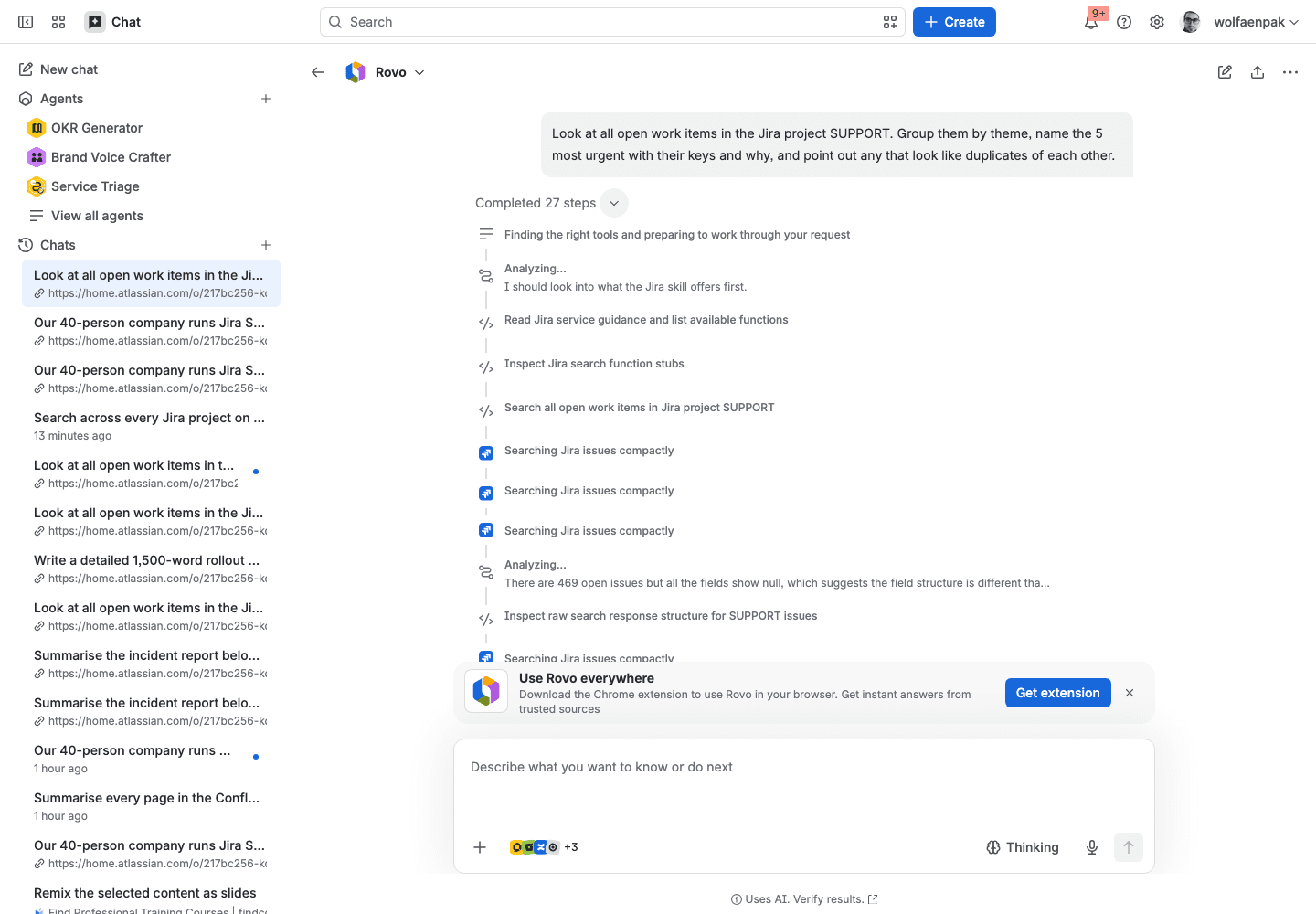
Steps aren't the meter either. The run with 75 steps cost 79, the one with 54 cost 94, and the one with 27 cost 182. On the 182 run Rovo did 5 Jira searches over 469 open items and named 33 of them in its answer. My guess is the charge follows how much text goes through the model while it reasons, retrieved data included. I can't prove it, and Atlassian doesn't publish a formula.
Our plain thread went 49, 44, 29, 26, and the Jira thread went 141, 86, 79, so later messages didn't get dearer. Follow-ups did cost a bit more than a fresh short prompt (26 to 44 against 10 to 16), which would fit a small charge for the context the thread carries. Three data points, so treat it as a hint.
Then the row that annoyed me most. On Let Rovo decide, the 469-item question cost 11 credits. That answer says it reviewed all 469 items, found the same six themes, counted the same 166 overdue items and named 26 work items. Its step panel says Completed 24 steps. On Think deeper the same question cost 106, 141 and 182. The work looked the same from where I sat. It's one run, so I won't call it a rule, but on that question the mode label was the difference between 11 and 182.
Rovo credits pricing: Atlassian's own bands already allowed 300
Atlassian's pages allowed for all of this. We misread them.
The How Rovo credits work page lists Think deeper under "Variable credits per billable event" and names four things that move the number: "Reasoning steps", "Search volume", "Tools invoked" and "Model power". It also says Think deeper "dynamically plans, searches, reasons, and iterates to return a thorough answer, with built-in quality validation that automatically retries if it doesn't meet the quality bar." Atlassian's usage pricing page adds "the output generated", which our long-answer runs didn't bear out.
That support page also links an image called "Rovo Credits: Task Types". Light tasks are "Estimated Rovo Credits 10-200". Medium tasks are "201-500". Heavy tasks are "500+". The Wayback Machine's capture of 14 September doesn't have the image, and its capture of 17 September does. We quoted those bands in the first article and also wrote that Atlassian "publishes no number" for Think deeper. The second statement was wrong, and I should have caught it.
So our 310 sits in Atlassian's own medium band, and a 300-plus call like the one we were told about is at least medium. The card has a heavy band above 500.
Rovo "will activate think deeper mode automatically if it detects a multi-layered or open-ended prompt", says the reasoning modes page. Your users don't have to pick the expensive mode to get it. And Rovo shows no estimate before you send. ROVO-866, "Show estimated credit cost before submitting a prompt", had 6 votes on 27 October, and its description still quotes June's flat 10 and 100.
Why this hurts on 3 December
From 3 December, extra usage is billed at "$0.01 per Rovo credit, or $10 per 1,000 credits", and "extra usage is on (by default)". A Jira Standard seat gets 25 credits a month. So our 182-credit Jira question is more than seven seat-months, and the 310 is twelve, or $3.10.
Your pool is shared, and you can't cap a person yet. The support page says "Coming soon: you'll be able to allocate Rovo credits by user", with no date. On ROVO-1224 a customer wrote on 26 October that one user spent 101,000 of their org's 196,000 credits in a month, and added: "Hearing there is no timeline for said feature feels nothing more like a cash grab." The broader request, ROVO-532, had 57 votes.
You can't switch Think deeper off for Chat either. ROVO-1302 asks for control over the automatic switch (2 votes), and ROVO-1317 asks for an admin setting for the default mode (12 votes). And a usage limit won't stop an expensive message halfway: when a limit is hit, Atlassian says work already running completes and only new credit-consuming requests pause.
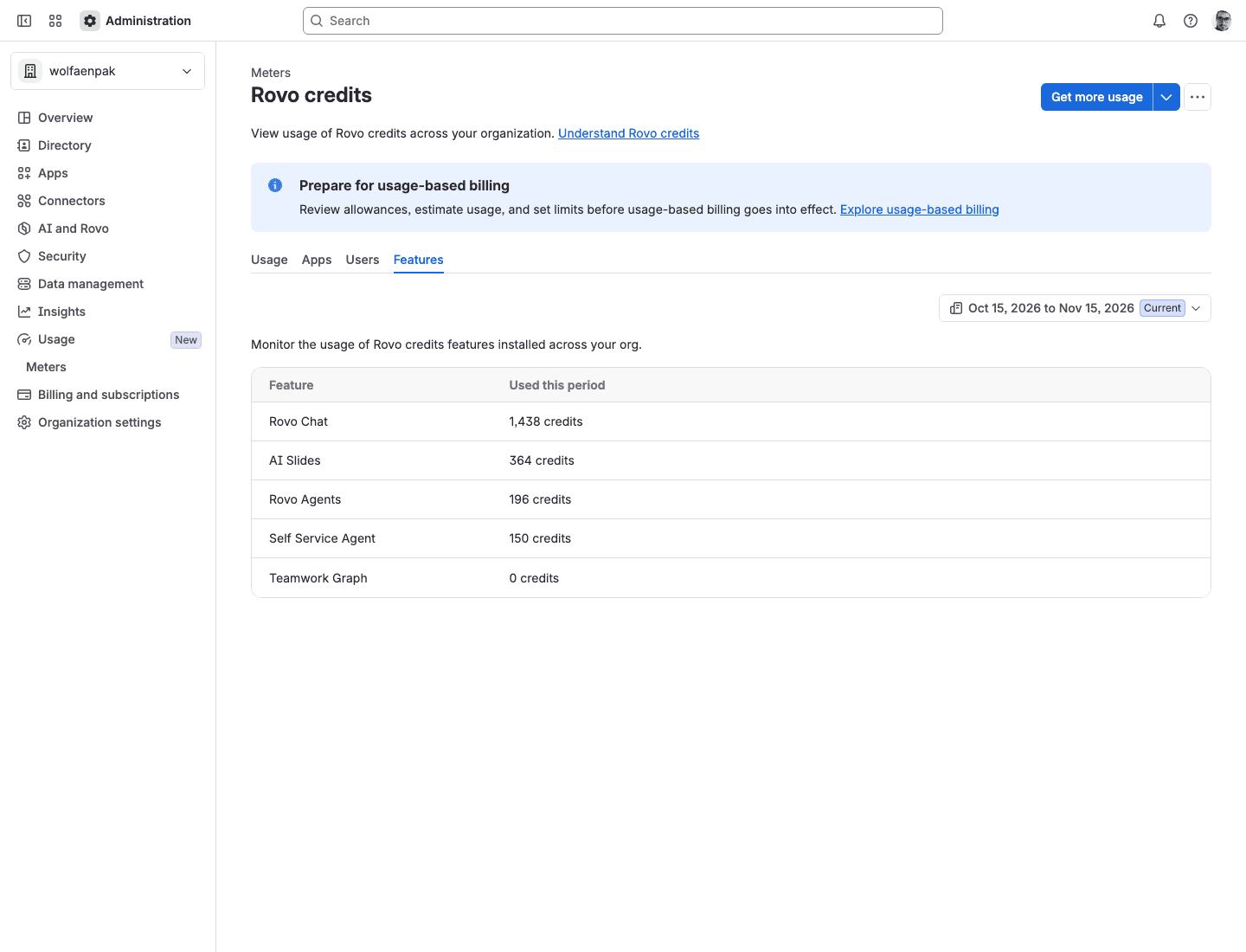
Afterwards you can't see which messages were the expensive kind. Our Features tab for the billing period that started 15 October, test included, shows "Rovo Chat 1,438 credits", every mode on one line. That's a different window from the export's 1,435, so the near match is a coincidence. The Teamwork Graph line stayed at 0 even though Rovo ran Teamwork Graph searches inside our chats.
No quote before you send, no mode in the export, no cap per person. I can't budget that, and I doubt you can.

What I'd do as an admin this week
- Export your CSV now and sort the Rovo Chat rows by Usage Count. If your top rows are in the hundreds, that's your real per-message price. The export walkthrough shows where the button is, and the emailed link expires after 24 hours.
- Tell people which questions cost money. Asking Rovo to read a project or a space ("look at all open items", "summarise every page") was our expensive class. Writing and rewriting stayed cheap even in Think deeper.
- Try Let Rovo decide on the big read-everything questions before Think deeper. In our one run on the 469-item question it found the same themes and overdue count for 11 credits. One run proves little, but it's a cheap thing to test on your own org.
- Set a usage limit before 3 December, or decide not to on purpose. The usage limit walkthrough covers both settings.
- Re-check any budget built on a fixed Think deeper price. Ours modelled it at 75.5 credits in the usage-based pricing budget, which is too low for data questions.
Some of this we couldn't test. Deep Research has disappeared from the mode menu on our org, and the chat composer has no agent or model picker, so nothing here covers either. Our biggest Jira project has 469 open items and our biggest Confluence space has 13 pages. Yours are probably bigger, and my guess is that's how people get past 300.
What's the most expensive single Rovo message in your export? If you've got one above 310, I'd like to know what the question was.
Comments
0Add a comment