
Teamwork Collection pricing vs Jira, Confluence and Loom: cost at 50, 200 and 500 seats

13 min readOctober 30, 2026
Key takeaways
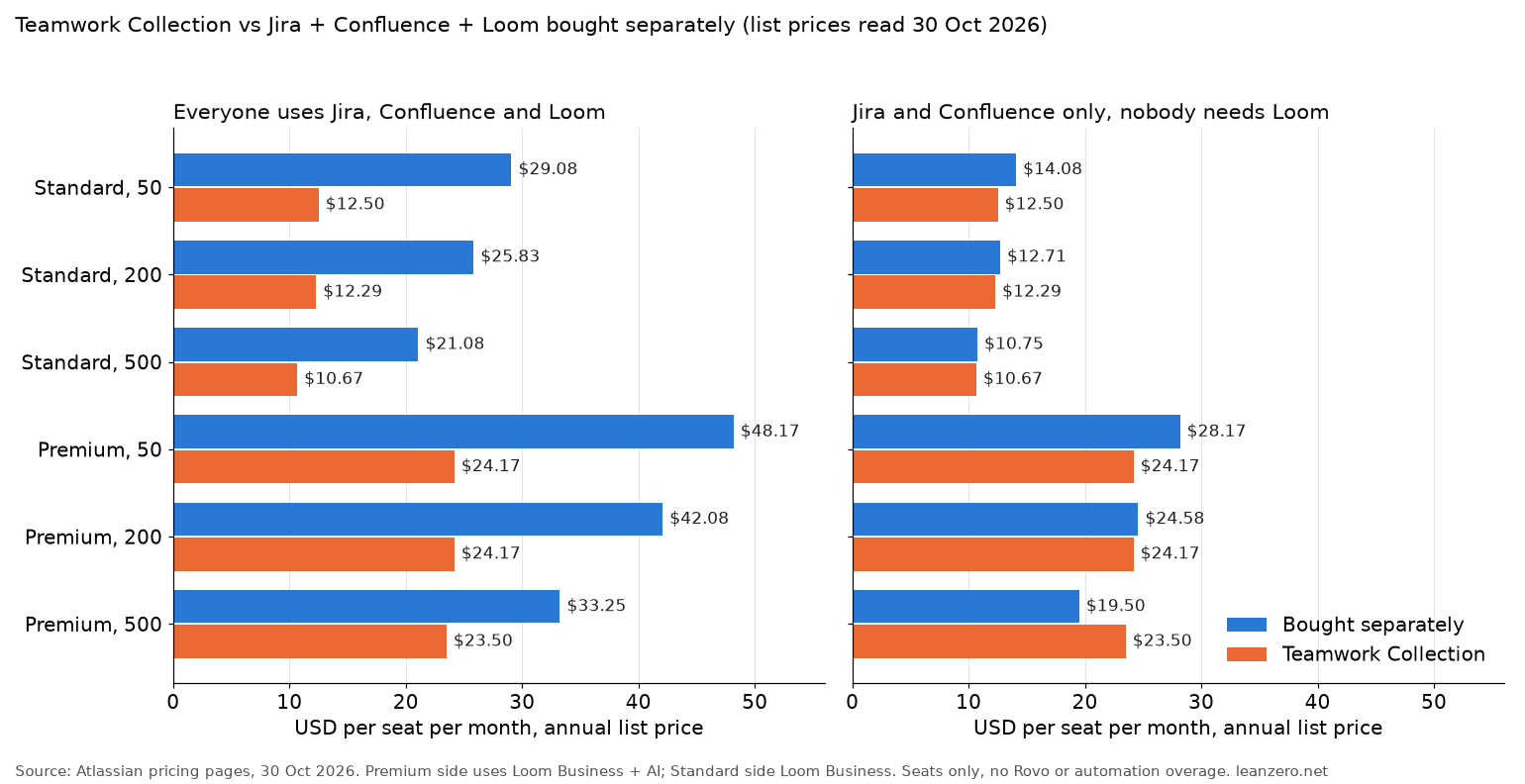
- If everyone uses all three apps, Teamwork Collection Standard costs $12.29 per seat per month at 200 users on annual billing, against $25.83 for the three apps bought separately. Premium is $24.17 against $42.08. Atlassian list prices, 30 October 2026.
- Without Loom the gap nearly closes. Standard at 200 seats is $29,500 a year for the collection against $30,500 for Jira plus Confluence, and on Premium at 500 seats the collection costs $24,000 a year more ($141,000 against $117,000).
- The collection bills every user who can open any one of its apps, and you can't buy Jira-only seats beside it. On monthly billing, 30 Jira-only contractors in a 200-person Standard company cost about $2,232 a year more as collection users than as Jira users. On annual billing they add $0 to the collection bill while you stay inside the 101-200 tier, and the bill jumps by $12,500 the moment user 201 arrives.
- With no Loom need, the collection only pays on annual Standard once at least 51% of your Jira users also use Confluence at 50 or 200 seats, and 81% at 500. On annual Premium at 500 seats it never pays on licences alone.
- The collection's allowances are five times what Jira plus Confluence give together: Standard gives 250 Rovo credits and 2,500 automation steps per user per month, against 50 credits and 500 steps. That matters from 3 December 2026, when extra usage is billed at $0.01 a credit and $0.50 per 1,000 steps.
- Loom's annual plans are sold in user tiers, so 120 users and 200 users both pay $31,500 a year. Giving Loom to only 60% of a 200-person company saves nothing on annual billing.
Someone on the Atlassian Community asked a question in a thread that's now been read 2,299 times. Their company wanted Teamwork Collection. They also had freelancers who "should have access to Jira but should not have access to Confluence or Loom". So could they just book a few extra Jira licences for them? After the answers came in, they summed it up themselves: "Using the Teamwork Collection will result in paying for the whole collection, even if they only have access to one of the apps."
It's a fair question for anyone weighing the collection, and the calculator doesn't answer it. On Atlassian's list prices, 200 people on Standard pay $12.29 a seat per month for the collection on annual billing and $25.83 for the three apps bought separately, as long as all of them use all three. To see what happens when they don't, we took Atlassian's own list prices as they were on 30 October 2026, after the 13 October increase. Then we worked out the cost per seat per month both ways for 50, 200 and 500 users. We did it on Standard and on Premium, with and without Loom. Then we added the usage meters that start being billed on 3 December (Rovo credits and automation steps).
If everyone in your company really uses all three apps, I think the collection is an easy yes: about half the cost per seat on Standard, and 29% to 50% less on Premium. Take Loom out and it's close to a tie on Standard. On Premium above 200 seats the collection costs more. If you mostly want Jira, it's an expensive way to get it.
This is for whoever has to put a number in next year's budget: an IT manager, an Atlassian product owner, someone in finance. The prices come from Atlassian's pages, read on 30 October, and the assumptions sit at the end so you can swap in your own. Our 2027 usage-based pricing budget for 50, 200 and 500 seats compared the collection with Jira plus Confluence. It left out Loom, users who only need one app, and the billing rules that decide whether the collection is cheap for you in particular.
What we found: Loom decides whether Teamwork Collection is cheaper
- With all three apps for everyone, the collection is 49% to 57% cheaper per seat on Standard and 29% to 50% cheaper on Premium, across 50, 200 and 500 users.
- Loom is what makes the collection cheap. Without it, Standard saves $500 to $1,000 a year at our three sizes, and Premium costs $24,000 a year more at 500 seats.
- The collection charges a full seat for anyone who can open any one of its apps. Jira-only people can't be carved out, editions can't be mixed, and an app can't be swapped out.
- Partial adoption saves less than you'd think on annual billing, because the apps are priced in user tiers.
- The collection's Rovo credit and automation step allowances are five times what Jira and Confluence give together. Whether that's worth money depends on usage nobody can measure for you yet.
- Atlassian's own pages disagree on two details (whether standalone Loom adds Rovo credits, and whether the Standard collection includes Rovo agents). We show both.
Teamwork Collection pricing vs Jira, Confluence and Loom bought separately: about half on Standard
Teamwork Collection is Atlassian's bundle of Jira, Confluence and Loom. It also brings Rovo, Atlassian's AI assistant, and the platform apps (Home, Goals, Teams, Studio, Search, Chat, Insights and Admin, as the pricing page lists them). The Teamwork Collection pricing page says you'll "pay a single price for the entire collection". You won't pay separately for the products inside it.
To compare it with buying the apps one by one, you have to decide which Loom plan the collection stands in for, and Atlassian doesn't say. We matched Standard with Loom Business and Premium with Loom Business + AI. Our reason is the Rovo credits table, which pairs "Loom Business plan" with Standard's 25 credits and "Loom Business + AI plan" with Premium's 70. The collection page also mentions Loom AI only from Premium up. If your company would buy plain Loom Business even on Premium, the separate column gets cheaper.
On annual billing, licences only, with all three apps for each user, it looks like this:
Seats | Standard: separate | Standard: collection | Premium: separate | Premium: collection |
|---|---|---|---|---|
50 | $17,450 a year ($29.08/seat/mo) | $7,500 ($12.50) | $28,900 ($48.17) | $14,500 ($24.17) |
200 | $62,000 ($25.83) | $29,500 ($12.29) | $101,000 ($42.08) | $58,000 ($24.17) |
500 | $126,500 ($21.08) | $64,000 ($10.67) | $199,500 ($33.25) | $141,000 ($23.50) |
The separate column adds up three list prices. At 200 users on Standard that's Jira at $18,000, Confluence at $12,500 and Loom Business at $31,500. Loom is the biggest line, $31,500 of the $62,000.
Atlassian Teamwork Collection cost per user on monthly Standard billing drops from $15.00 to $12.77
Atlassian's calculator shows monthly prices by default. At 200 users and monthly billing it shows $14.70 per user for the Standard collection and $29 for Premium.
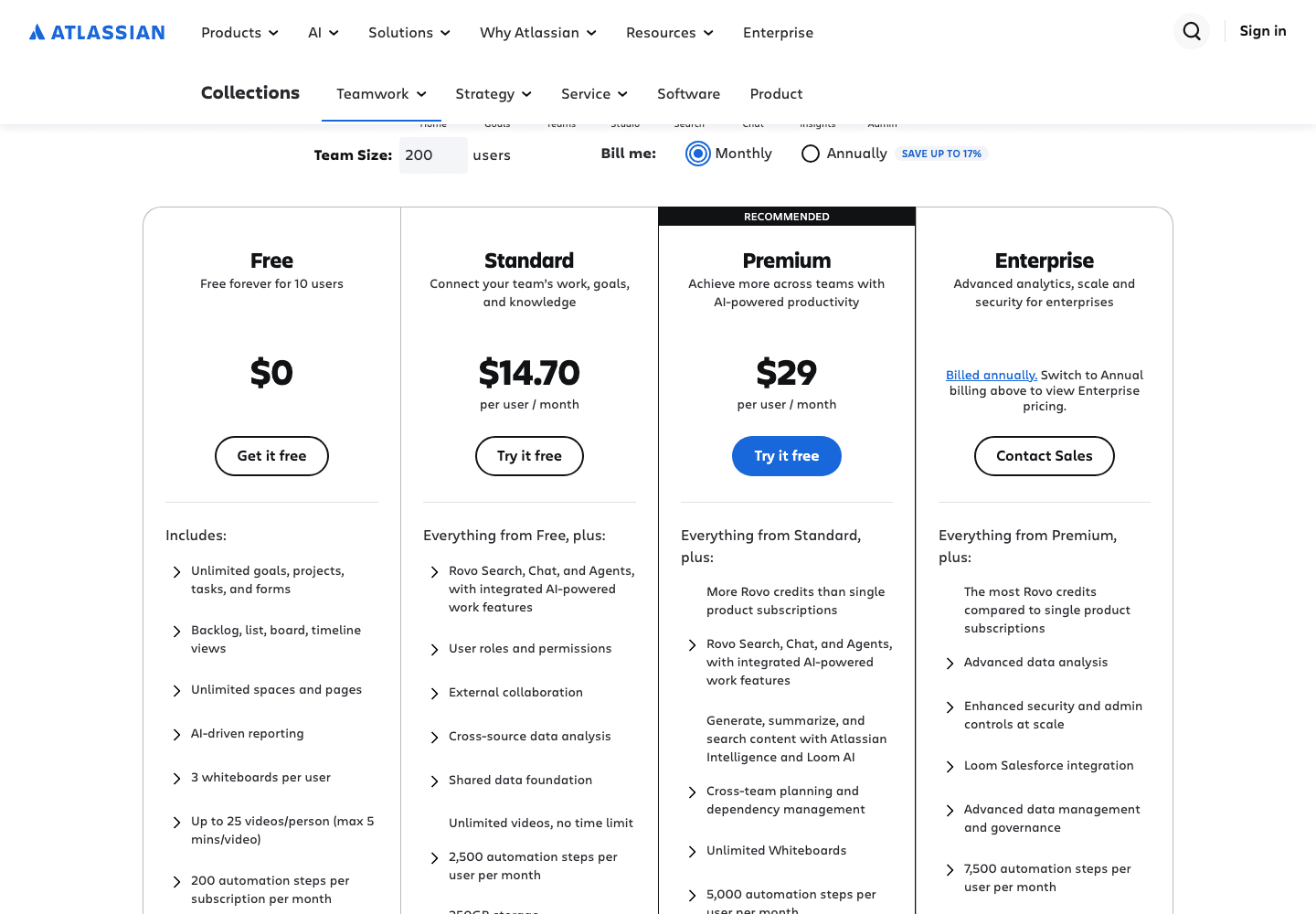
Monthly billing on Atlassian Cloud is graduated: the first 100 users pay one rate, the next band of users a lower one, and so on. Annual billing is a flat price for the user tier you fall into. So the same 200 people cost $14.70 a seat a month on monthly billing and $12.29 on annual. Monthly, side by side:
Seats, monthly billing | Standard: separate | Standard: collection | Premium: separate | Premium: collection |
|---|---|---|---|---|
50 | $34.85 | $15.00 | $57.70 | $29.00 |
200 | $31.00 | $14.70 | $50.27 | $29.00 |
500 | $25.27 | $12.77 | $39.84 | $28.28 |
We checked the price data we used against what Atlassian's pages actually display. At 200 users the collection calculator shows $14.70 and $29 and the Jira one shows $8.95 and $17.13. Loom at 100 users shows $18 for Business and $24 for Business + AI. Our numbers match all of them, and they also match the Jira and Confluence rows in Atlassian's cloud pricing tables. That page has no Teamwork Collection table, so use the calculator to check collection prices.
Enterprise is left out on purpose. The pricing page says "Enterprise plan pricing is available when you enter 801 or more users", annual only, so none of our three sizes can buy it.
Teamwork Collection Premium pricing beats Jira and Confluence Premium only up to 200 seats without Loom
Premium is where the answer depends most on Loom. With Loom Business + AI for everyone, the collection saves $14,400 a year at 50 seats, $43,000 at 200 and $58,500 at 500. Without Loom, the savings almost disappear:
Premium, no Loom, annual | Jira + Confluence Premium | Teamwork Collection Premium | Difference |
|---|---|---|---|
50 seats | $16,900 | $14,500 | collection $2,400 cheaper |
200 seats | $59,000 | $58,000 | collection $1,000 cheaper |
500 seats | $117,000 | $141,000 | collection $24,000 dearer |
We ran every seat count from 11 to 800. On annual Premium with no Loom, the collection becomes the more expensive option from 201 seats onward. On monthly billing it happens from 214. The 500-seat figures match our usage-based pricing budget.
Two things can still tip a no-Loom Premium buyer towards the collection. The first is Atlassian Guard, Atlassian's paid security layer (single sign-on enforcement, user provisioning, audit features). The billing doc for collections says Premium and Enterprise collections "have free access to Atlassian Guard Standard", and Guard Standard's own annual list price is $2,200 at 50 users, $8,700 at 200 and $19,500 at 500. If you'd buy Guard Standard anyway, the 500-seat gap shrinks from $24,000 to $4,500.
The second is Rovo credits, the units Rovo spends per answer or agent action. The Premium collection gives 700 credits per user per month, against 70 each for Jira Premium and Confluence Premium. At 500 seats, with no Loom, the collection comes out cheaper once the average person uses more than 540 credits a month, or more than 215 if you count Guard. I'd call 540 a lot of Rovo. On our own site a single answer in Rovo's Think deeper mode used anywhere from 10 to 182 credits. A few heavy users can get to 540. A whole company of 500 averaging it is a big assumption to put in a budget.
Can you buy additional Jira licenses on a Teamwork Collection site?
Back to the freelancers. Inside a collection, no. The billing doc says "each user who has access to least one of the included apps will be charged as a unique billable user" (the typo is Atlassian's). It counts that user once "even if the user has access to multiple apps". So a contractor who only opens Jira still counts as a full collection user.
How much that costs depends on how you're billed. Monthly billing is graduated, so each extra person is charged at the rate of their band. Between 101 and 250 users a Standard collection user costs $14.40 a month. If the company bought the three apps separately instead, those same people would be Jira users 171 to 200, at $8.20 each. Take a 200-person company where 30 people are Jira-only contractors. As collection users they cost $432 a month. As Jira users they'd cost $246. That's about $2,232 a year more, for apps they never open.
Annual billing works in tiers, which changes the answer. A Standard collection costs $29,500 a year for anyone from 101 to 200 users, so 170 staff plus 30 contractors pay exactly what 170 would. User 201 moves you to the next tier at $42,000. So on annual billing your contractors are either free or very expensive. It depends on where they put you in the tier.
Atlassian's own Teamwork Collection licensing FAQ is fairly upfront about who should skip it. It says buying the apps separately "may be the right choice" in a few cases. One is if you "want to enable significantly more users for one app than another". Another is if you "want different app editions for Jira, Confluence, and Loom", and the last is if you "don't anticipate using AI to improve teamwork outcomes". That middle condition means editions can't be mixed. You can't have Jira Premium for the engineers and Confluence Standard for everyone else inside one collection.
A few more rules from the same FAQ that I'd want to know before signing:
- You can't swap one of the apps for something else: "The apps available in a Teamwork Collection aren't customizable."
- Removing an app "takes effect immediately, and no credit or refund is provided for unused time".
- Cancelling the collection "cancels all underlying apps". Opting out of a collection trial "keeps individual apps active", which is gentler.
- If you already pay for Jira or Confluence, you're "eligible for a credit for any unused time". Mixed billing or annual quotes still mean contacting Atlassian.
- Marketplace apps you move into a collection "may impact their pricing". The doc doesn't say in which direction or by how much, so ask each vendor.
Praecipio's guide to the collection, from an Atlassian partner, says all users on the site become billable once the collection is switched on. Atlassian's billing doc says the trigger is having access to at least one of the included apps. I'd go with Atlassian's wording. Before switching, check which groups get product access. Each person in them becomes a billable collection user. Our guide to finding inactive Jira and Confluence users shows how to find the ones who left.
When buying separately is cheaper: the share of users who never open Confluence or Loom
Most companies aren't "everyone uses everything". So we modelled a few mixes.
Say nobody needs Loom and everyone uses Jira. How many of them also need Confluence before the collection becomes the cheaper option?
No Loom, everyone on Jira | 50 seats | 200 seats | 500 seats |
|---|---|---|---|
Standard, annual | 51% need Confluence | 51% | 81% |
Standard, monthly | 75% | 90% | 97% |
Premium, annual | 51% | 51% | never |
Premium, monthly | 67% | 98% | never |
On annual Standard the collection wins once about half your Jira users also live in Confluence. On monthly billing you need almost everyone. And on Premium at 500 seats, licences alone never get you there.
Loom needs less adoption than you'd expect, because of how annual tiers work. If everyone has Jira and Confluence on Premium, the collection is cheaper at 500 seats once at least 19% of people would otherwise need Loom Business + AI. At 800 seats it's 26%. On Standard the collection was already cheaper with 0% Loom at our three sizes.
Loom's annual plans are sold "for the tier that most closely matches your user count", per the Loom pricing page. In the price data, 120 users and 200 users both pay $31,500 a year for Loom Business. So "we'll only give Loom to 60% of people" saves nothing at 200 seats on annual billing. At 500 seats it does help, because 300 users drop to a lower tier ($43,000 against $62,000).

Here's a more realistic mix, with everyone on Confluence, 70% on Jira and 60% on Loom, annual:
70% Jira, 100% Confluence, 60% Loom | Standard separate | Standard collection | Premium separate | Premium collection |
|---|---|---|---|---|
50 seats | $13,850 | $7,500 | $24,100 | $14,500 |
200 seats | $62,000 | $29,500 | $101,000 | $58,000 |
500 seats | $101,000 | $64,000 | $164,500 | $141,000 |
The 200-seat row is the same as in the all-three table, and that isn't a copy error. On annual billing, 140 Jira users and 120 Loom users both fall into the 101-200 tier, so they pay the 200-user price.
What the 3 December 2026 usage meters add to each option
From 3 December, usage above your allowance gets billed. The Rovo credits doc says "On December 3, 2026, extra usage billing takes effect for Rovo credits", and the automation usage doc says the same for steps. The Rovo doc adds that extra usage "is enabled by default", and admins can set a spending limit or switch it off. It costs $0.01 per credit and $0.50 per 1,000 steps.
In both cases the allowances go into one pool for the whole organisation ("All of your organization's Rovo credit allowances are combined into a single shared pool"). So compare the size of the pool:
Per user per month | Jira | Confluence | Loom | Teamwork Collection |
|---|---|---|---|---|
Rovo credits, Standard | 25 | 25 | 25 (support doc) or none (licensing page) | 250 |
Rovo credits, Premium | 70 | 70 | 70 (support doc) or none (licensing page) | 700 |
Automation steps, Standard | 400 | 100 | not listed | 2,500 |
Automation steps, Premium | 750 | 250 | not listed | 5,000 |
The Loom cells are one of the places Atlassian disagrees with itself. The support doc has a Loom row. The Rovo licensing page has no Loom row. We used the support doc, which is the friendlier reading for the separate option. The other disagreement is about agents. The billing doc lists "Rovo agents (with Premium and Enterprise)" for the collection, while the pricing page's Standard column says "Rovo Search, Chat, and Agents". Ask your Atlassian contact which one is right for your contract.
I don't know how much usage you should plan for, and probably nobody does yet. Our own measurements swung too much to price a "typical user" (that's why we corrected our Think deeper numbers), so we used round levels instead. At 300 credits and 300 steps per person per month on Standard, the annual totals become:
300 credits, 300 steps per person | Separate (all three apps) | Collection |
|---|---|---|
50 seats | $18,800 ($31.33/seat/mo) | $7,800 ($13.00) |
200 seats | $67,400 ($28.08) | $30,700 ($12.79) |
500 seats | $140,000 ($23.33) | $67,000 ($11.17) |
On Premium at 700 credits and 1,000 steps, 200 seats cost $112,760 separately against $58,000 for the collection. With everyone on Loom, the bigger pool only widens the gap. Where it matters is the no-Loom Premium case above, at 540 credits a person.
If you want to see your own numbers before you decide, Atlassian Administration already shows the meters. This is our test organisation. We don't run Teamwork Collection there (we have Service Collection Premium for four users). Even so, the Rovo credits row is already listed as "Billable Usage", and the Atlassian Guard Standard row shows 0 users and USD 0.00.
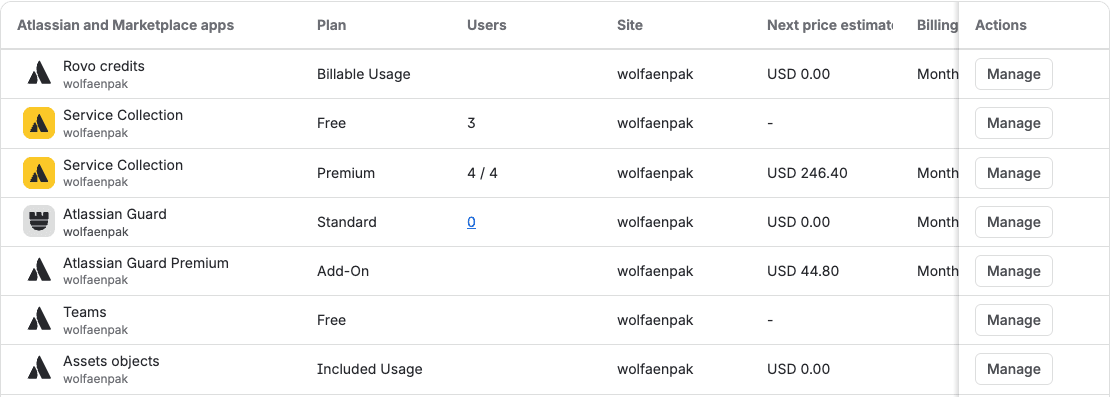
We have walkthroughs for checking Rovo credits for each user and for setting or turning off extra usage before 3 December, if you want to look at real usage first.
The assumptions behind the numbers
So you can redo any of this with your own figures:
- Prices are Atlassian's USD list prices read from its pricing pages on 30 October 2026. Everything except Loom carries the 13 October 2026 price change; Loom wasn't part of it, according to Atlassian's pricing FAQ.
- Annual means the flat price of the user tier your count falls into. Monthly means the graduated per-user bands, times 12.
- On the separate side, Standard means the Standard editions of Jira and Confluence plus Loom Business. Premium means their Premium editions plus Loom Business + AI. That Loom pairing is ours.
- No partner discounts, no Enterprise, no Marketplace apps, no taxes.
- Usage levels (100, 300, 700 and 1,500 credits, and 300 or 1,000 steps per person per month) are assumptions. They aren't measurements.
What I'd do before signing
If most of your people would use Loom, take the collection. At our three sizes it's roughly half the cost per seat on Standard and 29% to 50% cheaper on Premium. You get the bigger Rovo and automation pools on top.
If nobody needs Loom, it comes down to edition and size. On Standard with annual billing it's close to a tie, so pick the collection only if at least half your Jira users also use Confluence (81% at 500 seats). On Premium up to 200 seats the collection is a little cheaper, and its free Guard Standard (worth $8,700 a year at 200 users) makes it the better buy if you want Guard. Above 200 Premium seats, buy the two apps separately unless you were going to pay for Guard Standard anyway or you expect heavy Rovo use across the whole company.
If you have a big group of Jira-only people (contractors, support staff, an external team), work out where they put you in the tier before you decide. Each one counts as a full collection user, and Atlassian doesn't let you carve them out.
Whichever you pick, set an extra usage limit in Atlassian Administration before 3 December, because it's on by default. And count who has access to what before you sign. They're all on the bill.
I'm curious how this looks from your side. If you've moved to Teamwork Collection already, did the invoice match what you expected, and did the Jira-only users catch you out? Tell me in the comments, or write to me at gabriela@leanzero.net :)
Comments
0Add a comment