
Rovo Code Reviewer moves to Rovo credits on 3 December: pricing, setup and review budget

Key takeaways
- From 3 December 2026 Atlassian plans to meter Rovo Code Reviewer in Rovo credits, which it pools across the organization, as part of a Jira or Teamwork Collection subscription. It has not published how many Rovo credits one review costs.
- The only published ratio is in Rovo Dev credits: 2,000 cover 20 to 75 reviews, so 26.7 to 100 credits a review. If a Rovo credit buys the same review (our assumption), a 200-seat Jira Standard pool of 5,000 credits covers 50 to 188 reviews a month for the whole company.
- On our test site on 22 October the Bitbucket workspace and repository switches went on for one sandbox repository, three pull requests of 20, 198 and 976 lines opened, and none got a review: Rovo Dev not activated in this organization. Self-service Rovo Dev sign-up has been closed since late September.
- At 80 developers opening 8 pull requests a month, review-on-create needs 17,067 to 64,000 credits against a 5,000 pool, which is $121 to $590 a month in extra usage at $0.01 a credit with no other Rovo use, or $146 to $615 if Rovo Chat and agents already use half the pool.
- Atlassian says extra usage is on by default (ours was off on 22 October), and the limit dialog starts at No limit. Set a monthly limit and keep the trigger on When a PR is created before 3 December.
Rovo code review pricing changes on 3 December 2026. Nobody can tell you yet what one review will cost. From that day Atlassian plans to meter Code Reviewer in Rovo credits as part of your Jira or Teamwork Collection subscription. (The date it comes with no separate Rovo Dev license is still marked TBA.) Rovo credits are pooled across the organization, and Rovo Chat and your agents draw from the same pool. I looked for the per-review rate in Rovo credits on 22 October and couldn't find it on any Atlassian page.
So I tried to measure it. I switched Code Reviewer on for one repository in Bitbucket on our test site and opened pull requests of 20, 198 and 976 changed lines. Two of them had a bug planted in them. Then I waited. Nothing got reviewed. Each pull request showed the same panel: "Rovo Dev not activated in this organization. An organization admin needs to activate Rovo Dev." The Rovo credits meter read 214 before and 214 after.
What I can give you is the arithmetic. Atlassian's docs say 2,000 Rovo Dev credits "typically covers 20 to 75 code reviews". That's 26.7 to 100 credits a review. Now assume a Rovo credit buys the same review after 3 December (my assumption; Atlassian hasn't said). A 200-seat Jira Standard org pools 5,000 credits a month. That buys 50 to 188 reviews for the whole company, if nobody uses Rovo for anything else.
My short answer, if you're deciding this week: on Jira Standard or Premium, compare your monthly pull requests with what your pool covers at 100 credits a review. That's a quarter of your seat count on Standard and 70% of it on Premium, so 50 for a 200-seat Standard org and 140 for 200 Premium seats. If you open more, set an extra usage limit before 3 December and switch Code Reviewer on per repository, never for the whole workspace. On Enterprise or Teamwork Collection the pool covers it at Atlassian's low ratio, but at the high one a 200-seat Enterprise org would still be up to $340 a month over. The steps below get you there: check if your site can run it, switch it on where you want it with a cheap trigger, budget it with a small script, and set the limit. When I get a review to run, I'll put the measured number here.
- 1
Check your site
open /rovodev on your site as an org admin and read whether Rovo Dev is activated.
- 2
Switch it on in Bitbucket
Use Rovo Dev in this workspace, then AI code reviews in this repository for each repository you choose.
- 3
Set up GitHub if you use it
GitHub for Atlassian app, then the Rovo Dev app's Manage GitHub settings.
- 4
Pick the trigger
keep When a PR is created and turn off Review draft pull requests.
- 5
Budget it
run review_budget.py with your seats, plan and pull request volume.
- 6
Watch the meter
Rovo Dev credits today (Insights, Platform usage, Rovo Dev credits); after 3 December, the Rovo credits Features tab.
- 7
Set the limit
Enable or Update extra usage, a monthly number instead of No limit, Save.
Prerequisites — An Atlassian Cloud org on a paid Jira plan, and either a Bitbucket Cloud workspace connected to that Jira site or a GitHub organization (GitHub Enterprise Server isn't supported). To change the org-level settings and the extra usage limit you need to be an organization admin; the Bitbucket workspace switch needs a workspace admin. The budget script needs Python 3, standard library only. Everything here was captured on 22 October 2026 on our wolfaenpak test org and its Bitbucket workspace. Atlassian's pages were read the same day.

What changes for Rovo Code Reviewer on 3 December
Rovo Code Reviewer is the part of Rovo Dev that reads a pull request in Bitbucket Cloud or GitHub. It leaves comments where it thinks the code has a problem. Until now it came with Rovo Dev, a separate product. Rovo Dev Standard is $20 per developer a month with 2,000 Rovo Dev credits each, and the free tier has 350 per user per site. Rovo Dev credits are a different meter from the Rovo credits in your Jira plan.
Atlassian's Rovo Dev FAQ says Code Reviewer "will be available with your eligible Jira/TWC subscription, with no separate Rovo Dev license required", and "Code Reviewer will transition to Rovo Credits on December 3, 2026". It also says GitHub customers "will configure Code Reviewer in Jira; Bitbucket Cloud customers can continue configuring Code Reviewer in Bitbucket Cloud as they do today."
Two details in that FAQ matter for your budget. Before 3 December you can use Code Reviewer "without Rovo Credits metering during the transition window". That only applies once it "becomes available to you in Jira". And 3 December "is the planned start of Rovo Credits enforcement for Code Reviewer in Jira. It is not the Rovo Dev end-of-life date." So the review bill starts on 3 December, whatever happens to Rovo Dev as a product.
The pool is on Atlassian's Rovo plans page. Jira gives 25 credits per user per month on Standard, 70 on Premium and 150 on Enterprise. Teamwork Collection gives ten times that. The credits are shared across the organization and reset monthly with no rollover. Above the pool you pay "the list price of $0.01 per credit". My colleague Gabriela's Rovo credits per user piece has the full pool table and what Rovo Chat costs per message.
Rovo code review cost per pull request: what Atlassian has published
Atlassian publishes two ratios, both in Rovo Dev credits. From View your Rovo Dev credit usage: "Your default allowance of 350 credits per site should typically cover about 2 to 8 code reviews". And: "your allowance of 2,000 Rovo Dev credits typically covers 20 to 75 code reviews". Divide it out. The free ratio gives 43.75 to 175 credits a review, the Standard one 26.7 to 100.
What's missing is the Rovo credit price of a review after 3 December, and if one Rovo Dev credit equals one Rovo credit. Today the pull request author pays: the Bitbucket settings page says "Rovo Dev credits for code review usage will be deducted from the pull request author's allocation on this site." Rovo credits are pooled, so I expect reviews to draw on the shared pool, but Atlassian hasn't confirmed it, and its usage page says per-user allocation of Rovo credits is "Coming soon". The FAQ promises "Detailed admin guidance and usage dashboards will be provided well in advance." Six weeks out, I haven't seen them.
One user's numbers suggest a review can cost a lot more. In a Community thread from January, Rovo Dev insanely high credit usage, a developer had a custom instructions file with 20 rules. A simple pull request "appeared to use 965 of my 2000 credits with 760 being marked as Code review in Bitbucket". An Atlassian product manager asked for the PR to investigate. It's one report, so I read it as a warning about custom instructions. In another thread Atlassian support explained a 600-credit gap in a usage breakdown. It was "Custom code reviews (~440 credits)" plus "Acceptance criteria checks (~160 credits)". So those two options bill on top of the basic review.
How does that compare? GitHub's Copilot code review docs estimate $0.05 to $1 a review on Lite effort. On Balanced, the default, it's $0.25 to $5. CodeRabbit charges per developer ($24 to $72 a month billed annually) and $0.25 per reviewed file over the plan. At $0.01 a credit, Atlassian's Standard ratio is $0.27 to $1.00 a review. That would be at the cheap end. I don't know if it holds after 3 December.
2 to 8 or 20 to 75 reviews: check which Rovo Dev allowance
I got this wrong in my own first notes. I had Atlassian's ratio as "2 to 8 code reviews" per 2,000 credits, which implied $2.50 to $10 a review, and I'd picked "5 to 20 reviews a month for a 200-seat company" as the headline number. The 2-to-8 figure belongs to the 350-credit free allowance. 2,000 credits cover 20 to 75. Out by ten, roughly. Seen a scary per-review number floating around? Check which allowance it was divided by.
Step 1. Check whether your site can run Rovo code review today
Open https://<your-site>.atlassian.net/rovodev in a browser while logged in as an org admin. It tells you if Rovo Dev, and with it Code Reviewer, exists on the site at all. You should see either a Rovo Dev page or a not-activated message.
On our site it redirected, and you should see something like this if you're in the same position:
1https://wolfaenpak.atlassian.net/rovodev/no-installation
2Rovo Dev is not activated on this site.
3Start a free, 30-day trial of Rovo Dev Standard to get access.
I clicked the trial button. It said "Rovo Dev sign-up is no longer available. You can no longer sign up for Rovo Dev here. Get in touch with our sales team to talk through your options." That matches Atlassian's cloud changes for 21 to 28 September: "New customers must now contact sales to request the app, while existing customers retain all current access and billing functionality."
I looked for Code Reviewer in Jira Settings and in the admin.atlassian.com Rovo menu. I tried Apps > Add app too, and the AI settings path the rollout doc names. On 22 October I found no Rovo Dev or Code Reviewer entry in any of them. The rollout doc says Rovo Dev has been "gradually rolling out to sites with Jira Standard or Premium plans" since mid-October 2025. Our site has Jira Premium: Atlassian's Rovo credits page counts it, 350 credits a month, though it comes with our Service Collection Premium subscription and isn't a Jira subscription of its own. A year into that rollout, the site still has no Rovo Dev. Atlassian doesn't say if a Jira plan that comes inside Service Collection counts.
If /rovodev opens a Rovo Dev page, you already have it. Your reviews run today on Rovo Dev credits, and the change on 3 December is about how they're billed. If it says not activated and you're on a paid Jira or Teamwork Collection plan, you wait for the version included with Jira. The steps below get the settings ready so it starts the moment it arrives.
Step 2. Set up Rovo code review in Bitbucket
In Bitbucket Cloud there are two switches. One is per workspace, one per repository. The workspace switch only allows reviews. The repository switch turns them on, so I'd leave the bulk button alone.
Go to your workspace, then Workspace settings, then AI, then Rovo Dev. (Atlassian's docs say Atlassian integrations > Rovo Dev; on our workspace it sat under AI.) The page names the Jira site it bills ("Site selected") and has one toggle, Use Rovo Dev in this workspace. Switch it on. You should see a new box with an Update all repositories button.
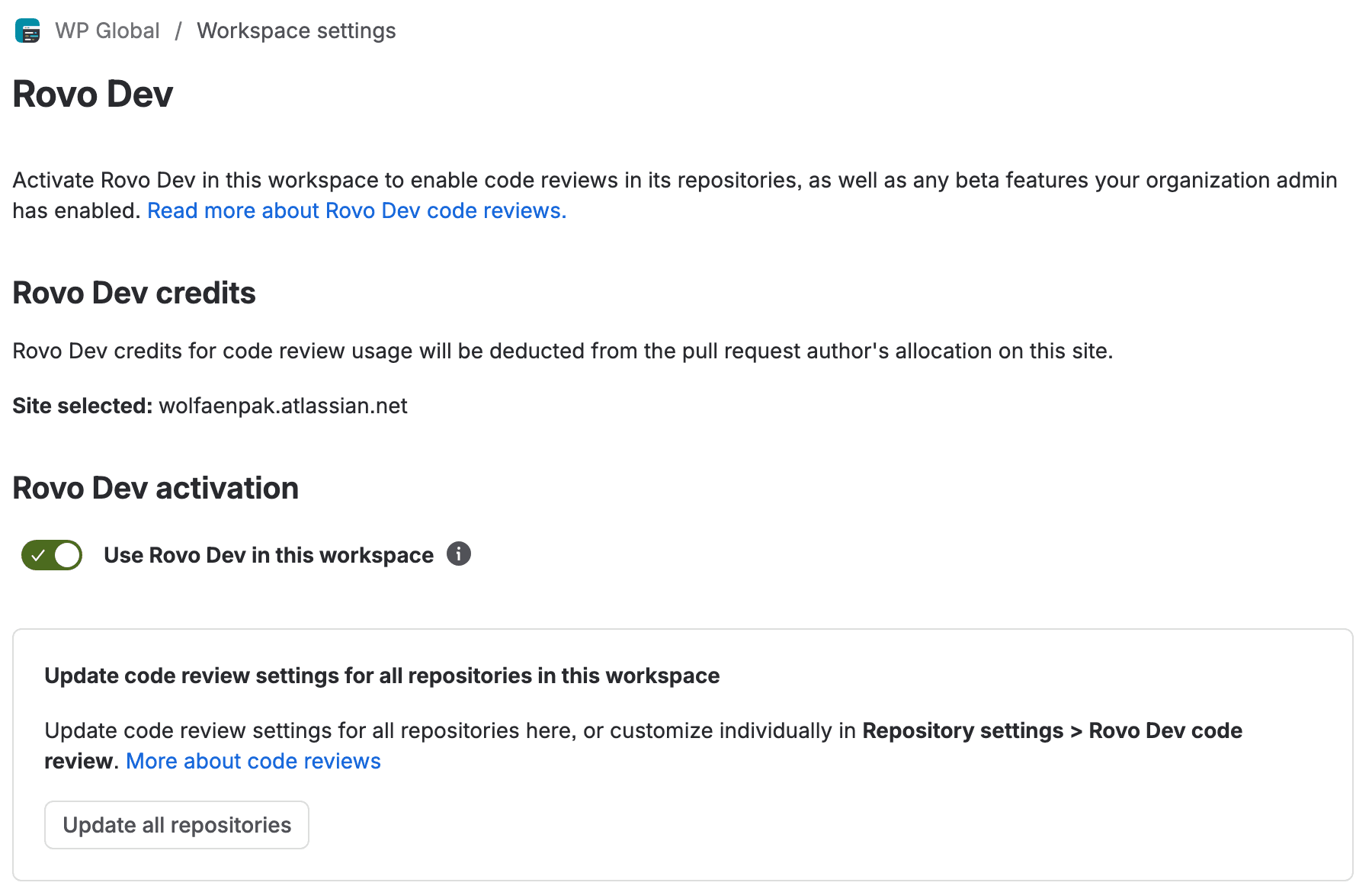
Don't click that button unless you want all your repositories reviewed. Open the repository instead, then Repository settings, Features, Rovo Dev code review. Switch on AI code reviews in this repository. Our workspace has 16 repositories, and I turned it on for one of them, a private sandbox I made for this test with a small order-processing module in it, then went back afterwards and checked that the other 15 were still off.
Then open a small pull request in that repository. You should see a Rovo Dev section in the right-hand panel. If reviews work, Rovo Dev posts comments (on GitHub it also writes progress into the description). If it has nothing to say it stays silent. The trigger docs say "If Rovo Dev doesn't have any feedback, it won't leave any comments." So a quiet pull request isn't proof it ran. Ours showed this:
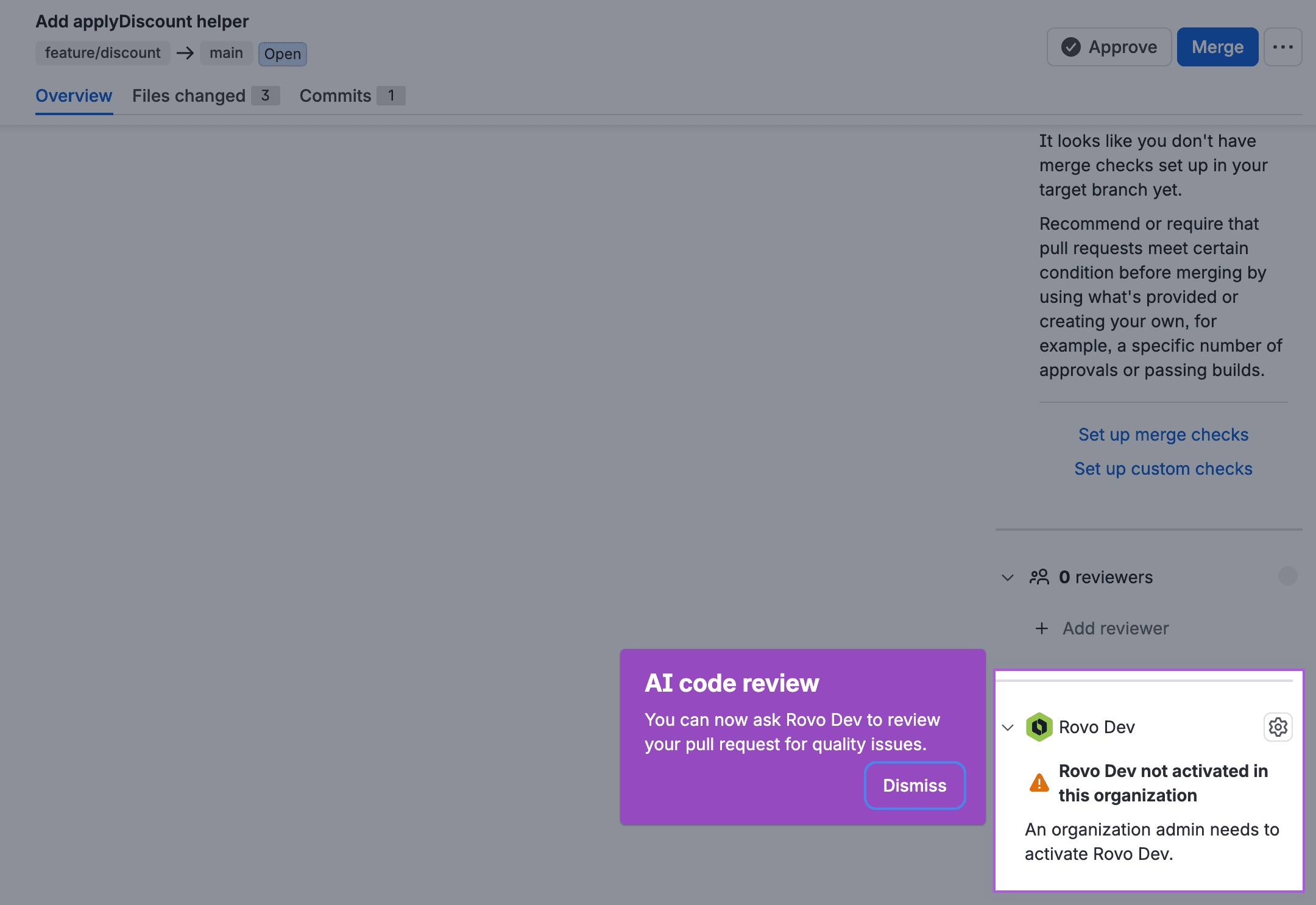
I gave the first pull request 29 minutes and the other two 13 each. The 198-line one had an off-by-one in pagination and a crash on a null customer. The 976-line one parsed "1,249.00" as 1.00. Not one comment came back. I also commented @atlassian /review on the first one, the comment trigger the activate doc gives for Bitbucket. No reply. (The trigger doc says to use a Review code button instead; our panel didn't show one.)
To switch reviews off later, turn the repository toggle off, or the workspace toggle to stop them everywhere. On GitHub it's the same pair in the Rovo Dev app's GitHub settings.
Step 3. Set up Rovo code review for GitHub (Rovo Dev app today, Jira Settings after the move)
I couldn't run this one. Our site had no GitHub for Atlassian app and no Rovo Dev, so there was nothing to connect GitHub to. Below is Atlassian's documented path as of 22 October. Check your own screens against it.
Today, per Activate code reviews in your repository, you need "GitHub connected to Jira using the GitHub for Jira app". GitHub Marketplace now lists it as GitHub for Atlassian. Then from the app switcher pick Rovo Dev, Settings, Manage GitHub settings. Turn code review on for the organization and choose Set billing to this site. Repository admins toggle each repository and pick its trigger under Manage settings.
After the move, the FAQ says "Jira administrators will be able to manage Code Reviewer directly in Jira Settings, including repository enablement and triggers". It also says "Your active repository connections, review rules, custom instructions, and setup will remain intact". I found no support page for that Jira Settings screen yet. Set GitHub up through the Rovo Dev app now and, per Atlassian, it carries over.
Step 4. Run reviews only when a pull request is created, or on demand
The trigger is the biggest cost lever you control. It's under Repository settings > Features > Rovo Dev code review, in Trigger schedule. The options are When a PR is created (Default), Every commit (Best for continuous feedback) and Manual trigger only.
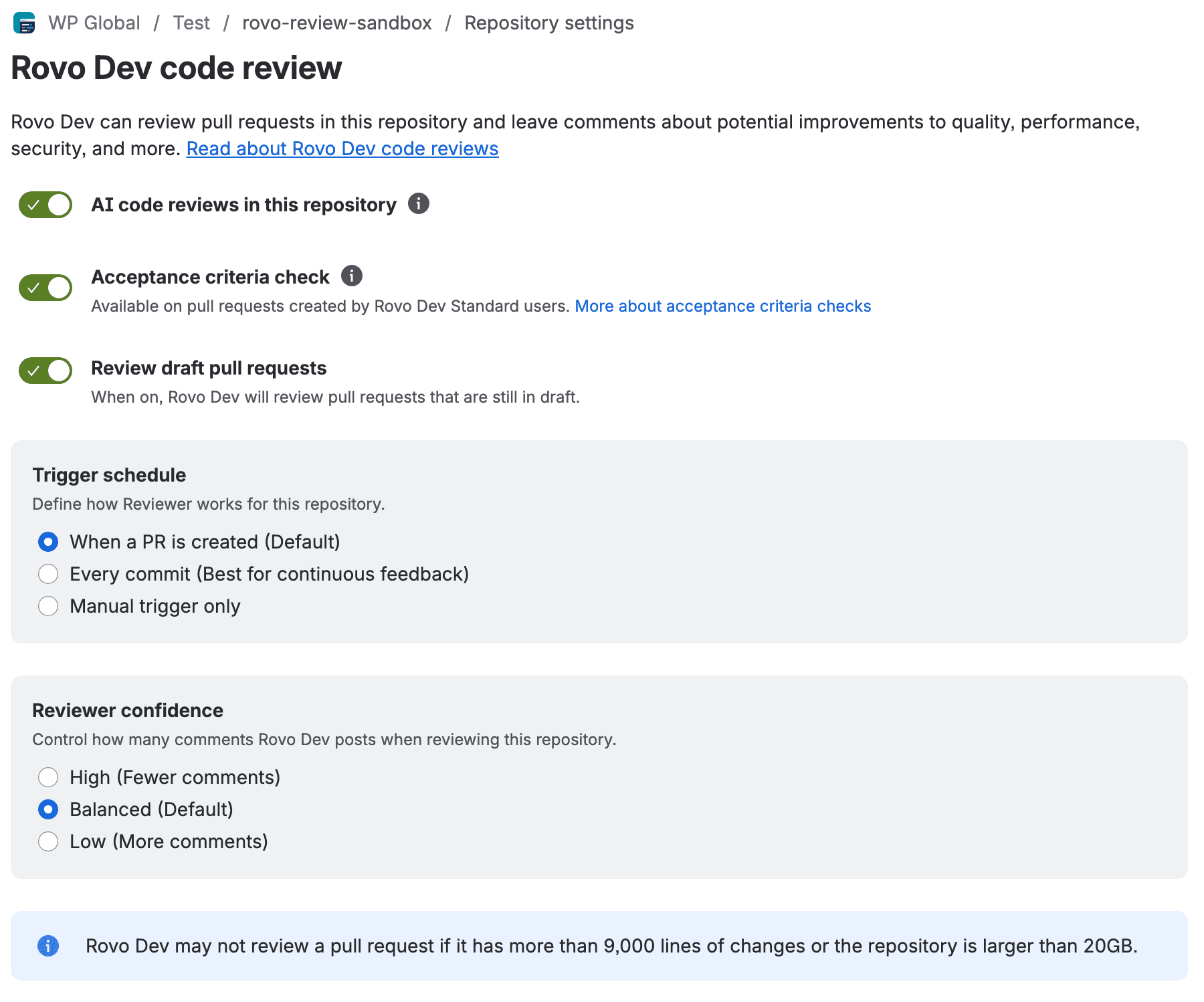
Reviewing on each commit multiplies the bill by the number of new commits. Our own GitHub organization had 21 pull requests in the 30 days to 22 October. They carried 109 commits between them, a median of 2 and a maximum of 23. (That includes commits pushed before the PR opened, so it's an upper bound.) Review on create means 21 reviews. Review per commit means up to 109, about five times as many. Manual trigger only is cheapest of all, but then reviews happen when someone remembers. I'd keep the default. You should see When a PR is created (Default) selected when you're done.
The same page has more settings that change what you pay:
- Acceptance criteria check and custom instructions (a
.rovodev/.review-agent.mdfile in the repository root) are Rovo Dev Standard features and, per the Community answer above, bill separately from the basic review. - Review draft pull requests was on by default for us. If your team opens drafts early and pushes for days, those are reviews nobody reads. I'd turn it off.
- Reviewer confidence (High, Balanced, Low) controls how many comments you get. Atlassian doesn't say whether it changes the credits.
The size limit on the page says 9,000 lines, as does the troubleshooting doc. The activate doc says 10,000. Our pull requests had a median of 703 changed lines and a maximum of 3,577. Neither limit would have mattered to us.
Step 5. Work out your Rovo code review cost with your own numbers
There's no measured rate yet, so budget a range. Save this as review_budget.py. Then change the numbers at the top to your own. Each line has a comment saying what it is.
1#!/usr/bin/env python3
2"""Rough monthly Code Reviewer budget against a pooled Rovo credit allowance.
3Every input is an assumption you should replace with your own numbers."""
4SEATS = 200                 # Jira users on the plan
5CREDITS_PER_USER = 25       # Jira Standard 25, Premium 70, Enterprise 150
6OTHER_ROVO_USE = 0.5        # share of the pool Rovo Chat and agents already eat
7DEVS = 80                   # people who open pull requests
8PRS_PER_DEV = 8             # pull requests per developer per month
9REVIEWS_PER_PR = 1          # 1 = "When a PR is created"; raise it for "Every commit"
10PRICE = 0.01                # USD per extra Rovo credit (list price)
11
12pool = SEATS * CREDITS_PER_USER
13left = pool * (1 - OTHER_ROVO_USE)
14reviews = DEVS * PRS_PER_DEV * REVIEWS_PER_PR
15print(f"pool {pool:,} credits, {left:,.0f} left for reviews, {reviews:,} reviews a month")
16for per_review in (80 / 3, 100, 175):   # Atlassian's Rovo Dev ratios, not a Rovo credit rate
17    need = reviews * per_review
18    over = max(0, need - left)
19    print(f"{per_review:6.1f} credits/review: need {need:9,.0f}, over by {over:9,.0f} = ${over * PRICE:,.2f}/month")
Run it:
1python3 review_budget.pyWith the numbers above (a 200-seat Jira Standard org where 80 people open pull requests) you should see:
1pool 5,000 credits, 2,500 left for reviews, 640 reviews a month
2  26.7 credits/review: need    17,067, over by    14,567 = $145.67/month
3 100.0 credits/review: need    64,000, over by    61,500 = $615.00/month
4 175.0 credits/review: need   112,000, over by   109,500 = $1,095.00/month
The 50% for other Rovo use is my guess. On our test org it's 214 of 3,710 credits so far this period, because only two of us use Rovo there, and a company that uses Rovo every day will sit much higher. Read your own from Insights > Platform usage > Rovo credits before you trust the output. The rates in the loop are Atlassian's Standard ratio, low and high, plus the free ratio's high end. Once Atlassian publishes a rate in Rovo credits, put it in the tuple.
Budget Code Reviewer in a 50, 200 or 500 seat Rovo credits pool
Here's what each pool covers at Atlassian's Standard ratio, if reviews were the one thing spending credits:
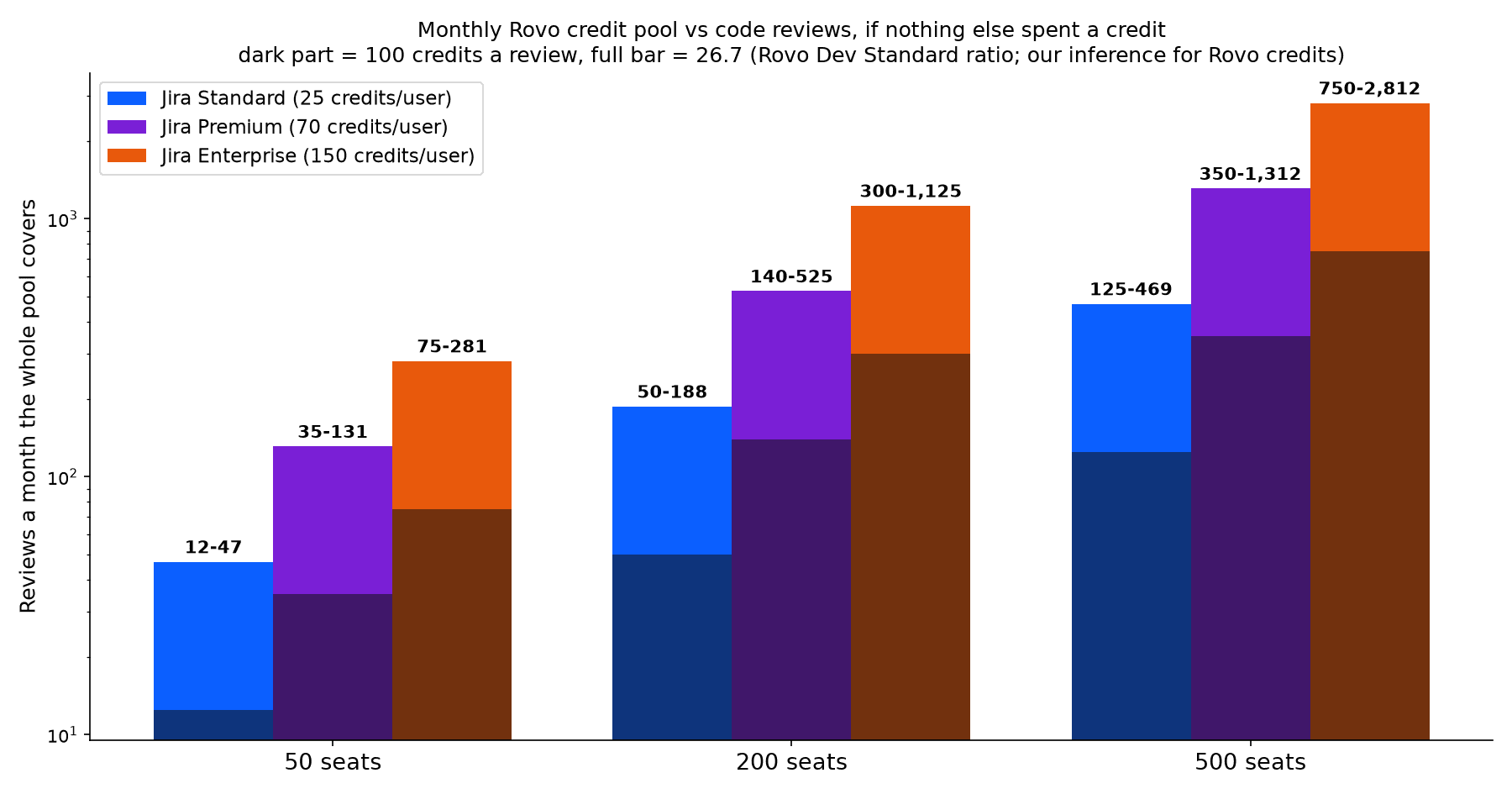
Plan and seats | Pool a month | Reviews at 100 credits | Reviews at 26.7 credits |
|---|---|---|---|
Jira Standard, 50 | 1,250 | 12 | 47 |
Jira Standard, 200 | 5,000 | 50 | 188 |
Jira Standard, 500 | 12,500 | 125 | 469 |
Jira Premium, 200 | 14,000 | 140 | 525 |
Jira Enterprise, 200 | 30,000 | 300 | 1,125 |
Teamwork Collection Standard, 200 | 50,000 | 500 | 1,875 |
I think the pattern holds even with the uncertainty. Take a company where 40% of seats write code, 8 pull requests a month each. On Jira Standard or Premium it runs past the pool on reviews alone. At 200 Standard seats that's $121 to $590 a month over, with no other Rovo use. At 200 Premium seats it's $31 to $500. Enterprise and Teamwork Collection pools absorb a lot more. At the low rate they cost nothing extra. One more thing to keep in mind: it's one pool. If reviews use it up and extra usage is off, or your cap is reached, new Rovo Chat and agent requests pause for everyone until the allowance resets or you buy more credits. Work already running finishes.
For our own team the numbers are small. 21 pull requests a month at 26.7 to 100 credits is 560 to 2,100 credits. That's $5.60 to $21 if all of it were extra usage. All 21 came from one account, our organization's bot login. Under today's author-pays rule that one account's allocation would carry the lot, and with no Rovo Dev allocation none of them would be reviewed at all. BCLOUD-24187, a request to pool Rovo Dev credits per organization, has 4 votes. If reviews draw on the shared Rovo credits pool like other Rovo features, that request goes away for Code Reviewer. Atlassian hasn't confirmed it.

Step 6. Read Rovo Dev credits usage after each review
Once reviews run, check what they cost. Today Rovo Dev credits live under Insights > Platform usage > Rovo Dev credits > Users (billing docs). Developers can see their own under Rovo Dev > Your usage. On our site that page redirected to the not-activated page, because we have no Rovo Dev.
After 3 December I expect the cost in the Rovo credits meter instead. On 22 October our Features tab had four rows, none of them Code Reviewer:
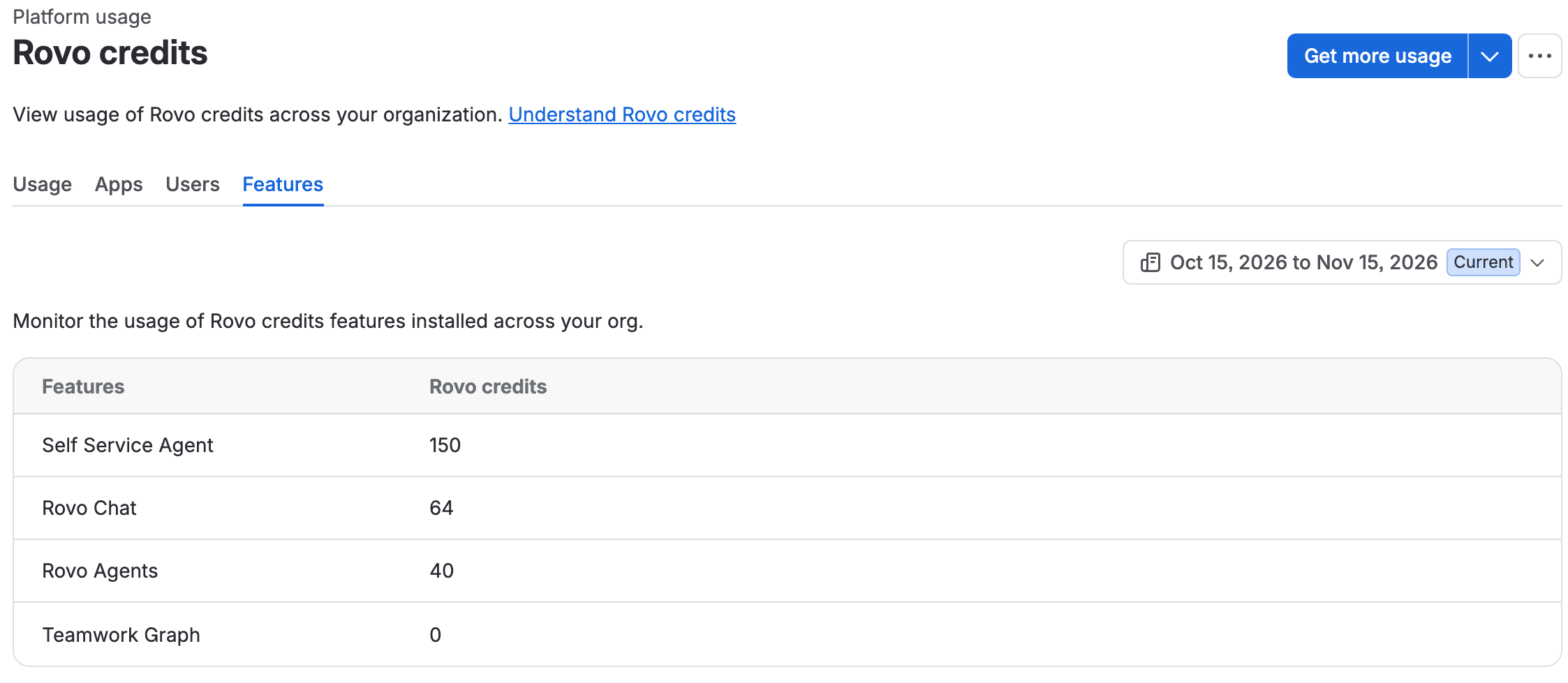
Those rows add up to 254. The headline meter said 214 of 3,710. On 22 October the breakdown and the total didn't agree, so compare like with like. To measure a review yourself, read the Features tab and open one pull request. Wait for the review, then read the tab again a few hours later. I'll do that as soon as I have a site where reviews run.
Step 7. Cap or turn off extra usage before 3 December
Atlassian's usage limits page says "On December 3, 2026, extra usage billing takes effect for Rovo credits" and that extra usage is enabled by default. Ours was off on 22 October, as it was when we checked on 14 and 16 October, so look at yours. If reviews push past the pool with extra usage on, you pay $0.01 a credit up to whatever limit is set.
Go to admin.atlassian.com, then Insights, Platform usage, Rovo credits. Our org had extra usage disabled. So the button said Enable extra usage, and it opened this:
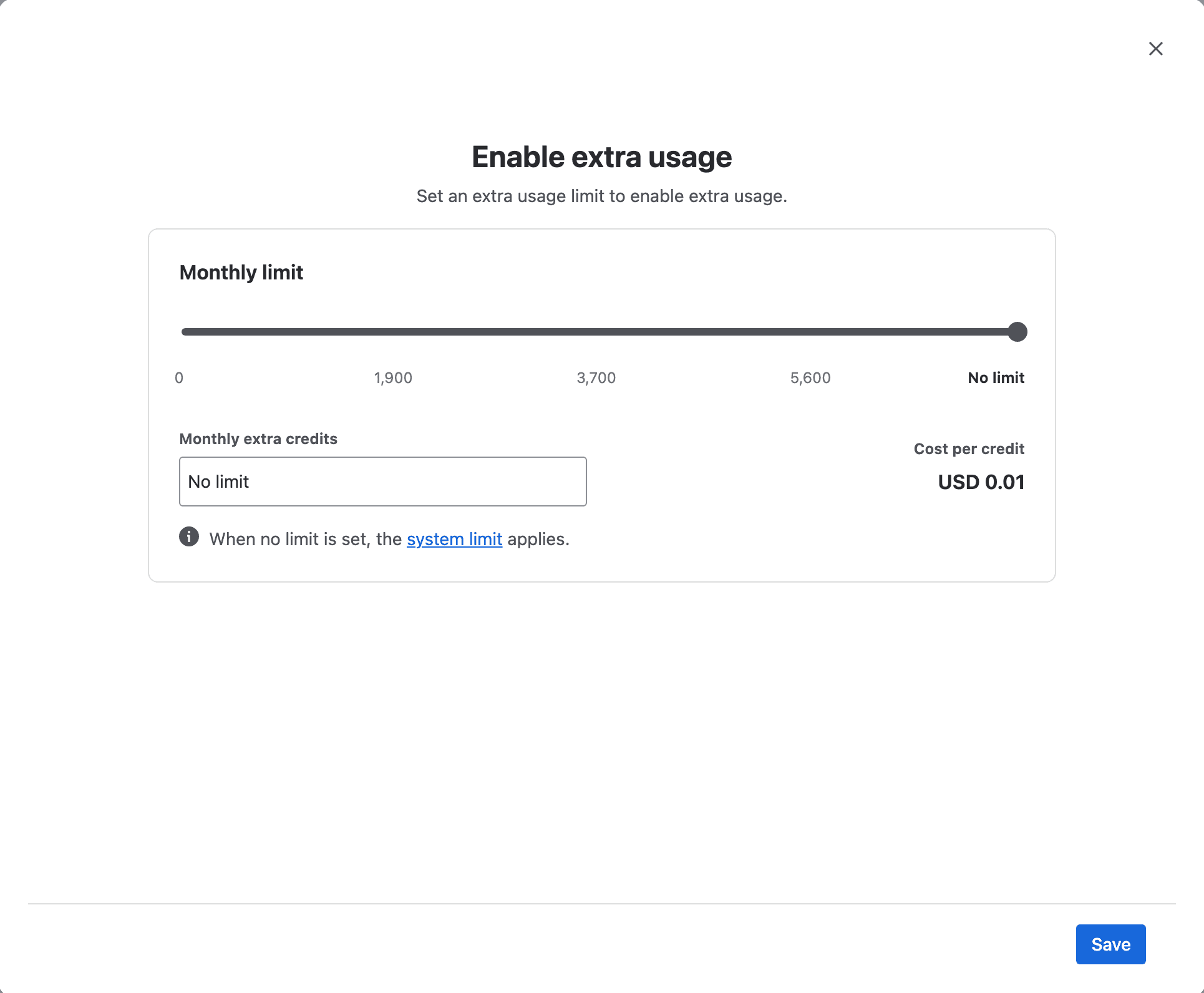
The slider starts at No limit. "When no limit is set, the system limit applies." Atlassian describes that as "well above typical usage levels" and gives no number. Drag the slider to a figure you're happy to spend, or type it in Monthly extra credits, and Save. You should see your number in Monthly extra credits when you reopen it. Want to stop at the pool? If the dropdown next to Get more usage offers Enable extra usage, you already do. If extra usage is on, choose Disable extra usage from that dropdown. (Atlassian's doc puts it next to Update extra usage limit; when we had it on, on 16 October, it sat next to Get more usage.) New credit-using requests then pause until the allowance resets. Chat or agent work already running finishes. Atlassian doesn't say what happens to a review in progress at the limit.
I wrote up the limit screens in Rovo usage limit: set or turn off extra usage, including the audit log entry. For the rest of the 2027 bill, see the usage-based pricing budget for 50 to 500 seats.
Rovo Dev end of life: what happens to your Rovo Dev subscription
Standalone Rovo Dev "will reach end of life". Atlassian promises "at least 60 days' notice" and has no date yet. It "will not automatically cancel your Rovo Dev subscription". If you only use Code Reviewer, Atlassian will "notify you when it is live in Jira so you can comfortably cancel". If you use the CLI or IDE features, keep the subscription until those move too. (The CLI becomes the Atlassian Rovo CLI. The standalone IDE features will be retired, date not set.)
Don't cancel early. Cancel before Code Reviewer is live in Jira for you and reviews stop. You'd be where we are, with switches on and nothing reviewing.
If your screens don't match
"Rovo Dev not activated in this organization" on a pull request
It means the review job found no Rovo Dev for your org. The Bitbucket switches don't fix it. Go back to Step 1. If /rovodev says "Rovo Dev is not activated on this site", check you're on a paid Jira or Teamwork Collection plan, then wait for the version included with Jira, or talk to Atlassian sales.
Rovo Dev free trial: "Rovo Dev sign-up is no longer available"
You get this after clicking Start free trial, and it's expected since late September. Self-service sign-up was removed.
No review and no message
Rovo Dev may not review pull requests over 9,000 changed lines (the UI and troubleshooting doc; the activate doc says 10,000) or repositories over 20 GB, and sometimes comments that the pull request is too large. It skips lock files and binaries inside a review too. It also posts nothing when it has nothing to say. And if the pull request author is out of Rovo Dev credits, "code reviews won't run".
The manual trigger doesn't respond
Atlassian's two docs disagree. The trigger page says GitHub uses an @atlassian /review comment and Bitbucket a Review code button. The activate page says Bitbucket uses the @atlassian /review comment and GitHub an Analyze code button. Both say the pull request author is the one who can trigger it.
A Rovo Dev section in the admin menus that I said wasn't there
Then the rollout has reached you. Follow its screens over mine.
What you have now
Key takeaways
- An answer to whether Code Reviewer can run on your site today, from /rovodev, and the reason if it can't (no Rovo Dev, closed sign-up, or a plan that doesn't qualify).
- Code Reviewer allowed at workspace level and switched on only for the repositories you chose, trigger on When a PR is created, draft reviews off, and the two toggles that switch it off again.
- A budget range for your seat band from review_budget.py, with your own share of the pool that Rovo Chat and agents already use.
- A monthly extra usage limit in place of No limit, and the Features tab to watch for a Code Reviewer row after 3 December.
- What it doesn't cover: a measured Rovo credit price per review, which nobody has published yet.
If your developers open more pull requests a month than your pool covers at 100 credits a review (a quarter of your seats on Jira Standard, 70% on Premium), set the limit now and start with the repositories where a human reviewer is the bottleneck. Leave per-commit reviews off until there's a real per-review number. Has Code Reviewer reached your site, and what did a review cost you? Tell me in the comments and I'll add your number here next to ours.
Comments
0Add a comment